
Kenilworth specifications from CA-C20-F4 to CA-C30-F6
Calcium sulphate screed is graded by strength. Break down CA-C25-F5 and you get the material, calcium sulphate, then a compressive strength of 25 and a flexural strength of 5, measured in N/mm2.
A lightly used house floor can take CA-C20-F4. The C25 grade is the everyday choice for houses, flats and offices, and CA-C30-F6 is there for floors that work harder. Where your Kenilworth drawings state a grade, that is the one we pour; where they are silent, we suggest one from what the room is for and what lies beneath it.
Alpha hemihydrate screeds stand apart, picked when a thinner floor or quicker drying is needed. Each one's own data sheet sets its minimum depth and drying, and the usual guidance may not carry over.
Flats are a good match. Purpose-built blocks hold 13% of Kenilworth's homes, and because calcium sulphate hardly shrinks, a flat's floor can be poured in big bays with little jointing. We work out where the joints go beforehand, lining them up with doorways and with any movement joints in the structure.
Calcium sulphate has one firm limit: it does not tolerate repeated wetting. So a plant room, a wet room or any floor that could see standing water gets a flowing screed made with cement, or hand-laid sand and cement, in its place. For more on the chemistry, see our guide to anhydrite screed.
Laitance, primers and moisture in Kenilworth anhydrite floors
Looking dry and being ready for a finish are two different things on a calcium sulphate floor.
First, laitance. While the screed settles, a fragile skin builds up on top. Glue stuck to that skin fails along with it, which is why, once the floor has dried far enough, we sand it off, vacuum the dust and roll on a primer suited to calcium sulphate.
Second, moisture. Flooring makers often allow a calcium sulphate base less moisture than a cement one. The target is whatever the flooring maker states, confirmed by a hygrometer test on the floor. Where there are heating pipes, warming the floor from about 7 days can bring that day forward.
Third, records. The drying and laitance advice is handed over in writing, which tells the flooring fitter when the floor was sanded, primed and tested. Laying wood or LVT on a calcium sulphate screed that has not passed its test risks the finish.
If the pumping alone is needed for another team's pour, our screed pumping service covers it. For projects across the city boundary, see Coventry.
Anhydrite & Flow Screed prices in Kenilworth
Liquid flowing screed (which includes anhydrite): £24 to £31 per m² supplied and laid (MyJobQuote, August 2026), so £960 to £1,240 for 40 m². MyJobQuote does not say whether these figures include VAT. See our floor screeding cost guide or screed calculator.
Who lays your anhydrite and flow screed in Kenilworth
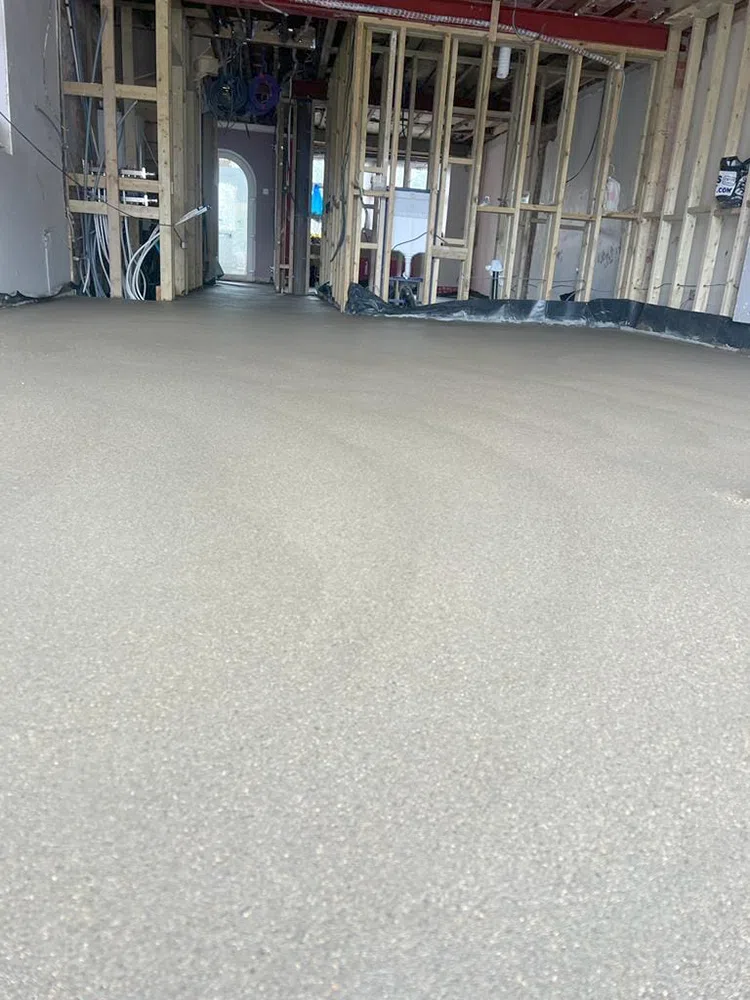
K & B Screeding’s own team, led by director Donatas Bardisevicius. Founded 2019, company 12298780.
See what customers say in our Google reviews and on our testimonials page.
Anhydrite & Flow Screed from Slough to Kenilworth
As the crow flies, our yard in Slough is about 68.8 miles from Kenilworth, which lies to the north-west. Postcodes here include CV8, and Royal Leamington Spa (3.9 miles), Warwick (4.1 miles), Coventry (5.4 miles) and Solihull (9.7 miles) are close by.
More on anhydrite screed, part of our screeding services.