
Heated extensions against an old Kenilworth slab
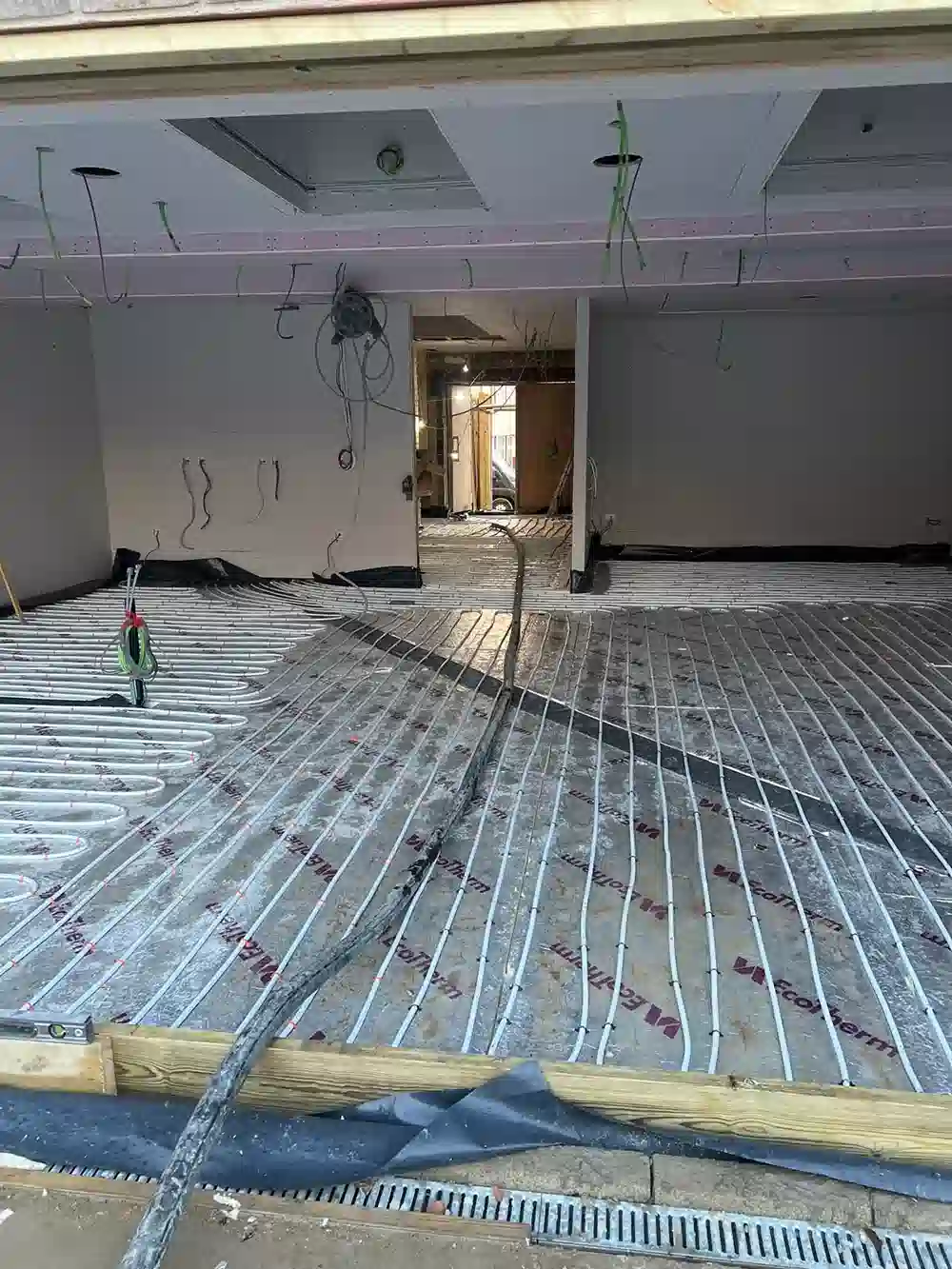
On a heated extension in Kenilworth, the height of the existing floor is the starting point. The new floor must meet it exactly, and inside that height go insulation, heating pipes and the screed. Get the build-up wrong and you either lose insulation or end up with a step at the old back wall.
The screed's own depth is set by the pipes. Liquid must have 25mm or more over the pipe tops, which brings the layer to about 45 to 50mm. A sand and cement floor carries about 45mm above them, so it builds up deeper. For that reason a liquid screed over the pipes is often the practical answer where an extension meets a 1960s slab.
Liquid also closes in around each pipe without leaving air gaps, so the warmth spreads evenly through the slab and the room heats up sooner.
Houses from the later decades are part of this too. 27% of Kenilworth's homes went up between 1973 and 1999, and extending those houses raises the same question of matching the existing floor.
Retrofit into an older room is tighter still. Taking up a solid floor to add heating means fitting the whole build-up under fixed thresholds and the bottom stair, so measure before buying a system. The drying times guide explains how depth affects the wait before flooring.
Warm-up schedules for new Kenilworth heated floors
A new heated screed must cure before it is warmed, then be brought up to temperature slowly.
The heating can usually go on from about 7 days after a calcium sulphate pour; a sand and cement floor has to be left 21 days or longer. The heating engineer then starts at a low flow temperature, raises it a few degrees at a time over several days, holds it, and lets it fall back. We leave written guidance, and the manufacturer's sheet sets the exact steps.
The temptation is to turn the heating up to dry the floor faster. That is the usual cause of cracks along the pipe runs and curling at the edges.
Newer homes are designed around this from the start. Kenilworth's homes built from 2015 onwards make up 7%, and recent designs commonly bed the heating in a flowing screed.
The loops need a pressure test ahead of pour day, and should stay pressurised while the screed goes in. Our quick drying screed is an option on sand and cement floors where time is short. Projects in Solihull follow the same sequence.
Underfloor Heating Screed prices in Kenilworth
Liquid screed over underfloor heating: £20 to £35 per m² supplied and laid (trade2base, June 2026), so £700 to £1,230 for 35 m². trade2base gives these figures excluding VAT. See our floor screeding cost guide or screed calculator.
Who lays your underfloor heating screed in Kenilworth
K & B Screeding’s own team, led by director Donatas Bardisevicius. Founded 2019, company 12298780.
See what customers say in our Google reviews and on our testimonials page.
Underfloor Heating Screed from Slough to Kenilworth
As the crow flies, our yard in Slough is about 68.8 miles from Kenilworth, which lies to the north-west. Postcodes here include CV8, and Royal Leamington Spa (3.9 miles), Warwick (4.1 miles), Coventry (5.4 miles) and Solihull (9.7 miles) are close by.
More on underfloor heating screed, part of our screeding services.
