
Adding underfloor heating to a Bedworth kitchen floor
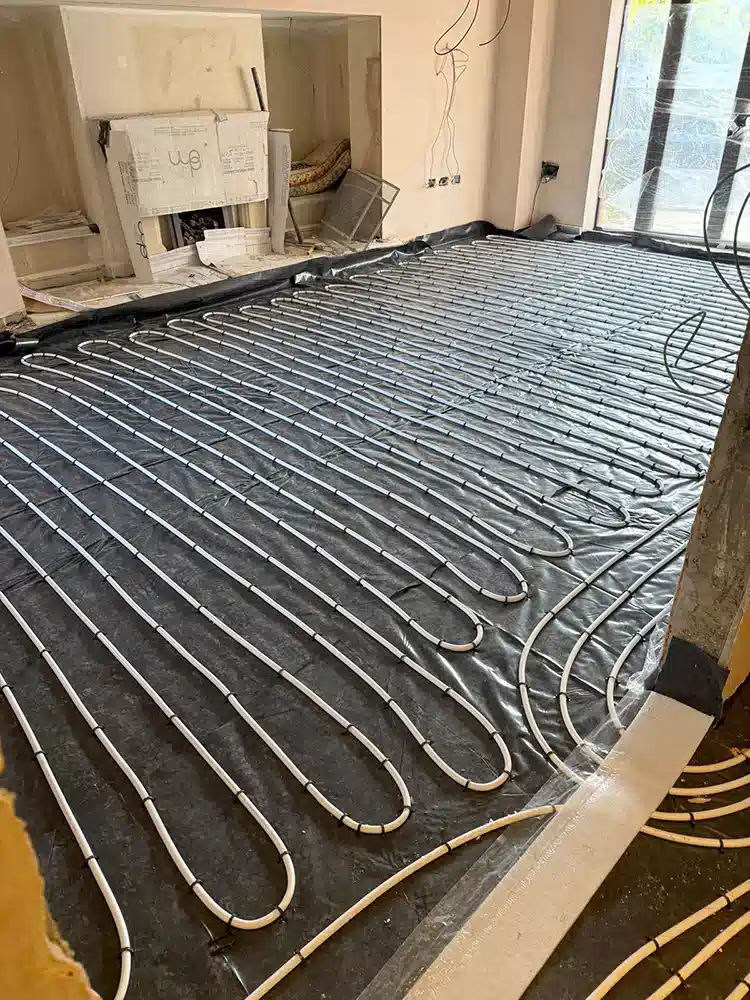
In an existing Bedworth house, a heated floor usually starts with a dig-out. The old kitchen or extension floor is broken up, and in its place goes a layer of insulation, the heating pipes clipped down on top, and a screed poured over them. The screed is not just a cover. It takes the heat from the pipes and spreads it evenly across the room, so its depth and its contact with the pipes decide how well the system works.
Pipe cover is the first rule. With liquid, 25mm over the pipe tops is the minimum, so the layer comes to about 45 to 50mm. Sand and cement, packed by hand, should have about 45mm sitting over them, so the floor gets thicker. In a room where the floor must finish level with the hall and the back door, that difference can decide how much insulation fits underneath. A liquid screed over the heating pipes often wins for that reason.
Encapsulation is the second. Because it flows, a liquid screed wraps each pipe completely and leaves no trapped air to hold the heat back. Hand-laid screed can do the same, but it takes careful compaction along each pipe run.
Bigger houses bring a different layout question. With 18% of Bedworth's homes detached, there are ground floors big enough for heating across several rooms, where joints in the screed must line up with the heating zones. The insulation, membrane and edge strip can come from our insulation and membranes service.
Bringing a new Bedworth heated floor up to temperature
A heated screed has to cure before it is warmed, and then the warm-up must be gradual.
A calcium sulphate floor is normally ready for gentle heat from about 7 days, and a sand and cement one only after 21 days or more. The heating engineer then sets a low flow temperature and raises it a few degrees at a time over several days, holds it, and brings it back down. We leave written guidance on the day, and the screed manufacturer's sheet gives the exact steps.
Rushing this stage is the usual cause of cracks. Turning the heating up high to dry the floor quickly makes the screed shrink unevenly, and the cracks follow the pipes.
The controlled warm-up also helps drying, which matters when a kitchen fitter is booked. Our screed drying time guide goes through the numbers.
Pressure testing belongs before all of this. The pipes should be filled and tested before we arrive, and kept under pressure while the screed is poured, so a leak shows at once rather than after the floor has set. A compressible strip round the room edges gives the warm screed space to move, so it does not crack where it meets the walls. 20% of Bedworth's homes were built between 1973 and 1999, and on a house of that age or older the existing slab's level and condition are checked before the insulation goes down. The same service is offered in Hinckley.
Underfloor Heating Screed prices in Bedworth
Liquid screed over underfloor heating: £20 to £35 per m² supplied and laid (trade2base, June 2026), so £700 to £1,230 for 35 m². trade2base gives these figures excluding VAT. See our floor screeding cost guide or screed calculator.
Who lays your underfloor heating screed in Bedworth
K & B Screeding’s own team, led by director Donatas Bardisevicius. Founded 2019, company 12298780.
See what customers say in our Google reviews and on our testimonials page.
Underfloor Heating Screed from Slough to Bedworth
Bedworth is about 74.3 miles north-north-west of our Slough base as the crow flies, with postcodes including CV12 and CV7. The nearest towns to it are Nuneaton (3 miles), Coventry (5.1 miles), Hinckley (6 miles) and Earl Shilton (9.4 miles).
More on underfloor heating screed, part of our screeding services.
