
Heated extensions on Chase Meadow and Myton Green
An extension on a modern estate is the simplest place to put underfloor heating under screed. Chase Meadow and Myton Green lend themselves to liquid screed with heating when owners extend, and the new room is designed with the full build-up so the heights line up at the doorway. Garden rooms built on a new slab follow the same pattern at a smaller scale.
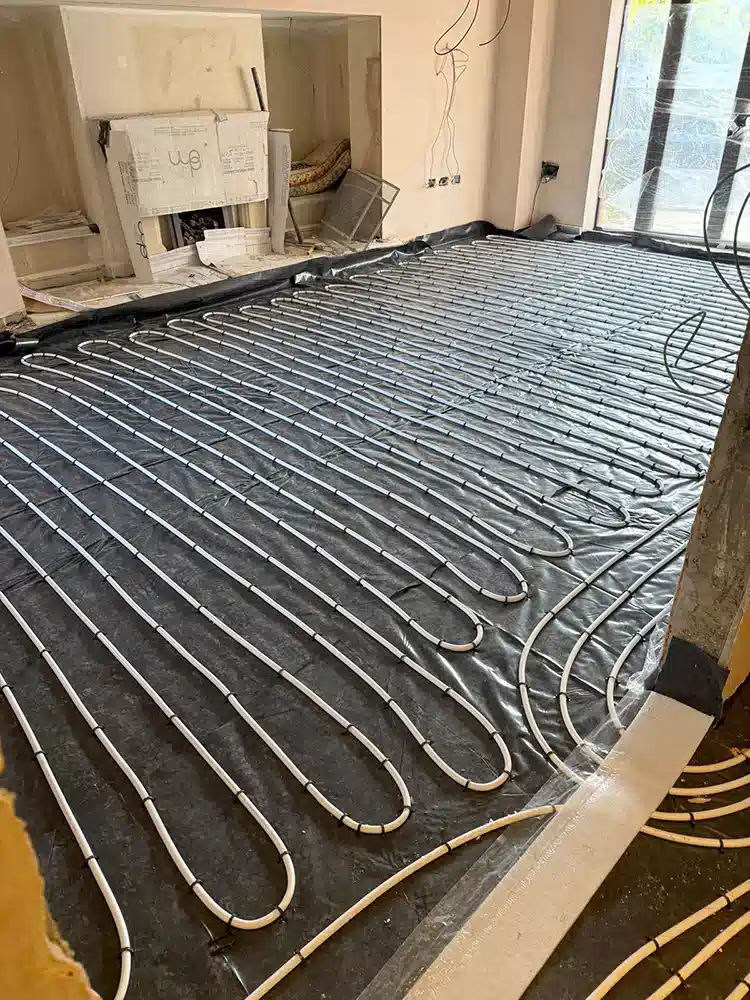
On a Myton Green or Chase Meadow extension we go over the insulation boards, membrane and perimeter edge strip before any screed is pumped in. The edge strip lets the screed move as it warms without pushing against the walls, and we supply any of these if they are missing; see insulation and membranes. Pipe laying and the pressure test are your heating engineer's job, because K & B does not fit underfloor heating pipes.
Cover depth decides how well the floor works. Liquid types sit at least 25mm proud of the pipework, so the finished heated layer measures about 45 to 50mm. With sand and cement, around 45mm goes over the pipework. Liquid screed flows round each pipe and leaves no air pockets, which spreads heat evenly and warms the room faster, so it is the usual pick for an open-plan extension. Our liquid screed page for Warwick covers the pour itself.
The finish matters as well. A heated floor is often tiled or laid with engineered wood, and both need a flat base, so the screed is finished flat enough for tiles, LVT and engineered wood without extra levelling.
Fitting heating under older Warwick floors
Retrofitting is harder. In an older house, the solid floor normally comes out to make space for insulation, pipes and screed, and the new floor still has to meet the stairs, doorways and the next room. In Warwick's Georgian and older townhouses, where the structure is historic and finished floor heights often cannot change, that space may not exist. Liquid screed, with its smaller cover over the pipes, keeps the total build-up down and is usually the way to make it fit. Where it still will not fit, it is better to know before the floor is dug out.
Commissioning needs care. Warmth can go into calcium sulphate after roughly a week, 7 days, whereas a townhouse floor in sand and cement waits a minimum of 21. In both cases, the temperature goes up gradually over several days, because turning it straight to full can crack the screed. We hand over the schedule in writing, and how long screed takes to dry explains why flooring waits a little longer still.
Digging out a tired Warwick ground floor before any of that happens comes under our floor preparation work.
Underfloor Heating Screed prices in Warwick
Liquid screed over underfloor heating: £20 to £35 per m² supplied and laid (trade2base, June 2026), so £700 to £1,230 for 35 m². trade2base gives these figures excluding VAT. See our floor screeding cost guide or screed calculator.
Who lays your underfloor heating screed in Warwick
K & B Screeding’s own team, led by director Donatas Bardisevicius. Founded 2019, company 12298780.
See what customers say in our Google reviews and on our testimonials page.
Underfloor Heating Screed from Slough to Warwick
On the map, Warwick sits north-west of Slough, about 65.8 miles from our base in a straight line (postcodes including CV34), next to Royal Leamington Spa (2.3 miles), Kenilworth (4.1 miles), Stratford-upon-Avon (8 miles) and Coventry (9.3 miles).
More on underfloor heating screed, part of our screeding services.
