
Grades and products for Warwick apartments and plots
Calcium sulphate screeds are labelled under the European screed materials standard with a code along the lines of CA-C20-F4. The number following C is compressive strength; the one after F is flexural; N/mm2 is the unit for both. Lightly used house floors take CA-C20-F4. Homes, flats and offices in general are specified at CA-C25-F5. For floors that see heavier wear, the step up is CA-C30-F6.
Whether the drawings are for a Warwick apartment block or a street of new houses, the grade they state is what goes in. An engineer may instead write alpha hemihydrate into the spec, for a quicker dry or a thinner floor. Those follow their own product sheet, so its figures for depth and drying override the general ones.
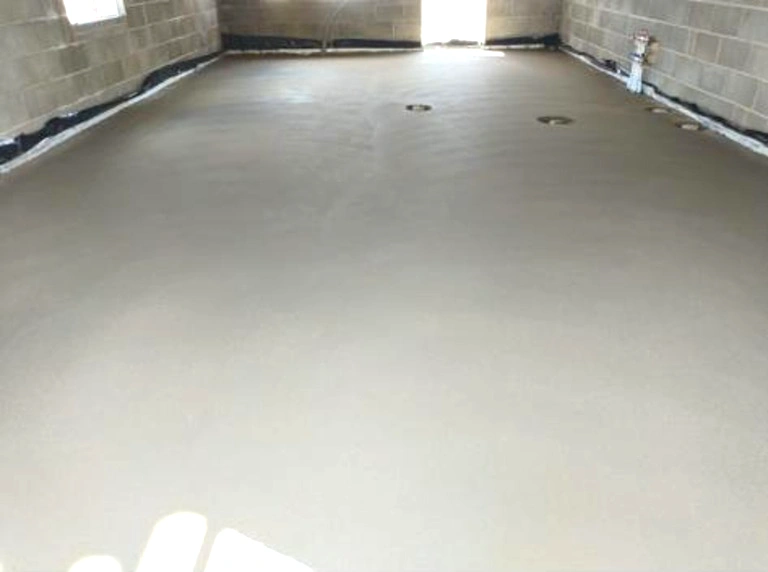
What makes calcium sulphate suit apartments is low shrinkage. Wide bays can be poured with hardly any joints, meaning a whole Warwick flat goes down in one go with no grid of joint lines to work around. Any joints that are needed are planned before the pour. Our crew lays the insulation, membrane and edge strip beneath it themselves.
In a block, the acoustic layer between floors comes first. Many flats built in Warwick in the last decade have acoustic requirements, and the screed is part of how the floor meets them, so the resilient layer and edge detail must be right before we pump. Further reading: anhydrite screed explained.
Laitance, testing and wet areas in Warwick homes
A calcium sulphate floor can look dry well before it is fit to take flooring. Curing also leaves laitance behind, a soft film across the top. If adhesive goes onto it, the floor finish is stuck to a skin that can shear away. Later, with the moisture down, that film gets sanded off and a calcium sulphate compatible primer is rolled on.
Drying is checked with a hygrometer. Flooring manufacturers frequently allow calcium sulphate less moisture than a cement base, which makes testing even more important on these floors. In a flat with heating already in, the system can usually begin force drying at about 7 days and cut the wait, as our page on screed over heating in Warwick explains.
Keep it out of wet areas. A shower room, wet room or any floor likely to stay damp should have a cement based flowing screed or a hand-laid Warwick sand and cement floor instead. If a Warwick floor just needs pumping and has no specification behind it, the plainer page is our liquid screed service.
Offices fall under CA-C25-F5 in the standard grading, so the same material serves a fit-out as well as a home, and our commercial screeding page covers larger sites.
Anhydrite & Flow Screed prices in Warwick
Liquid flowing screed (which includes anhydrite): £24 to £31 per m² supplied and laid (MyJobQuote, August 2026), so £960 to £1,240 for 40 m². MyJobQuote does not say whether these figures include VAT. See our floor screeding cost guide or screed calculator.
Who lays your anhydrite and flow screed in Warwick
K & B Screeding’s own team, led by director Donatas Bardisevicius. Founded 2019, company 12298780.
See what customers say in our Google reviews and on our testimonials page.
Anhydrite & Flow Screed from Slough to Warwick
On the map, Warwick sits north-west of Slough, about 65.8 miles from our base in a straight line (postcodes including CV34), next to Royal Leamington Spa (2.3 miles), Kenilworth (4.1 miles), Stratford-upon-Avon (8 miles) and Coventry (9.3 miles).
More on anhydrite screed, part of our screeding services.