
Reading a Redditch screed specification: CA grades
Anhydrite is the everyday name for calcium sulphate screed, and on a drawing it appears as a code from the BS EN standard that covers screed materials. In that code, C gives the compressive strength and F the flexural strength, each measured in N/mm2.
On a lightly used domestic floor you will often see CA-C20-F4. Most houses, apartments and offices are written up as CA-C25-F5, and heavier use calls for CA-C30-F6. If your architect or developer has written one of these on the drawings, that is the grade we supply, and the depth and bay layout follow from it.
Alpha hemihydrate screeds sit apart from those grades. Specifiers pick them when a floor has to dry sooner or go in thinner, say in a retrofit with hardly any height in hand, and each product is laid to its own data sheet, not a general rule.
With 15% of Redditch homes being flats, apartment floors are a natural home for calcium sulphate. Low shrinkage means large bays with few joints, and each bay and joint is planned before the pour so it lines up with doorways and any heating zones. There is a fuller account of the material in our anhydrite screed guide.
It does not belong everywhere, though. A floor that could get wet is better served by a flowing screed with a cement base, which we can pour in its place. If your question is more about pumping speed and suitability than the material itself, our Redditch liquid screed page covers that.
Laitance, drying and testing before Redditch floor finishes
Once poured, calcium sulphate leaves a thin, weak skin called laitance on its surface as it dries. It must be removed. Once the screed is dry, the surface is sanded to take off the laitance and open the pores, then vacuumed and primed with a product compatible with calcium sulphate. Skipping either step can lead to adhesive failure under tiles or LVT. Sanding and priming can be booked through our floor preparation work.
Drying is helped by the heating. Where pipes run through it, the underfloor heating can normally start drying the screed from around day 7, provided it is warmed up gradually.
Testing comes next. Plenty of flooring makers allow less moisture in calcium sulphate than in a cement screed, which means a reading that is fine on one type can be too high on the other. A hygrometer test tells you whether it is ready, and the flooring maker's own limit is the one to follow. You get our drying and laitance guidance written down when we leave. The same specification work is available in Stratford-upon-Avon for projects a short way to the south-east.
Anhydrite & Flow Screed prices in Redditch
Liquid flowing screed (which includes anhydrite): £24 to £31 per m² supplied and laid (MyJobQuote, August 2026), so £960 to £1,240 for 40 m². MyJobQuote does not say whether these figures include VAT. See our floor screeding cost guide or screed calculator.
Who lays your anhydrite and flow screed in Redditch
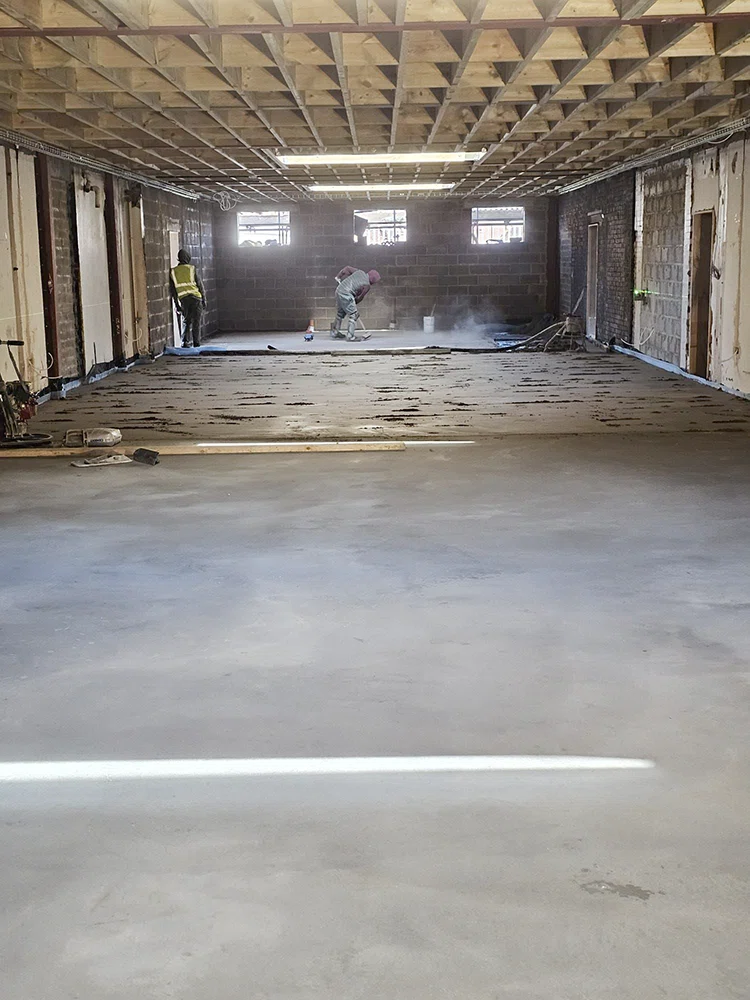
K & B Screeding’s own team, led by director Donatas Bardisevicius. Founded 2019, company 12298780.
See what customers say in our Google reviews and on our testimonials page.
Anhydrite & Flow Screed from Slough to Redditch
Redditch is about 77.1 miles north-west of our Slough base as the crow flies, with postcodes including B97 and B98. The nearest towns to it are Solihull (10.1 miles), Stratford-upon-Avon (12.7 miles), Evesham (14.8 miles) and Warwick (15 miles).
More on anhydrite screed, part of our screeding services.
