
Anhydrite grades for Rugby apartments and Houlton plots
Think of the grade on the drawing as a label. Take CA-C25-F5: the CA says the binder is calcium sulphate, the C25 says it holds 25 N/mm2 under compression, and the F5 says it holds 5 N/mm2 in bending, the classes coming from the European standard for screed materials.
Three grades cover most projects. CA-C20-F4 is for houses where floors get light wear, CA-C25-F5 turns up in the bulk of homes, flats and offices, and CA-C30-F6 is reserved for tougher duty. On a new plot at Houlton or an apartment block anywhere in the town, the grade is usually fixed by the designer, and that is the product we lay.
Rugby has 13% of its homes in purpose-built blocks of flats, and those floors and calcium sulphate go well together. Shrinkage is minimal, so a whole flat goes down in broad bays with scarcely a joint, finished smooth enough for thin coverings.
Alpha hemihydrate sits apart from the standard grades. A designer reaches for it when time is short or the floor must be shallower, and it is laid to its maker's data sheet instead of the usual rules. Ahead of pouring, our own crew sets out the bays and joints and puts down the insulation, membrane and edge strip. To read up on calcium sulphate itself, try the anhydrite guide, and a project about 9 miles off may suit our Daventry anhydrite page.
Testing and sanding anhydrite before flooring in Rugby
A curing calcium sulphate floor grows a weak, papery skin on top, called laitance. Tile adhesive and smoothing compound will not key into it properly. After drying, we sand that skin away, vacuum up every bit of dust and seal the floor with a primer suited to calcium sulphate.
Drying is confirmed with a hygrometer. Flooring makers frequently want calcium sulphate drier than they would accept for a cement screed, so the reading has to come in under their stricter figure before anything is laid. Where the floor is heated, gentle warmth from around day 7 helps it get there. The general target used for cement screed may not be low enough, so check the flooring maker's own figure. A dry floor still has to be sanded and primed before the flooring fitter starts.
Wet rooms, utilities and garages in Rugby need something that tolerates water, which calcium sulphate does not. Each of those gets either a pumped mix with a cement binder or a traditional Rugby sand and cement floor. If the dried floor needs a skim to meet SR1, see our floor levelling page.
Anhydrite & Flow Screed prices in Rugby
Liquid flowing screed (which includes anhydrite): £24 to £31 per m² supplied and laid (MyJobQuote, August 2026), so £960 to £1,240 for 40 m². MyJobQuote does not say whether these figures include VAT. See our floor screeding cost guide or screed calculator.
Who lays your anhydrite and flow screed in Rugby
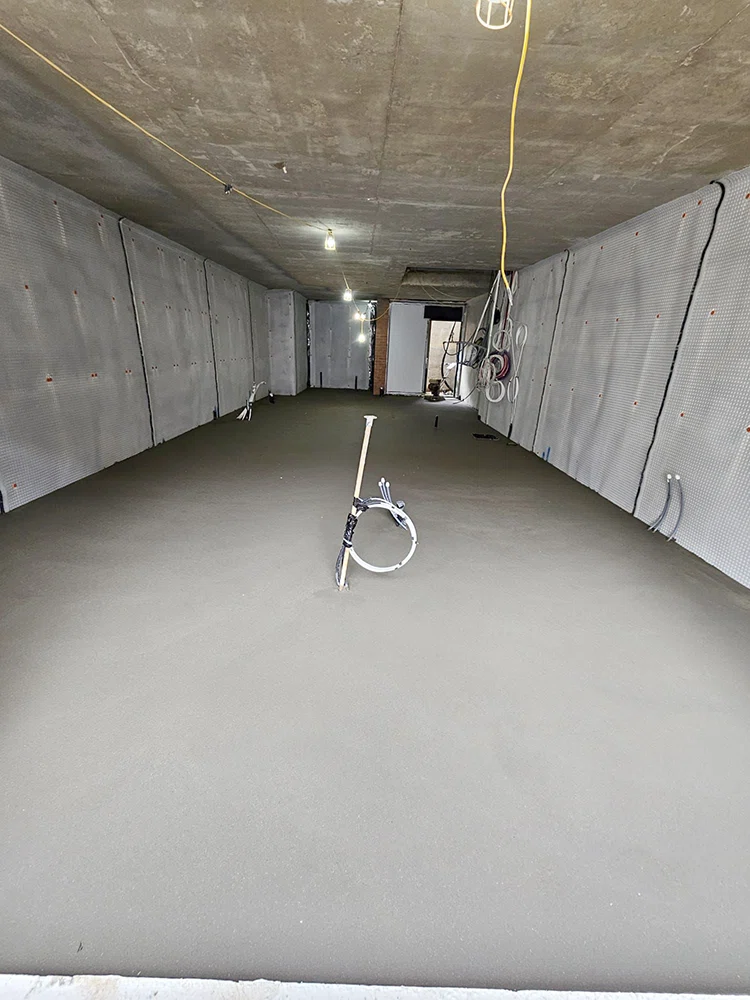
K & B Screeding’s own team, led by director Donatas Bardisevicius. Founded 2019, company 12298780.
See what customers say in our Google reviews and on our testimonials page.
Anhydrite & Flow Screed from Slough to Rugby
On the map, Rugby sits north-north-west of Slough, about 63.8 miles from our base in a straight line (postcodes including CV21 and CV22), next to Lutterworth (6.3 miles), Daventry (9 miles), Coventry (10.6 miles) and Bedworth (11.5 miles).
More on anhydrite screed, part of our screeding services.
