
Anhydrite grades on Hinckley drawings explained
Anhydrite is the trade name for calcium sulphate screed, and a specification usually gives it as a code rather than a product. The code comes from the British and European screed materials standard. In the code, CA is calcium sulphate, C gives compressive strength and F flexural strength, each in N/mm2.
Light domestic floors are what CA-C20-F4 is for. CA-C25-F5 is what a typical house, apartment or office is specified at. Heavier use calls for CA-C30-F6. If the drawings for a Hinckley plot or block just say flowing screed, it is worth asking the designer which grade they intend before the order is placed.
Alongside those grades are alpha hemihydrate products, picked where a floor build-up is tight or faster drying matters; their depth and drying follow their own data sheet.
In practice, calcium sulphate earns its place because it stays stable. It shrinks so little that bays can be large with few joints, which helps on a wide, open downstairs or along a run of apartment corridors. Before pouring we set out the bays and joints to line up with the doorways and any heating zones. There is more on the material itself in our anhydrite screed explainer.
Where the same building has areas that will get wet, the specification should switch those to a cement based flowing screed, because calcium sulphate is not the right choice there.
Sanding, testing and priming on Hinckley new builds
Calcium sulphate screed needs more aftercare than the pour suggests. As it cures, a weak, powdery layer called laitance forms on the surface. Once the screed is dry, that layer must be sanded off, or adhesives and levelling compounds will bond to the laitance instead of the screed and can fail.
The step that tends to get skipped next is the moisture test. Flooring makers often allow less moisture in a calcium sulphate base than in a cement one, so a reading that would pass on cement can still be too wet here. We test with a hygrometer against the limit set by the flooring maker, not by feel or by counting days.
Where the floor is heated, drying can be helped along. Once a gradual warm-up is under way, the heating can usually force dry a calcium sulphate floor from about 7 days, as our underfloor heating screed page explains.
The last step is priming. Before adhesive or compound goes on, the screed needs a primer made to work with calcium sulphate. If a thin smoothing layer is needed before LVT or sheet flooring, our floor levelling work uses compounds compatible with the screed underneath. Every pour ends with written advice from us on drying and on removing laitance.
Anhydrite & Flow Screed prices in Hinckley
Liquid flowing screed (which includes anhydrite): £24 to £31 per m² supplied and laid (MyJobQuote, August 2026), so £960 to £1,240 for 40 m². MyJobQuote does not say whether these figures include VAT. See our floor screeding cost guide or screed calculator.
Who lays your anhydrite and flow screed in Hinckley
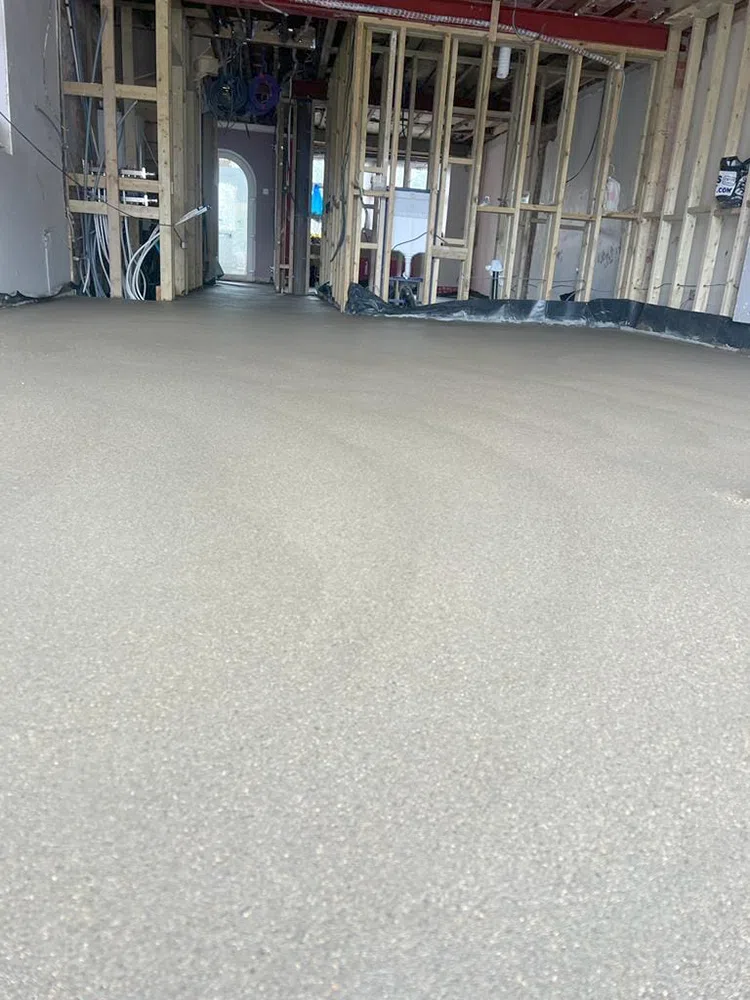
K & B Screeding’s own team, led by director Donatas Bardisevicius. Founded 2019, company 12298780.
See what customers say in our Google reviews and on our testimonials page.
Anhydrite & Flow Screed from Slough to Hinckley
As the crow flies, our yard in Slough is about 76.3 miles from Hinckley, which lies to the north-north-west. Postcodes here include LE10, and Earl Shilton (3.4 miles), Nuneaton (4.2 miles), Bedworth (6 miles) and Lutterworth (9.5 miles) are close by.
More on anhydrite screed, part of our screeding services.