
Retail and office refits at Elliott's Field and Technology Drive
When a retail or office unit changes hands, the new tenant's flooring contractor needs a flat, sound base on a fixed date. The existing floor usually carries old adhesive, patched repairs and uneven joints, and new finishes such as LVT, sheet vinyl and large format tiles will show every flaw.
Rugby's retail parks at Elliott's Field, Junction 1 and Technology Drive, and the industrial estates to the north of the town, are where units of this kind are found. Programmes are tight, so the levelling is planned around the fit-out date and the flooring contractor's start.
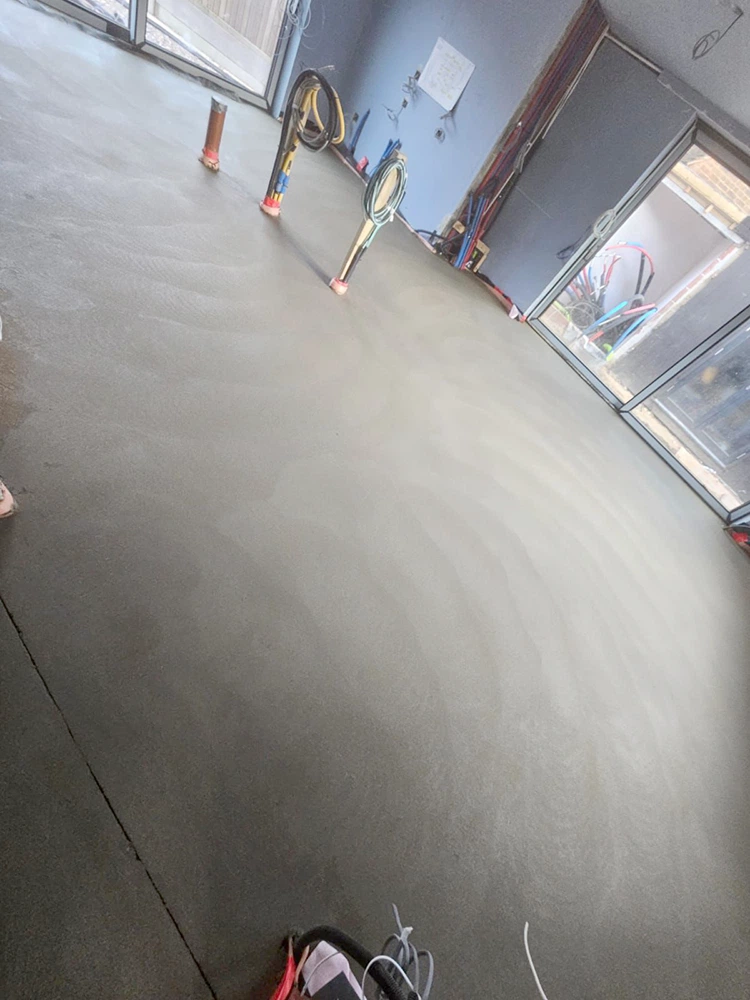
We check flatness with a straightedge rather than a glance. BS 8204 grades a floor by the deepest gap under a 2m length: 3mm or under is SR1, 5mm is SR2 and 10mm is SR3. For a lot of thin sheet flooring in a shop at Elliott's Field or Junction 1, SR1 is the standard to hit. Most compound goes down between about 2mm and 10mm thick, a few products further, and the fast drying sort lets the shopfitters' floor layer in quickly.
Preparation decides whether the compound stays put. Old adhesive and weak surfaces come off first, often with concrete floor grinding, and damaged areas are cut out and repaired through our concrete floor repair service. Each base then gets the primer that suits it, whether concrete, old screed or calcium sulphate. If a unit wants a resin coating, a polished concrete finish or a new structural slab, that is another contractor's work, not ours.
Levelling floors in Rugby homes from the 1950s to 1990s
In a house, the usual reason to level is a sound floor that is not flat enough for a modern finish, or a step where an extension meets the original building. Compound fixes both, and a single finish can then run through.
Homes built from 1945 to 1972 are 26% of Rugby's stock, and those from 1973 to 1999 another 17%. A floor from those decades can be solid and serviceable yet carry dips and ridges from settlement or old repairs, and those show through thin flooring. The job is to clean the floor, repair loose areas, prime for the base, then pour compound to the depth the straightedge shows.
There is a limit. A floor that is loose, cracked through or badly out of level should not be buried under a deep pour of compound, because it can crack and debond. Rebuilding with new screed is the better bet there. For very thin work, our latex screed service covers compounds a few millimetres thick, and for a site in Coventry, see floor levelling in Coventry.
How we price floor levelling in Rugby
A fixed written price within 24 hours, once we know the area and the base. See our floor screeding cost guide.
Who levels your floor in Rugby
K & B Screeding’s own team, led by director Donatas Bardisevicius. Founded 2019, company 12298780.
See what customers say in our Google reviews and on our testimonials page.
Floor Levelling from Slough to Rugby
On the map, Rugby sits north-north-west of Slough, about 63.8 miles from our base in a straight line (postcodes including CV21 and CV22), next to Lutterworth (6.3 miles), Daventry (9 miles), Coventry (10.6 miles) and Bedworth (11.5 miles).
More on floor levelling, part of our screeding services. Not sure whether you need a thin compound or a full flowing screed? See self levelling screed explained.
