
Matching floor levels at Middlemore Farm and Lang Farm
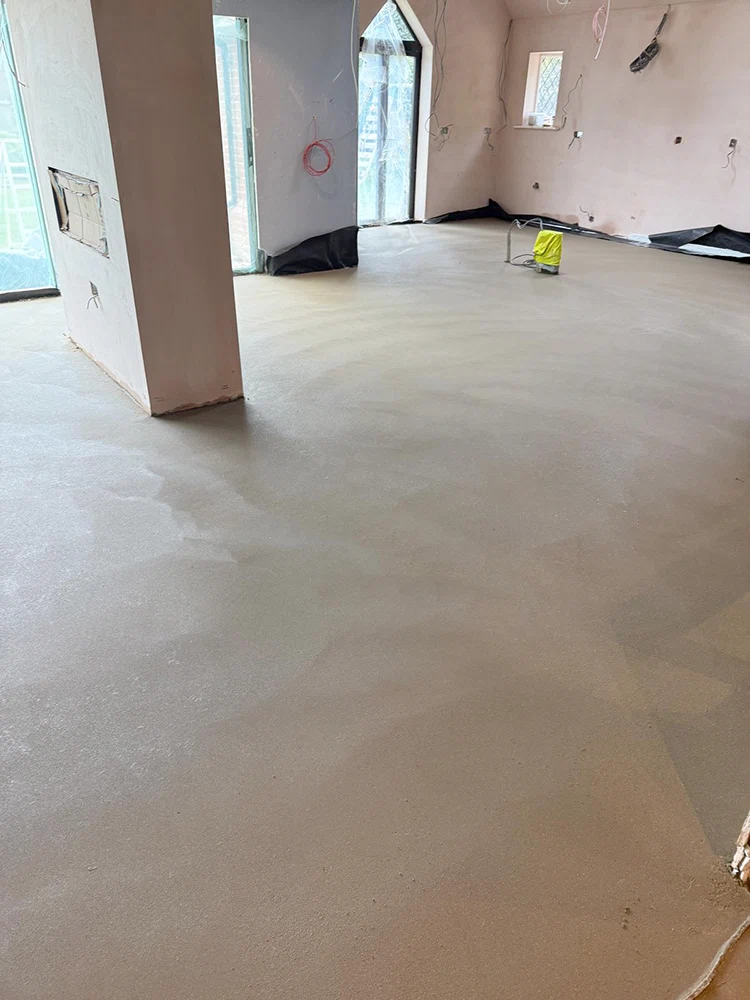
When a room is added to a house, the new floor is designed to finish at the same height as the old one. In practice there is often a small step, or the old slab itself is slightly out. Under thin flooring that step becomes a ridge across the doorway. Self levelling compound, feathered across the join, lets the finished floor run through as one surface.
Our test is simple: a 2m straightedge laid across the floor, and a look at the biggest gap beneath it. BS 8204 lets SR1 show no more than 3mm beneath it, with 5mm allowed for SR2 and 10mm for SR3, and thin sheet finishes commonly ask for SR1. Compound is usually laid from about 2mm up to around 10mm, with some products deeper, so it suits small steps, dips and ridges rather than big level changes.
Older slabs need the same care. In Daventry, 30% of homes date from 1945 to 1972, and floors that old have usually had layer after layer laid and lifted. Stripping them back leaves adhesive, patches and uneven sections that must be dealt with first.
Once the base is clean and repaired, it gets the primer that matches it, which differs for concrete, cement screed and calcium sulphate. Trying to fill a floor that is too far out with a thick pour of compound tends to crack and come loose, so a screed is the straight answer there. Our screed repairs service and the Daventry sand and cement screed page cover that route.
Refit floors on Daventry's Royal Oak Industrial Estate
The Royal Oak Industrial Estate and the Drayton Fields Industrial Estate host large distribution buildings, and the Daventry International Rail Freight Terminal sits near junction 18 of the M1. Warehouse floors like these need heavy duty screeds, repairs and grinding. Their offices, welfare areas and trade counters are a different job: when they are refitted, the floor needs to be flat and ready for carpet tiles, vinyl or LVT within a tight programme.
Fast drying levelling compounds suit that work. Old adhesive and loose material come off, damaged areas are repaired, the base is primed, and compound is poured to the flatness the flooring maker asks for. If the slab surface is broken up, repairs to the concrete are done before compound goes anywhere near it.
In town, the same method applies to shops and offices changing hands. The existing floor is checked with a straightedge first, so the price reflects the compound actually needed rather than a guess. Resin, polished concrete and sanding timber floors are not part of what K & B does. For work towards Towcester, see floor levelling in Towcester.
How we price floor levelling in Daventry
A fixed written price within 24 hours, once we know the area and the base. See our floor screeding cost guide.
Who levels your floor in Daventry
K & B Screeding’s own team, led by director Donatas Bardisevicius. Founded 2019, company 12298780.
See what customers say in our Google reviews and on our testimonials page.
Floor Levelling from Slough to Daventry
As the crow flies, our yard in Slough is about 54.8 miles from Daventry, which lies to the north-north-west. Postcodes here include NN11, and Rugby (9 miles), Northampton (11.3 miles), Towcester (11.4 miles) and Lutterworth (13.7 miles) are close by.
More on floor levelling, part of our screeding services. Not sure whether you need a thin compound or a full flowing screed? See self levelling screed explained.
