
Latex over tiles and ply in Bedworth semis
Two part latex pairs a cementitious powder with a bottle of latex, which is stirred in where plain water would normally go. The latex gives the cured layer a little flexibility and a stronger grip, which is why it is chosen where the base is anything other than plain, clean concrete.
Bedworth's 1950s and 1960s semis can hold plenty of those bases. A kitchen refit in one of them might uncover quarry tiles from the original build, vinyl tiles stuck over those, and a patch of newer concrete where a wall was moved. A bathroom upstairs normally sits on timber joists and boards. None of these is a good surface for thin sheet flooring as it stands, because every grout line, board edge and step shows through.
Where the old tiles are firmly bonded, they can usually stay. We sound every tile, take out the loose ones, fill the gaps, degrease and prime the surface, and the latex goes over in one smooth coat that hides the pattern underneath.
Upstairs the method changes. Bare floorboards move too much for a thin compound, so they are screwed down and covered with flooring grade plywood first. The latex then evens out the ply joints and fixings.
On the ground floor, the old concrete in many of these kitchens is cold and uninsulated. If you are replacing the kitchen anyway, compare a latex coat with a full rebuild, which our sand and cement page for Bedworth explains.
Checking a Bedworth floor before latex goes down
Latex corrects small faults. It is no cure for a weak base, and three conditions stop it working.
Movement is the first. If a floor bounces when you cross it, the boards or joists need fixing before plywood goes down, or the new layer will crack along every joint.
Damp is the second. A thin latex coat does nothing to stop moisture rising through an old slab. In a kitchen without a membrane the moisture gathers under the new vinyl and lifts it, so a damp floor is dealt with first, usually by breaking it out.
Level is the third. Latex is spread only a few millimetres thick. A floor that falls away across the room by more than that needs a screed or a deeper levelling product, which our floor levelling page compares.
Primer completes the preparation. Glazed tiles, plywood, concrete and old adhesive each take a matched primer, and any calcium sulphate screed has its laitance sanded off and is primed before latex goes on.
We cover the whole town, including Black Bank, Coalpit Field and Bedworth Heath, and latex smoothing for Nuneaton homes is handled the same way.
How we price latex screed in Bedworth
A fixed written price within 24 hours, once we know the area and the base. See our floor screeding cost guide.
Who lays your latex screed in Bedworth
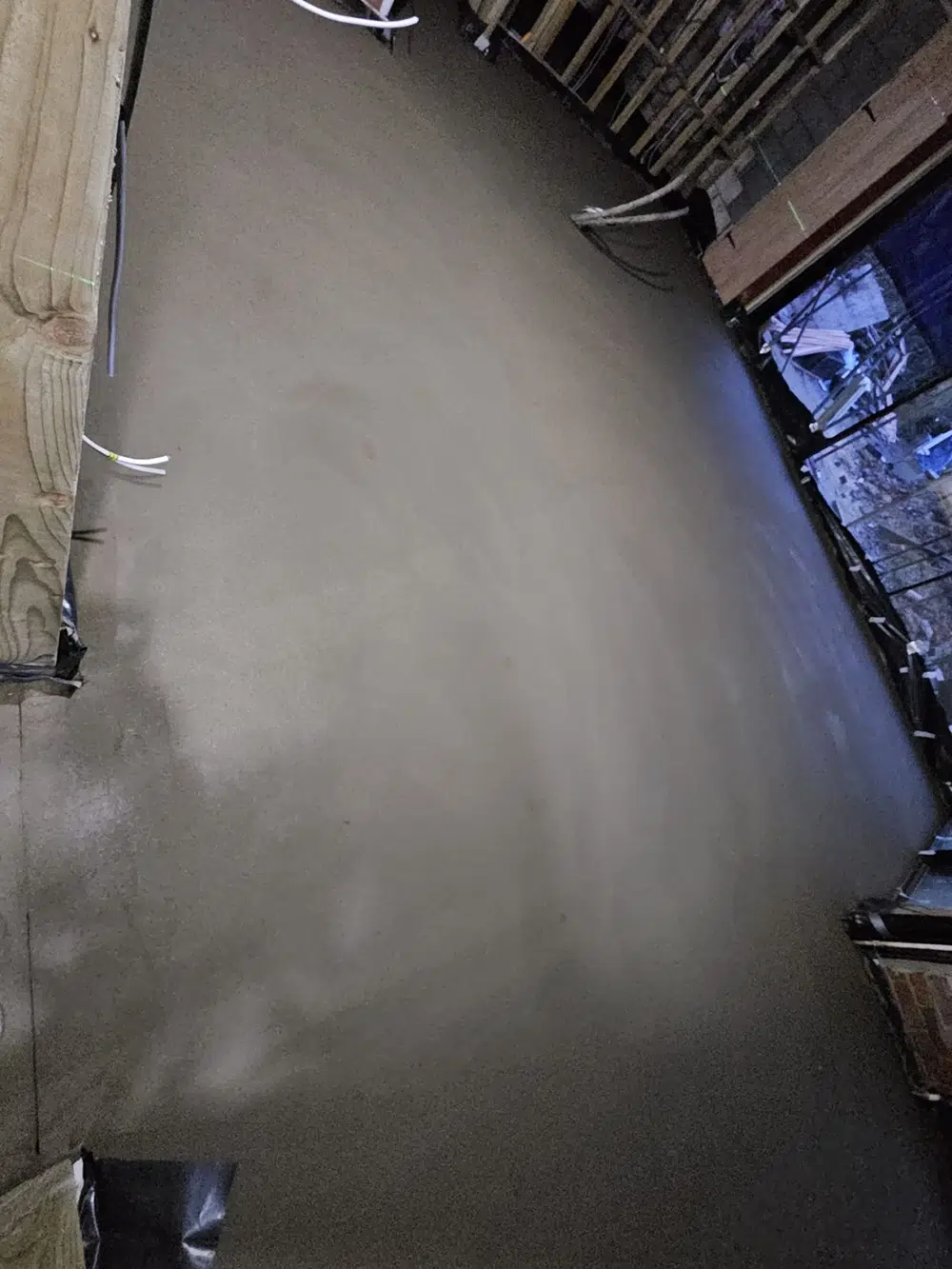
K & B Screeding’s own team, led by director Donatas Bardisevicius. Founded 2019, company 12298780.
See what customers say in our Google reviews and on our testimonials page.
Latex Screed from Slough to Bedworth
Bedworth is about 74.3 miles north-north-west of our Slough base as the crow flies, with postcodes including CV12 and CV7. The nearest towns to it are Nuneaton (3 miles), Coventry (5.1 miles), Hinckley (6 miles) and Earl Shilton (9.4 miles).
More on latex screed, part of our screeding services.
