
Warmer floors for Ruscote's post-war homes
Ruscote's post-war housing, and similar mid-century homes across Banbury, often have ground floors that feel cold and have gone uneven with age. Replacing them with an insulated, heated screed changes how the whole ground floor feels.
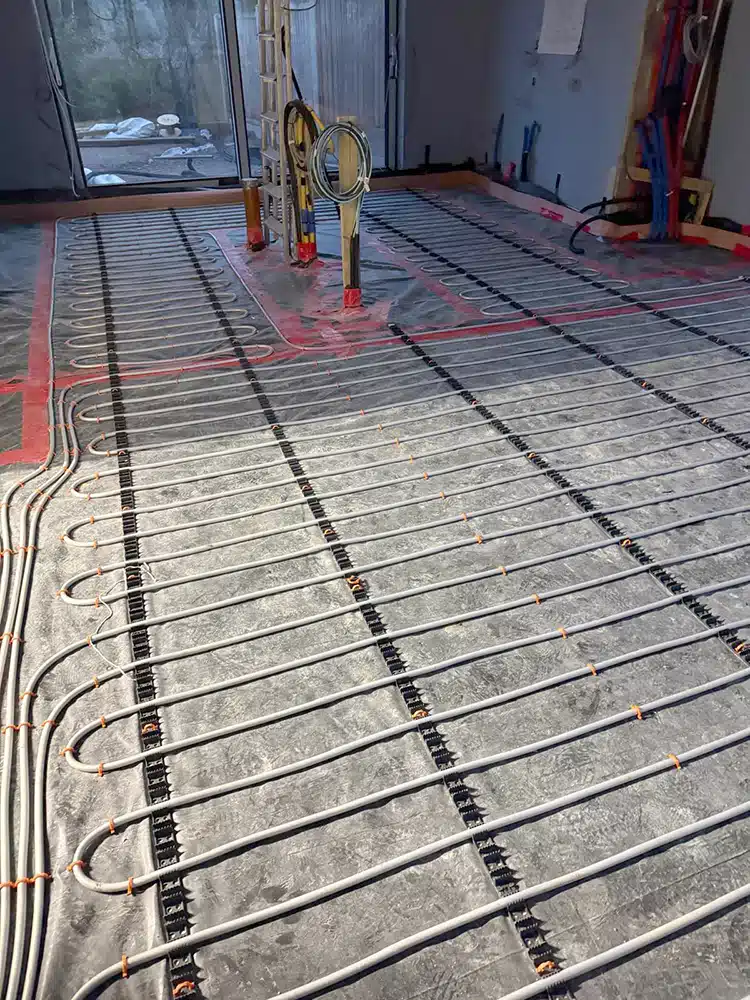
The build-up goes in from the bottom. Rigid insulation sits on the prepared base, then a membrane with taped joints, and an edge strip around every wall to let the heated screed expand. Your engineer then fits and pressure tests the pipes. We can look over the insulation and membrane, or bring them ourselves through our insulation and membrane supply.
Pipe cover sets the depth. A pumped floor wants 25mm or more over the pipes, which normally comes to 45 to 50mm altogether. A hand-laid cement floor wants about 45mm of cover on its own, so it ends up thicker. In an older house where doorways and stairs fix the finished height, that difference can decide whether heating fits at all. The liquid screed page for Banbury covers the thinner option in more detail.
Just as important is how completely the screed wraps each pipe. Every pipe must be fully surrounded, with no air pockets that leave cold spots. A flowing screed does this naturally; a hand-laid screed is worked carefully around each loop.
Fitting the pipes is not something K & B does. Once your engineer has them in and has proven them under pressure, we lay the screed that carries their heat into the room.
First heat-up in a Banbury kitchen extension
Kitchen extensions on post-war houses are a natural place for a heated floor, since the new room is often large, open and tiled. After the pour, though, leave the thermostat alone for a while.
With calcium sulphate the system can normally come on from around day 7; with sand and cement, not before day 21. Either way, the start is gradual. Start with cool flow water and nudge it up a little at a time across several days, as set out in the commissioning plan your heating engineer and the screed supplier give you. Turning the system straight up risks cracking and curling at the edges.
Warming the floor helps it dry, but only a test shows it is ready. Check with a hygrometer before tiles, LVT or engineered wood go down, and meet the moisture limit your flooring maker sets. Calcium sulphate screeds also need their laitance sanded off first. How depth stretches that timetable is covered in how long screed takes to dry.
Extensions rarely meet the old house at exactly the same level. A thin compound can blend the two before one continuous floor goes across, as covered under floor levelling in Banbury.
Underfloor Heating Screed prices in Banbury
Liquid screed over underfloor heating: £20 to £35 per m² supplied and laid (trade2base, June 2026), so £700 to £1,230 for 35 m². trade2base gives these figures excluding VAT. See our floor screeding cost guide or screed calculator.
Who lays your underfloor heating screed in Banbury
K & B Screeding’s own team, led by director Donatas Bardisevicius. Founded 2019, company 12298780.
See what customers say in our Google reviews and on our testimonials page.
Underfloor Heating Screed from Slough to Banbury
On the map, Banbury sits north-west of Slough, about 47 miles from our base in a straight line (postcodes including OX16), next to Brackley (8.3 miles), Bicester (13.8 miles), Buckingham (15.4 miles) and Daventry (15.4 miles).
More on underfloor heating screed, part of our screeding services.
