
Heated extensions and orangeries on Brackley family homes
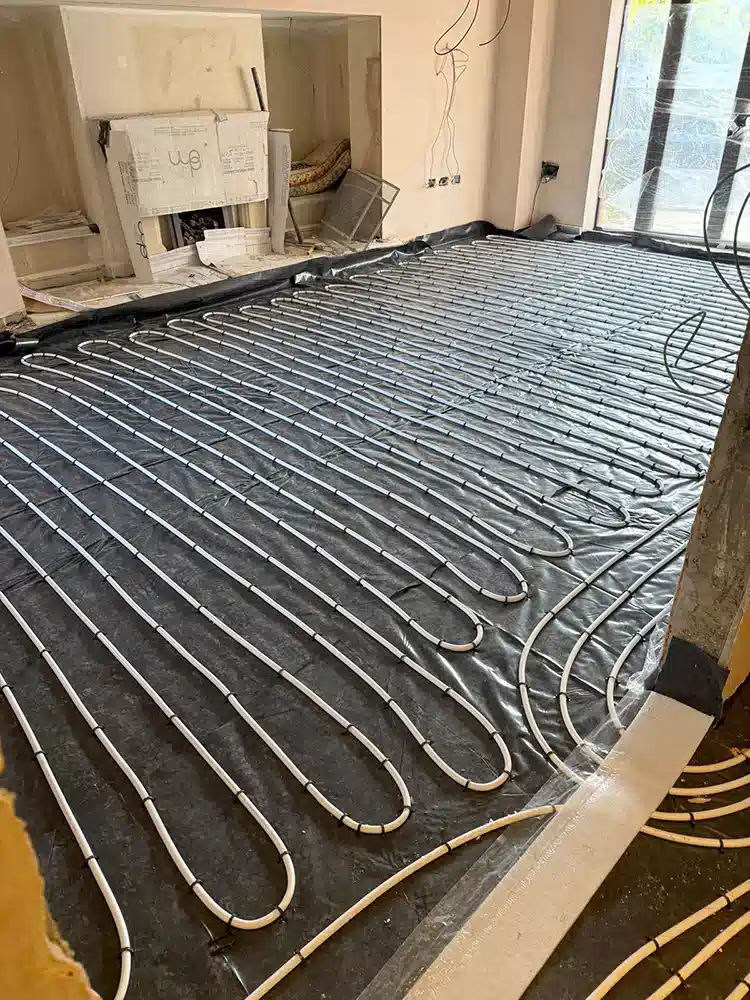
An orangery or single storey extension with underfloor heating is a common way to add a warm, usable room to a 1970s to 1990s house. It is the screed that turns those pipes into a working floor. It wraps round the pipework, carries the warmth across the room and leaves a flat surface for tiles, LVT or engineered wood. Pipe cover sets the depth. Liquid needs 25mm or more above the pipes, so the whole floor usually ends up 45 to 50mm. With sand and cement the cover is around 45mm. The finished level must also meet the existing house floor, so the insulation thickness is chosen to suit. On an extension where every millimetre is fixed by the existing slab, the slimmer liquid build-up often helps. Because liquid flows right round each pipe without trapping air, the heat moves into the floor better and the room warms sooner. Sand and cement still works, particularly where the room may get wet, but it must be compacted properly around the pipes. An orangery has one extra detail: large areas of glass meet the floor, so the edge strip and the membrane at the perimeter need care. That perimeter strip gives the warm floor room to expand so it does not crack against the glazing frame or the walls. If the specification names a calcium sulphate product, the anhydrite screed page for Brackley covers grades and the laitance that must be removed.
Commissioning heating on new Brackley homes
On a new build plot, underfloor heating often runs across the whole ground floor, in semi-detached houses as much as in detached ones. For a developer, the screed date sets the heating commissioning date, which in turn sets when flooring goes down and the house is ready. Heating goes on in stages. Calcium sulphate can normally be warmed roughly 7 days after pouring, but sand and cement needs 21 days or more. We start with cool water and lift the temperature in stages over several days, in line with the schedule set by your heating installer and the screed maker. Warming too hard, too soon, risks cracking, and a cracked heated screed is difficult to repair without disturbing the pipes beneath it. Ahead of pour day we look over the insulation, membrane and perimeter strip, or supply them, and settle the depth with your installer. For more on how long each stage takes, read how long screed takes to dry. For Banbury, about 8 miles away, see underfloor heating screed in Banbury.
Underfloor Heating Screed prices in Brackley
Liquid screed over underfloor heating: £20 to £35 per m² supplied and laid (trade2base, June 2026), so £700 to £1,230 for 35 m². trade2base gives these figures excluding VAT. See our floor screeding cost guide or screed calculator.
Who lays your underfloor heating screed in Brackley
K & B Screeding’s own team, led by director Donatas Bardisevicius. Founded 2019, company 12298780.
See what customers say in our Google reviews and on our testimonials page.
Underfloor Heating Screed from Slough to Brackley
Brackley is about 40.7 miles north-north-west of our Slough base as the crow flies, with postcodes including NN13. The nearest towns to it are Buckingham (7.1 miles), Banbury (8.3 miles), Bicester (9.4 miles) and Towcester (9.5 miles).
More on underfloor heating screed, part of our screeding services.
