
Reading an anhydrite specification for Brackley plots
Each calcium sulphate screed has a CA code under the European screed material standard. In that code, C gives compressive and F gives flexural strength, each in N/mm2. For lightly used rooms at home the grade is CA-C20-F4. Houses, flats and offices mostly take CA-C25-F5. Floors that will see harder wear get CA-C30-F6. On a development in Brackley, the engineer's drawings set the grade, and the pour matches that specification rather than a near equivalent. Some drawings instead name an alpha hemihydrate product, which is chosen where faster drying or a reduced depth matter. For those, depth and drying come from that product's data sheet. Calcium sulphate barely shrinks while it sets, so bays can be big and joints few. That works for the open ground floors of new Brackley houses and for blocks of flats. Purpose-built flats account for about 10% of Brackley homes, and one apartment's floor there can often go down in a single visit. Where a joint is needed, at certain doorways or where heating zones meet, we draw up the bays and joints before pouring. The specification also sets the depth over insulation or heating, and that depth decides the drying time, so a thicker floor over deep insulation needs a longer wait before flooring. To understand the material in more depth, read anhydrite screed explained.
Getting Brackley anhydrite floors ready for flooring
As it dries, calcium sulphate leaves laitance, a thin and weak skin, on top. That skin must be sanded away before adhesive, primer or levelling compound is applied, otherwise the flooring is stuck to the laitance and not to the screed. After sanding, a primer compatible with calcium sulphate is applied, because some cement-type primers do not bond to it. Moisture is the next check. Flooring makers often want calcium sulphate drier than cement screed, so our readings come from a hygrometer rather than the number of days gone by. A floor that looks pale and dry on top can still hold moisture lower down. If heating pipes are in the floor, forced drying can normally begin after about 7 days. Keep calcium sulphate away from any floor that could stay wet. In wet rooms, en suites with walk-in showers or utility areas with a real leak risk, a cement based flowing screed is the alternative, or a hand-laid cement screed for Brackley wet rooms. If the floor will then need levelling, see latex screed for thin smoothing layers.
Anhydrite & Flow Screed prices in Brackley
Liquid flowing screed (which includes anhydrite): £24 to £31 per m² supplied and laid (MyJobQuote, August 2026), so £960 to £1,240 for 40 m². MyJobQuote does not say whether these figures include VAT. See our floor screeding cost guide or screed calculator.
Who lays your anhydrite and flow screed in Brackley
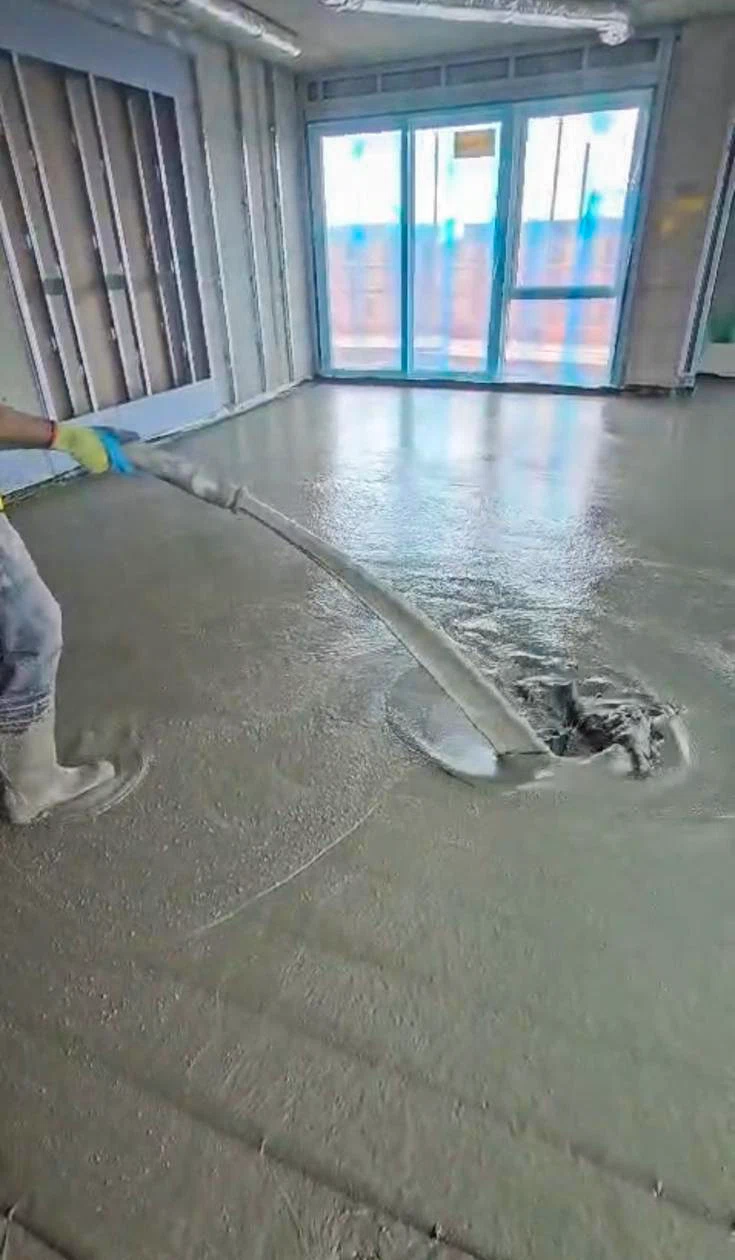
K & B Screeding’s own team, led by director Donatas Bardisevicius. Founded 2019, company 12298780.
See what customers say in our Google reviews and on our testimonials page.
Anhydrite & Flow Screed from Slough to Brackley
Brackley is about 40.7 miles north-north-west of our Slough base as the crow flies, with postcodes including NN13. The nearest towns to it are Buckingham (7.1 miles), Banbury (8.3 miles), Bicester (9.4 miles) and Towcester (9.5 miles).
More on anhydrite screed, part of our screeding services.
