
Levelling for refits at Maybird Shopping Park and Bell Court
Commercial floors are where compound saves the most time. The Maybird Shopping Park on Birmingham Road is a large retail site, the Rosebird Centre on Shipston Road is smaller, and Bell Court Shopping Centre sits in the town centre. When a unit changes tenant, the new finish often shows every hollow and ridge in the old base. Carpet hides some of it, while LVT, vinyl sheet and big format tiles hide none.
BS 8204 sets how flatness is judged: a straightedge 2m long is laid across the floor and the gaps beneath it measured. Gaps of no more than 3mm meet SR1, 5mm meets SR2 and 10mm meets SR3. Many thin sheet finishes ask for SR1, so a base that passed under carpet can fail once the specification changes.
A typical pour of compound runs between roughly 2mm and 10mm thick, and certain products are rated for more. A retail unit's old base gets cleaned and then primed for its own material, as concrete, sand and cement, calcium sulphate and stubborn adhesive residue all want different treatment. In a Maybird or Bell Court unit, a fast drying grade lets the flooring contractor start soon after.
The same approach suits restaurants and hotels serving visitors, where every day closed costs money and the refit has to finish on time. Where a shop slab is too worn or contaminated for compound alone, concrete floor grinding or wider floor preparation work comes first.
Uneven older floors in Stratford-upon-Avon homes
Homes bring their own levelling problems. 22% of Stratford-upon-Avon's homes were built between 1945 and 1972, and floors of that age have often settled, been patched after old services were removed, or been left uneven by earlier coverings. A rear extension adds another: the new floor is flat while the old one beside it is not, leaving a step or slope at the doorway. A skim of compound can blend the old floor into the new one.
In the listed buildings of the historic centre, a thin levelling layer is often preferred to a deep new screed, since it adds little weight or height. Consent conditions still come first.
There are limits. Compound is a finishing layer. Piled on thick over a failing Stratford floor, it will often crack and lose its grip. If the base is hollow, breaking up or out by more than compound can handle, the honest advice is a new screed, usually sand and cement in Stratford-upon-Avon, or a few millimetres of latex screed where only a thin build is needed. Either way, you hear which one your floor needs before any quote is written.
How we price floor levelling in Stratford-upon-Avon
A fixed written price within 24 hours, once we know the area and the base. See our floor screeding cost guide.
Who levels your floor in Stratford-upon-Avon
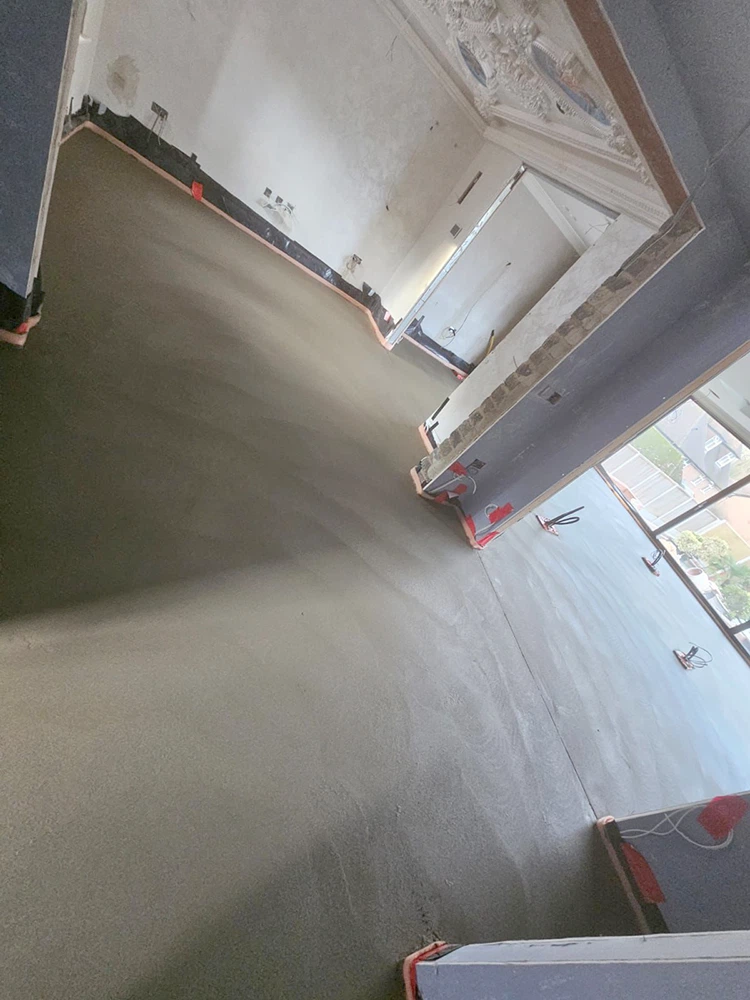
K & B Screeding’s own team, led by director Donatas Bardisevicius. Founded 2019, company 12298780.
See what customers say in our Google reviews and on our testimonials page.
Floor Levelling from Slough to Stratford-upon-Avon
On the map, Stratford-upon-Avon sits north-west of Slough, about 64.4 miles from our base in a straight line (postcodes including CV37), next to Warwick (8 miles), Royal Leamington Spa (10 miles), Kenilworth (11.7 miles) and Evesham (12.4 miles).
More on floor levelling, part of our screeding services. Not sure whether you need a thin compound or a full flowing screed? See self levelling screed explained.
