
What anhydrite grades mean for Burton Latimer floors
Read a code like CA-C25-F5 from left to right: CA for calcium sulphate, then the compressive figure after the C and the flexural figure after the F, both in N/mm2 as the European screed standard sets them out. A garden room at Hanwood Park with light use could take CA-C20-F4. CA-C25-F5 is what a typical house or office is drawn with, and CA-C30-F6 is kept for floors expected to work harder.
If an engineer has designed the plot, we pour the grade on the drawing and nothing else. Now and then a drawing calls for alpha hemihydrate rather than ordinary anhydrite. A designer picks it when the programme is short or there is little depth to play with, and that product's own data sheet then governs how we lay it.
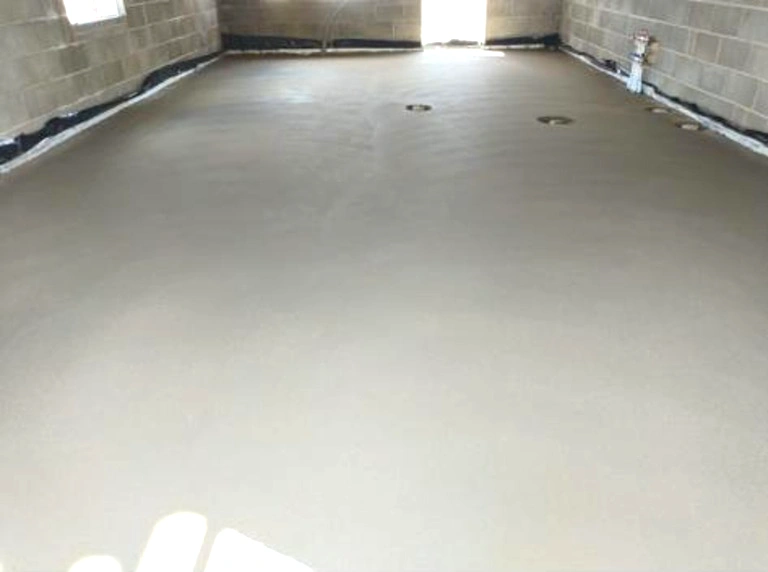
What makes the material useful is how little it shrinks. An open-plan ground floor in a Burton Latimer extension can usually be poured in one sweep with few joints. Purpose-built flats are just 6% of Burton Latimer's homes, so here calcium sulphate mostly ends up in houses, extensions and garden rooms rather than in blocks. Doorways and the edges of separate heating zones still need joints, and we mark those out on the plan before pouring, with our own team laying the insulation and membrane underneath.
Keep it out of any room that might end up wet. A flowing screed made with cement does that job instead, and hand-laid options for wet rooms are on our Burton Latimer page for traditional screed. Our anhydrite screed guide goes deeper into how the material behaves.
Laitance, sanding and moisture limits in Burton Latimer
Looking dry does not make a calcium sulphate floor ready for flooring. While it cures, a soft skin known as laitance builds up on top. Glue a tile or LVT to that and you are fixing it to a crust that can come away, finish and all. Once moisture levels allow, that skin is sanded away and a calcium sulphate compatible primer goes on; a primer sold for cement screed may not bond properly.
Then comes moisture. Adhesive and flooring suppliers tend to set a tighter limit for this material than for cement, so a Hanwood Park floor can test too wet even when a cement floor at the same reading would pass. We use a hygrometer and compare the result with the limit the flooring supplier sets instead of going by how many weeks have passed.
Where heating is fitted, force drying can usually start from about 7 days, with the temperature brought up gradually. Our drying and laitance notes are handed over in writing, so the flooring fitter can see exactly what has been done. If a very thin smoothing coat is wanted once the surface is ready, look at latex smoothing screed.
Anhydrite & Flow Screed prices in Burton Latimer
Liquid flowing screed (which includes anhydrite): £24 to £31 per m² supplied and laid (MyJobQuote, August 2026), so £960 to £1,240 for 40 m². MyJobQuote does not say whether these figures include VAT. See our floor screeding cost guide or screed calculator.
Who lays your anhydrite and flow screed in Burton Latimer
K & B Screeding’s own team, led by director Donatas Bardisevicius. Founded 2019, company 12298780.
See what customers say in our Google reviews and on our testimonials page.
Anhydrite & Flow Screed from Slough to Burton Latimer
On the map, Burton Latimer sits north of Slough, about 57.4 miles from our base in a straight line (postcodes including NN15), next to Kettering (3.3 miles), Wellingborough (4.2 miles), Rushden (6 miles) and Raunds (6.2 miles).
More on anhydrite screed, part of our screeding services.
