
Reading the grade on a Desborough specification
On paper, a calcium sulphate screed is named by a short code from the European screed standard. CA stands for the binder. Read the C figure as compressive strength in N/mm2, and the F figure as flexural strength in the same units. Nearly every house job uses one of three:
CA-C20-F4, for lightly used rooms at home such as bedrooms and lounges.
CA-C25-F5, the grade that suits the majority of houses, apartments and offices.
CA-C30-F6, for floors that have to stand up to harder wear.
On a new plot or a self-build in Desborough, the grade comes from the engineer or the architect, and we pour what is written rather than substituting something cheaper. On an extension without a formal specification, we recommend one based on the rooms, the loads and the finish going on top.
Alpha hemihydrate screeds sit in a family of their own. People pick them when the floor has to dry quicker or go in thinner, say where there is little height to spare, and every product has its own data sheet setting depth and drying. The sheet, not a general rule, sets what can be done.
Calcium sulphate's low shrinkage is what allows large bays with few joints. We still draw out where the bays and joints go ahead of pour day, working round doorways, corners where a room changes shape, and the heating zones. Only 5% of the town's homes are purpose-built flats, but where a small block is going up, the same planning applies floor by floor.
Laitance, sanding and moisture tests in Desborough homes
Pumping the screed in is only half the job with calcium sulphate. While it dries, a fragile skin known as laitance builds up on top. Nothing bonds well to that skin, whether adhesive, primer or levelling compound, so once the floor has dried enough we sand it away and prime with a product made to work on calcium sulphate. An unsuitable primer or adhesive can react with the screed and fail.
Moisture comes next. Flooring makers often allow less moisture in calcium sulphate than in a cement screed, which means a reading that would be fine for tiling on sand and cement can still fail on anhydrite. Our hygrometer reading is checked against the figure your flooring's manufacturer gives. Where the floor is heated, the system can usually be run to speed drying from around day 7, useful when the programme is tight.
Anhydrite has its limits in a Desborough house. Long exposure to water weakens it, so for a wet room, a level-access shower or any floor where a leak is likely, use a cement based flowing screed or traditional sand and cement for Desborough wet areas. Our anhydrite screed explained guide goes deeper into the material, and levelling over a finished anhydrite floor needs the same care with primers.
Anhydrite & Flow Screed prices in Desborough
Liquid flowing screed (which includes anhydrite): £24 to £31 per m² supplied and laid (MyJobQuote, August 2026), so £960 to £1,240 for 40 m². MyJobQuote does not say whether these figures include VAT. See our floor screeding cost guide or screed calculator.
Who lays your anhydrite and flow screed in Desborough
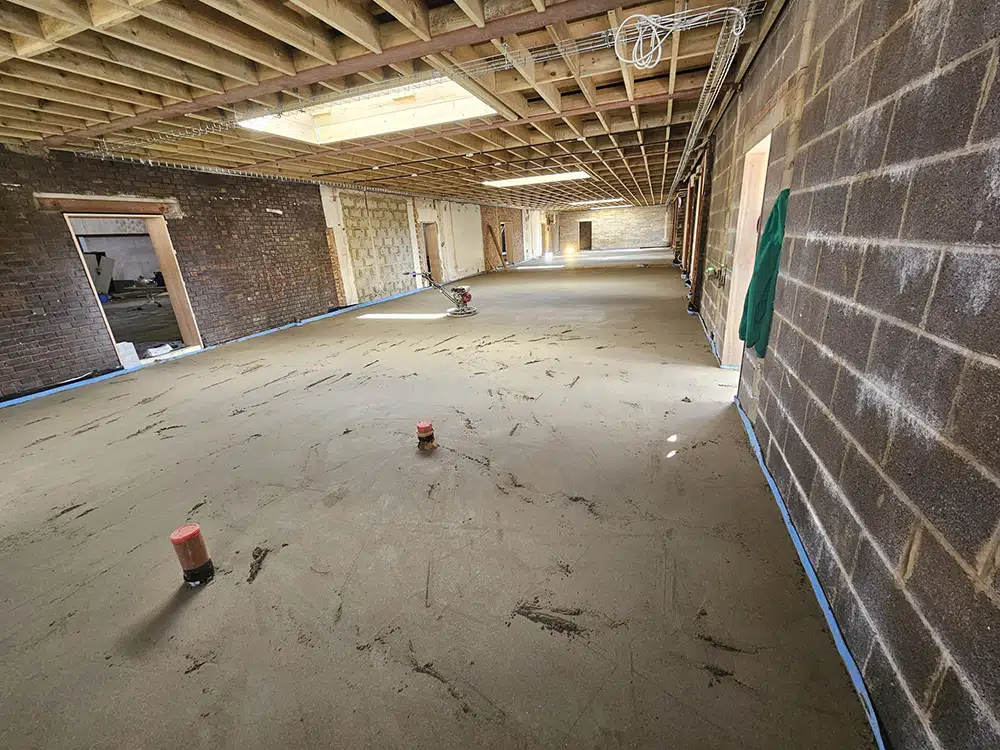
K & B Screeding’s own team, led by director Donatas Bardisevicius. Founded 2019, company 12298780.
See what customers say in our Google reviews and on our testimonials page.
Anhydrite & Flow Screed from Slough to Desborough
Desborough is about 63.3 miles north of our Slough base as the crow flies, with postcodes including NN14. The nearest towns to it are Kettering (4.9 miles), Market Harborough (5 miles), Corby (6 miles) and Burton Latimer (8.1 miles).
More on anhydrite screed, part of our screeding services.
