
Where pumped screed suits Burton Latimer homes
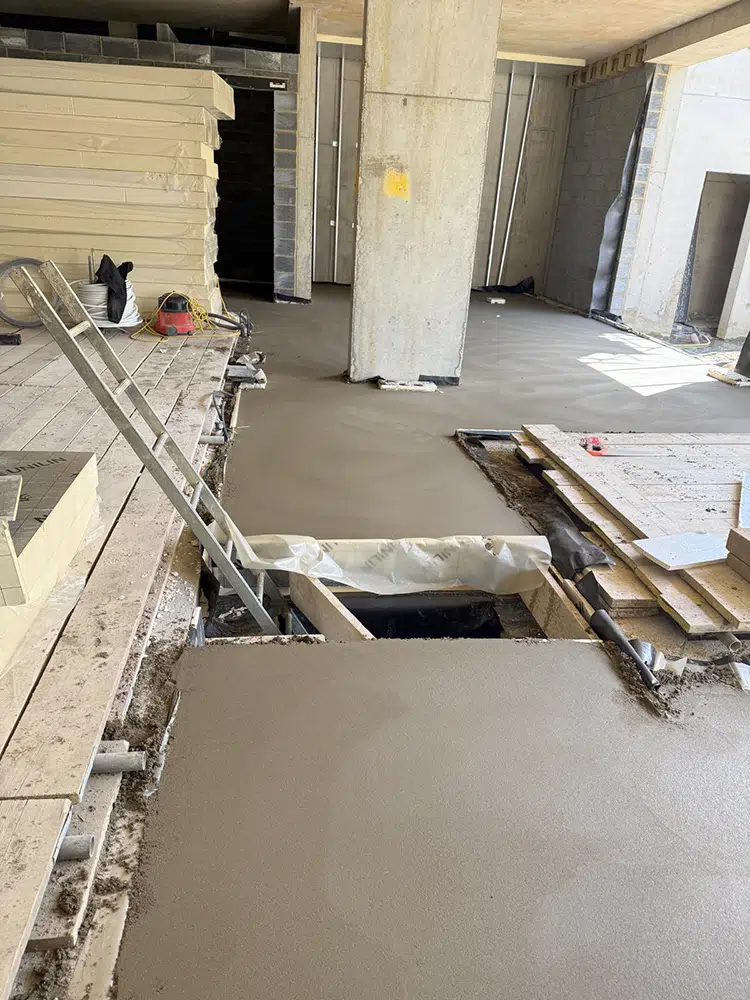
The screed arrives ready mixed and runs out of a hose across the slab or the insulation boards. Because it levels itself, an open floor finishes flat and dense, with far fewer joints than a hand-laid one. You can have it calcium sulphate based or cement based; the room's use and the finish you plan decide between them. The calcium sulphate material has its own page: anhydrite and flow screed in Burton Latimer.
Locally, the obvious places for it are the rear extensions on the housing that grew out from the old centre, where a kitchen is being knocked through into new space. Detached houses account for 32% of homes in the town, and bigger houses tend to mean bigger floors. That is when a pump earns its keep: the floor goes in on one visit instead of taking days of compacting by hand.
Getting the depth right matters as much as picking the product. In a house, a floating liquid screed begins at around 35mm. Where heating pipes run underneath, they need at least 25mm of screed above them, so the finished depth comes to about 45 to 50mm. Pumped floors like this reach the SR1 or SR2 tolerance without fuss, so a fitter laying LVT, big tiles or engineered boards in a new Burton Latimer kitchen has a true base.
It is a poorer fit for a very small room the hose cannot reach, or for a floor that has to carry weight within a day or two. There, traditional hand-laid screed usually makes more sense.
Getting the pump to a Burton Latimer doorway
Everything on pour day hinges on the lorry and pump getting near the house. They wait at the kerb or on the driveway while the hose is fed through to the room, so work out early where they can park. Wide roads on a new estate rarely cause a problem. On a narrower street without off-road parking, things like restrictions, shared passageways and front gardens set the route, so mention them when you get in touch.
Garden rooms and upper floors can be reached as well, provided the hose can run safely through the house or around the side. Before the pour, any gaps the screed might escape through are sealed and the edge strip and membrane checked.
A day or two after the pour, 24 to 48 hours as a rule, you can walk on it, but it is still wet underneath. Count on one day of drying for each millimetre up to 40mm deep, then more for every millimetre past that, so the flooring fitter should go by a moisture reading, not the calendar. Our guide on how long screed takes to dry covers what speeds or slows it, and the equipment is described under screed pumping. Pumps are not hired out separately.
Liquid Screed prices in Burton Latimer
Liquid screed: £24 to £31 per m² supplied and laid (MyJobQuote, August 2026), so £960 to £1,240 for 40 m². MyJobQuote does not say whether these figures include VAT. See our floor screeding cost guide or screed calculator.
Who lays your liquid screed in Burton Latimer
K & B Screeding’s own team, led by director Donatas Bardisevicius. Founded 2019, company 12298780.
See what customers say in our Google reviews and on our testimonials page.
Liquid Screed from Slough to Burton Latimer
On the map, Burton Latimer sits north of Slough, about 57.4 miles from our base in a straight line (postcodes including NN15), next to Kettering (3.3 miles), Wellingborough (4.2 miles), Rushden (6 miles) and Raunds (6.2 miles).
More on liquid screed, part of our screeding services.
