
Liquid screed for Oakley Vale and Priors Hall floors
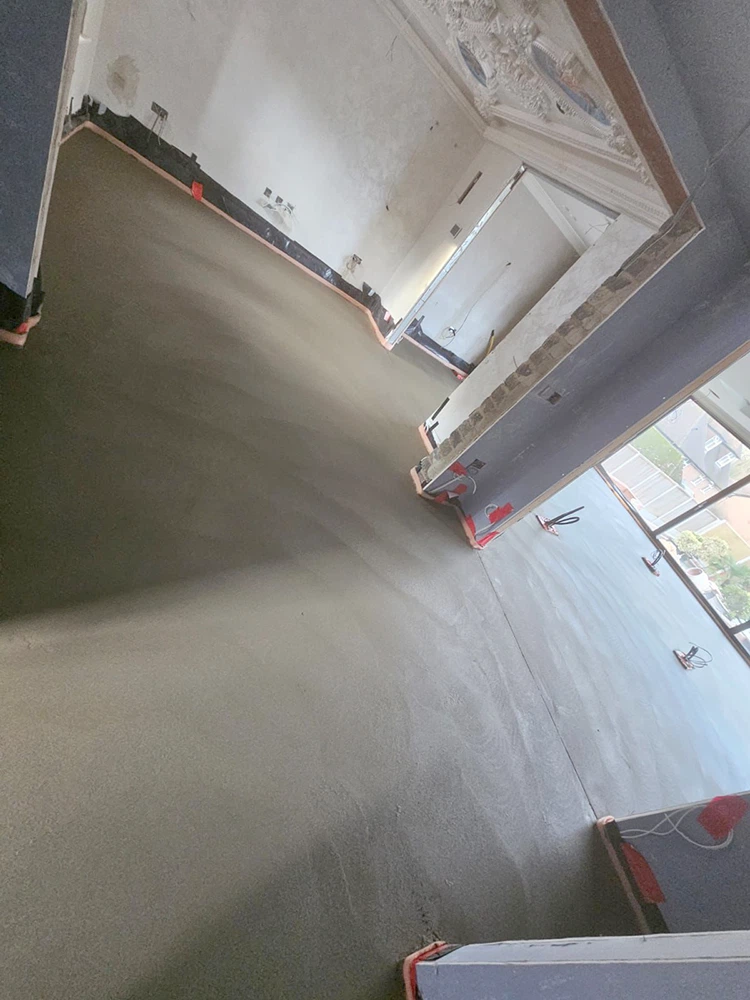
The mix turns up in a truck ready to go, and a hose carries it straight to the room, where it spreads over the boards or slab. It finds its own level, so the finish is flat and dense across the whole floor. You can choose a calcium sulphate mix or one made with cement. Both are pumped the same way, and which one is right depends on the finish and whether the room will ever get wet.
The strongest case for it in Corby is the newer housing. Oakley Vale combines small apartments with five and six bedroom houses, and there and at Priors Hall a flowing screed is commonly used over heating pipes. One of those big Oakley Vale ground floors can be done in a single day, and because the material barely shrinks it can be poured with only a handful of joints, where hand-laid work needs many.
Flats are a good fit as well. Apartment floors tend to be large, repeated and laid over insulation, so pouring each floor in one visit keeps a build moving, and upper storeys are reachable by hose.
On insulation, we start from roughly 35mm in a house and 40mm in commercial premises. Bury heating pipes under 25mm or more of it and the floor finishes somewhere near 45 to 50mm. Getting within SR1 or SR2 is straightforward with a pumped floor, and that is what the LVT and large tiles going into these new houses need. Every depth is listed together in our guide to how thick screed should be.
On a New Town estate, a kitchen extension that opens into the original house is a natural candidate too, because the pour can be taken level with the existing floor.
Pump access on Corby streets and upper floors
Out on the road sit the truck and pump; inside, only a hose. That makes access the first thing to plan. Parking bays, grass verges and communal paths can decide where the pump goes, and for apartments the route up a stairwell or through a window has to be agreed with the site team.
On the day, the edge strip, membrane and any heating pipes are checked, door openings are sealed, and the pour runs room to room. Most Corby house floors are poured and done on one visit. The floor can usually be walked on in 24 to 48 hours, which lets other trades back in quickly, but it will not be dry enough for flooring for some weeks. Reckon on a day of drying for each of the first 40 millimetres, then more for each one after.
Where a hose cannot reach, or a small room needs a screed that takes load early, traditional sand and cement for Corby is the alternative. More detail on the equipment is on our screed pumping page, and projects to the south can use the Kettering liquid screed page.
Liquid Screed prices in Corby
Liquid screed: £24 to £31 per m² supplied and laid (MyJobQuote, August 2026), so £960 to £1,240 for 40 m². MyJobQuote does not say whether these figures include VAT. See our floor screeding cost guide or screed calculator.
Who lays your liquid screed in Corby
K & B Screeding’s own team, led by director Donatas Bardisevicius. Founded 2019, company 12298780.
See what customers say in our Google reviews and on our testimonials page.
Liquid Screed from Slough to Corby
As the crow flies, our yard in Slough is about 66.1 miles from Corby, which lies to the north. Postcodes here include NN17 and NN18, and Desborough (6 miles), Kettering (6.2 miles), Burton Latimer (8.7 miles) and Market Harborough (9.4 miles) are close by.
More on liquid screed, part of our screeding services.
