
Reading the CA grade on a Baldock specification
A specification for calcium sulphate screed usually gives a designation such as CA-C25-F5. Taken a piece at a time under the screed standard Britain shares with Europe, CA names the binder as calcium sulphate, C carries the compressive strength figure and F the flexural one, with both numbers in N/mm2.
Nearly every job falls under one of three grades. CA-C20-F4 covers rooms in a home that see only light foot traffic. For ordinary houses, flats and offices the usual pick is CA-C25-F5. Anything working harder than that moves up to CA-C30-F6. We supply to whichever grade is written on the drawings, and if nothing is written we recommend one based on the use of the floor.
That middle grade is relevant in Baldock: 15% of its homes are flats in purpose-built buildings, and apartment floors are commonly specified in calcium sulphate. Because shrinkage is so low, the screed can go down in big bays with few joints, and where those bays and joints fall is drawn up before the pour, not decided on the day.
An alpha hemihydrate product is sometimes specified in place of anhydrite, usually where the floor needs to dry faster or be thinner, and its own product sheet then sets the depth and drying.
A heated floor brings its own build-up and warm-up routine, set out on the Baldock underfloor heating screed page. Background on the material, including how it differs from cement, is in anhydrite screed explained.
Laitance, testing and primers on Baldock floors
While calcium sulphate screed cures, laitance, a thin and weak skin, forms on its surface. It must come off. When the floor has dried, that skin is sanded back and the dust cleared, so adhesives grip a sound surface. Our floor preparation service covers sanding if your programme has not allowed for it.
Next comes testing. A hygrometer reads the relative humidity inside the screed, and that figure is checked against the calcium sulphate limit set by your flooring maker, which is frequently tighter than the cement one. Running the heating can usually start force drying the floor from about 7 days, bringing the test date forward.
Priming is the final step. Only a primer designed for calcium sulphate will do, and it goes on after the sanded floor passes the moisture test.
This material does not belong everywhere. In a shower area, plant room or anywhere else that may get wet, use a cement based flowing screed instead, or a hand-laid sand and cement screed if the floor needs falls. Of Baldock's homes, 8% were built between 2000 and 2014. On a new build plot laid in calcium sulphate, any shower or wet area should be detailed in a cement screed from the start.
Anhydrite & Flow Screed prices in Baldock
Liquid flowing screed (which includes anhydrite): £24 to £31 per m² supplied and laid (MyJobQuote, August 2026), so £960 to £1,240 for 40 m². MyJobQuote does not say whether these figures include VAT. See our floor screeding cost guide or screed calculator.
Who lays your anhydrite and flow screed in Baldock
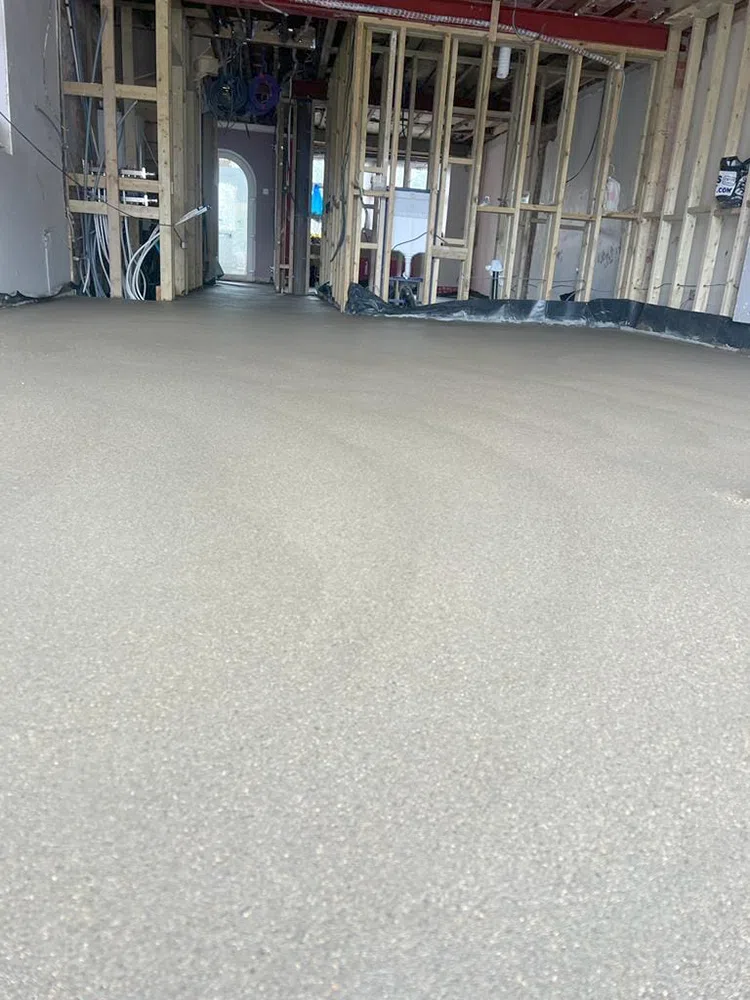
K & B Screeding’s own team, led by director Donatas Bardisevicius. Founded 2019, company 12298780.
See what customers say in our Google reviews and on our testimonials page.
Anhydrite & Flow Screed from Slough to Baldock
As the crow flies, our yard in Slough is about 37.2 miles from Baldock, which lies to the north-north-east. Postcodes here include SG7, and Letchworth (2 miles), Stotfold (2.6 miles), Hitchin (4.8 miles) and Stevenage (6.1 miles) are close by.
More on anhydrite screed, part of our screeding services.
