
Where pumped screed earns its place in Baldock
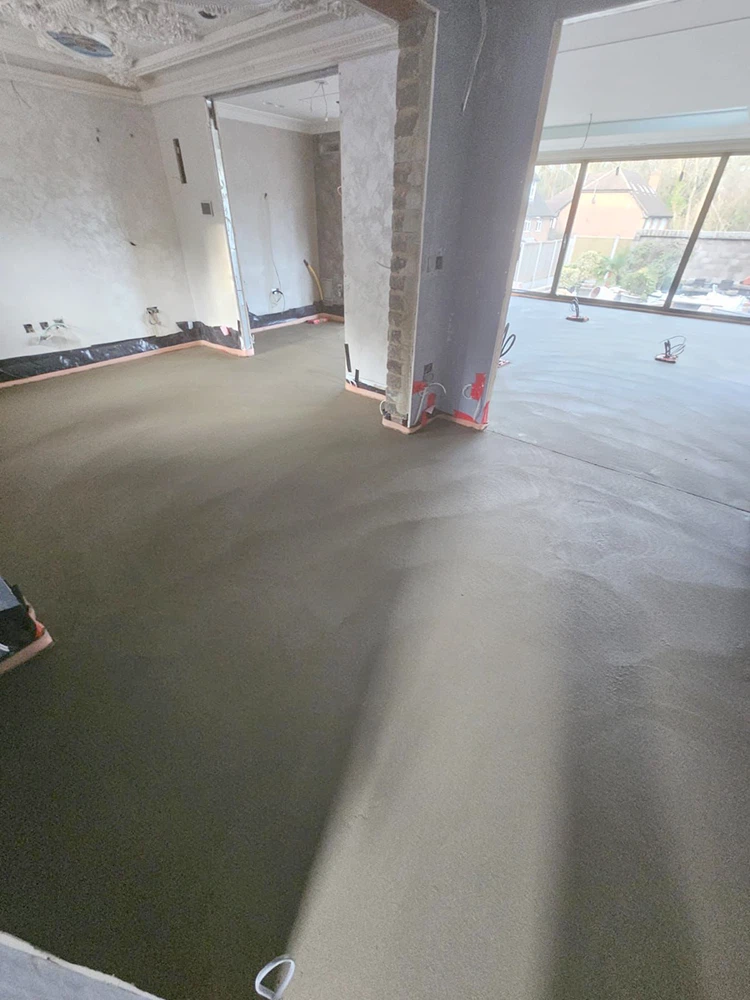
On Baldock floors, a pumped screed pays off most where the space is wide and unbroken. A single-storey extension across the back of a Clothall Common semi, opened up to the old kitchen, can be poured in a morning, with the screed finding its own level from wall to wall. On a pour like that SR1 or SR2 is a fair target, and because the material moves so little as it cures, a kitchen-diner that size can go down in large bays where a trowelled floor would be broken up by more joints.
Upstairs flats suit it too. Flats make up 18% of Baldock's homes, and carrying sand and cement up a staircase by the bucket is slow, heavy work. With a pump, the hose climbs the stairs instead of the bags.
Homes built since 2000 account for 12% of the town. Where a newer house already has insulation under the ground floor, a flowing screed can go straight over it once the membrane and edge strip are in.
Height is the other gain. In a home, a pumped screed over insulation can be as slim as about 35mm, where the hand-laid equivalent is about 65mm. Those saved millimetres are often what lets a new Baldock floor meet the existing one at the doorway without a step.
Pumped screed comes in a calcium sulphate version and a cement-based version. Which suits your floor comes down to the room and the finish going on top; the calcium sulphate material has its own page on anhydrite flow screed. Still undecided between pumping and hand laying? Weighing up pumped against trowelled screed covers the trade-offs.
From the kerb to the room in Baldock
Nothing heavy comes into the house: the plant stays out on the drive or at the kerb, and only the hose is run inside, usually through the door nearest the new floor. A hose can run a surprising distance, along a hallway or up to a first or second floor, as long as the route is clear and protected.
Parking is the thing to think about. A driveway is ideal. On a terraced street, or anywhere near the High Street, the lorry may need to stand on the road for a few hours, so mention parking bays, yellow lines or shared access when you send your details.
Ahead of pour day the room needs getting ready, which means perimeter strip fixed along each wall, membrane spread across the insulation with taped seams, and a stop-end at every doorway to keep the screed in the room. Each of those gets checked before the first mix leaves the pump.
Hard enough to walk on is a long way short of dry enough to cover. Most coverings need the screed to have dried for roughly as many days as it is millimetres thick, up to 40mm, and a deeper pour slows down further; why screed drying takes so long goes into the reasons. If the job is just over the boundary, see liquid screed in Letchworth.
Liquid Screed prices in Baldock
Liquid screed: £24 to £31 per m² supplied and laid (MyJobQuote, August 2026), so £960 to £1,240 for 40 m². MyJobQuote does not say whether these figures include VAT. See our floor screeding cost guide or screed calculator.
Who lays your liquid screed in Baldock
K & B Screeding’s own team, led by director Donatas Bardisevicius. Founded 2019, company 12298780.
See what customers say in our Google reviews and on our testimonials page.
Liquid Screed from Slough to Baldock
As the crow flies, our yard in Slough is about 37.2 miles from Baldock, which lies to the north-north-east. Postcodes here include SG7, and Letchworth (2 miles), Stotfold (2.6 miles), Hitchin (4.8 miles) and Stevenage (6.1 miles) are close by.
More on liquid screed, part of our screeding services.
