
Liquid screed for extensions off Sunderland Road, Sandy
The overspill estates built between Sunderland Road and St Neots Road in the 1970s to 1990s are lined with terraces and semis, and semi-detached houses alone make up 33% of Sandy's homes. When one of them gains a rear or side extension, the new floor has to be flush with the old kitchen or living room, with no step at the doorway.
Liquid screed suits that task. It is pumped from the mixer, flows around the room and settles to a flat, dense surface. Surface regularity to SR1 or SR2 is readily achievable, which matters if large tiles or LVT will run straight through from the old room to the new one.
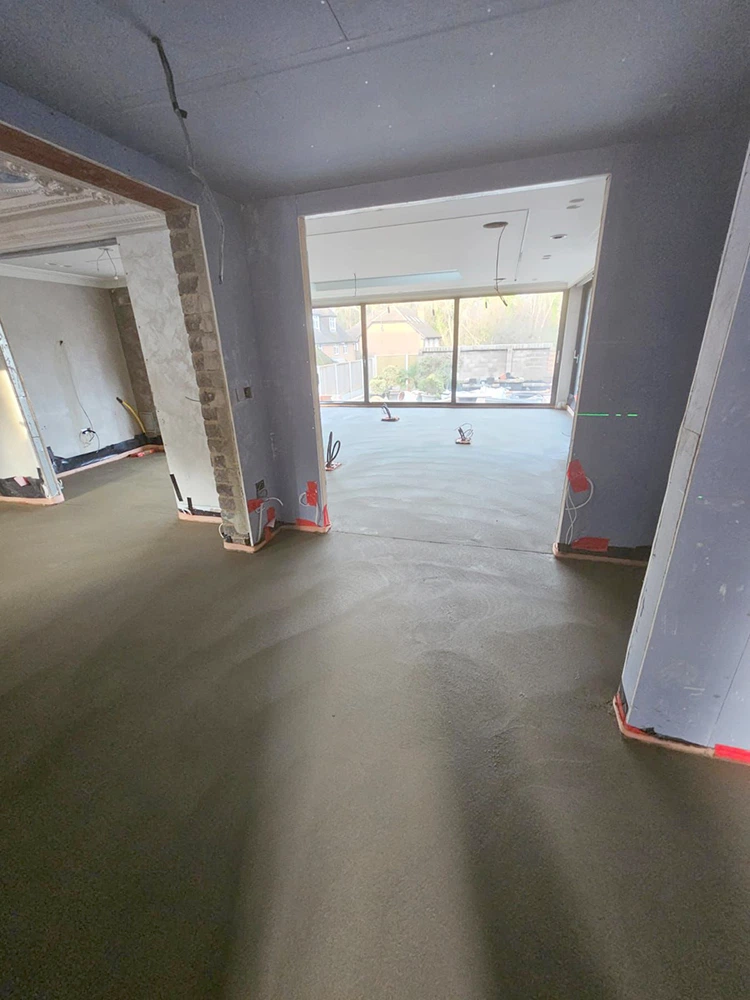
Floated over insulation in a Sandy extension, it goes down from roughly 35mm deep. It shrinks less than sand and cement and needs far fewer joints, so a long open-plan floor can be poured without breaking it into small bays.
New building is a smaller share. Only 14% of the town's homes date from 2000 onwards, so most liquid screed here goes into existing houses rather than new plots, but the same product suits a new build ground floor or apartment floor.
It comes in two bases, calcium sulphate and cement, and we choose between them by looking at the room in question and the floor finish you have picked. Torn between this and a hand-laid floor? Our guide to liquid or traditional screed weighs them up.
Pump access on Sandy's overspill estates
The pump and mixer are the part people rarely think about until the day. On a semi with a drive, the pump usually sits at the front and the hose runs round the side. With a mid-terrace that has no way round the side, the hose comes in through the front door, so we cover the floors and door frames along its path before the pump starts.
Parking is worth mentioning when you first get in touch. A narrow street, parked cars or a shared access path all change where the pump can stand. A room upstairs is no barrier either, as the hose can climb the staircase or come in at a window.
The pump only ever comes with our crew; it is never rented out by itself. For comparison, renting one on its own costs £300 to £600 a day on published figures. More on the equipment side is on our screed pumping page.
A day or two after the pour, somewhere between 24 and 48 hours, you can walk on it. Drying right through is slower, roughly a day for every millimetre of the first 40mm and longer past that, and keeping windows open cuts the wait. If you live in Biggleswade, the same service is on our Biggleswade liquid screed page.
Liquid Screed prices in Sandy
Liquid screed: £24 to £31 per m² supplied and laid (MyJobQuote, August 2026), so £960 to £1,240 for 40 m². MyJobQuote does not say whether these figures include VAT. See our floor screeding cost guide or screed calculator.
Who lays your liquid screed in Sandy
K & B Screeding’s own team, led by director Donatas Bardisevicius. Founded 2019, company 12298780.
See what customers say in our Google reviews and on our testimonials page.
Liquid Screed from Slough to Sandy
As the crow flies, our yard in Slough is about 44 miles from Sandy, which lies to the north-north-east. Postcodes here include SG19, and Biggleswade (3.1 miles), St Neots (6.9 miles), Bedford (7.7 miles) and Stotfold (8.2 miles) are close by.
More on liquid screed, part of our screeding services.
