
Replacing dated floors with heated screed in Abingdon-on-Thames
Taking out an old ground floor to fit heating is a bigger job than laying screed in an extension, and the height of the new floor has to be planned from the start.
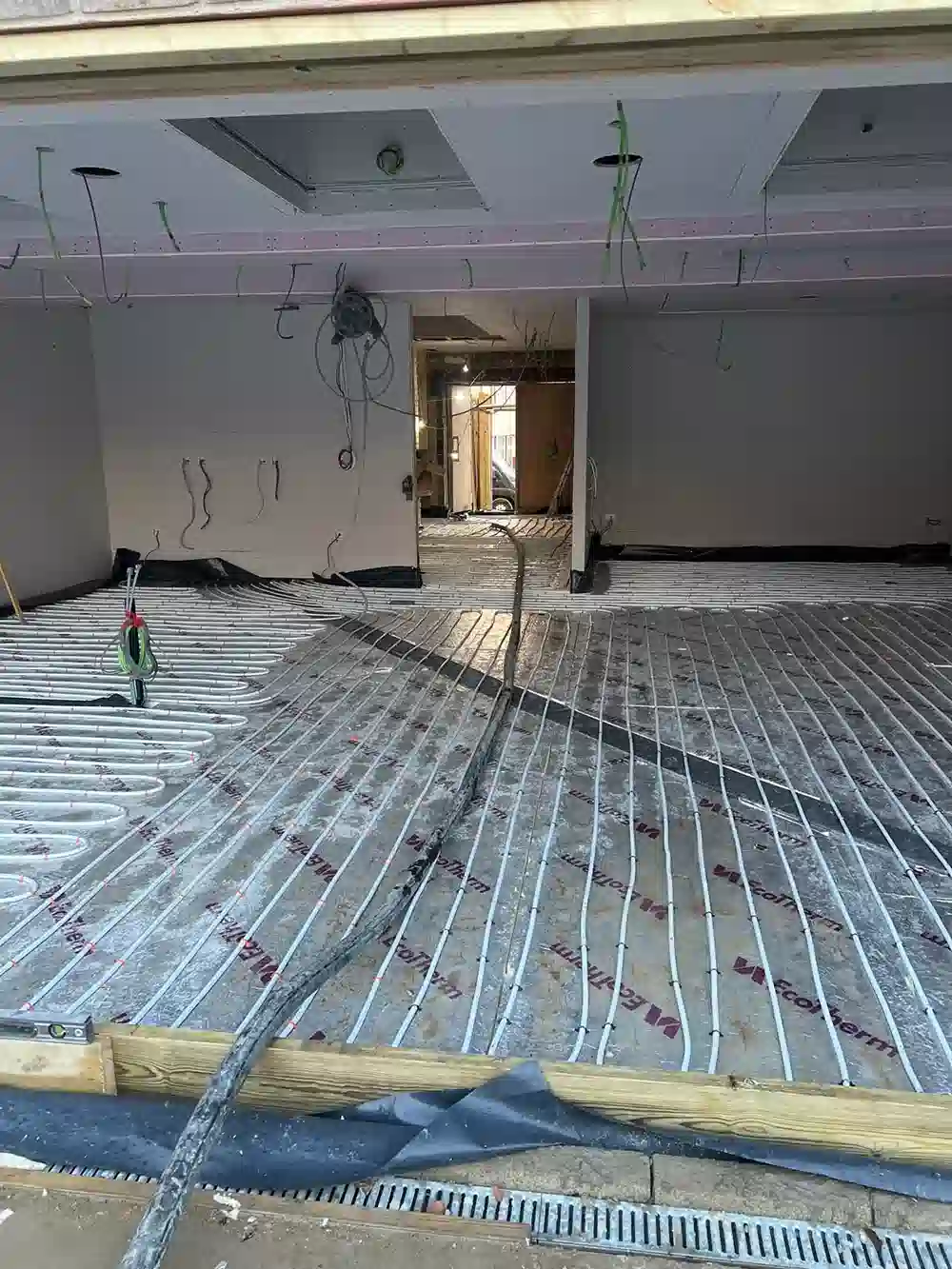
Once the old floor is removed, the new build-up goes in from the bottom: rigid insulation, a membrane with taped joints, an edge strip around every wall, then the heating pipes fitted by your engineer. We can look over that insulation and membrane, or provide them, as part of our insulation and membrane supply. The screed then goes over the pipes.
Pipe cover sets the depth. A pumped floor wants 25mm or more over the pipes, which normally comes to 45 to 50mm in all. A hand-laid cement floor wants about 45mm of cover on its own, so the whole thing ends up deeper. Where the finished floor must line up with existing doorways and stairs, the thinner liquid option is often what makes a retrofit work.
Encapsulation matters just as much. Every pipe must be fully surrounded, with no air pockets, or the floor develops cold spots. A flowing screed does this naturally; a hand-laid sand and cement heated floor has to be worked carefully around each loop.
Get this right and the floor warms up faster and runs more efficiently, because the screed sits in full contact with the pipes. The pipes themselves are not something K & B fits.
Heating up a new Peachcroft extension floor
Rear extensions are among the usual projects on post-war houses in Peachcroft and elsewhere, and a heated floor in the new kitchen or family room is a natural addition. Once the screed is laid, the heating waits.
With calcium sulphate the heating can normally come on from around day 7; with sand and cement, not before day 21. Even then, the flow temperature begins cool and is nudged up over several days, as the commissioning plan from your heating engineer and the screed supplier sets out. Turning the system straight up can crack the floor or make its edges curl.
Heating helps drying, but it does not prove the floor is ready. Take a hygrometer reading before any floor covering is laid, and make sure it is inside the limit the flooring manufacturer gives, which for calcium sulphate is often stricter than for cement. The screed drying guide explains how thickness changes the wait.
Whatever goes on top, whether tiles, LVT or engineered boards, wants a flat floor under it. If the new floor meets the old house at a slightly different level, a thin coat of compound can blend the two. See floor levelling in Abingdon-on-Thames for how that is done.
Underfloor Heating Screed prices in Abingdon-on-Thames
Liquid screed over underfloor heating: £20 to £35 per m² supplied and laid (trade2base, June 2026), so £700 to £1,230 for 35 m². trade2base gives these figures excluding VAT. See our floor screeding cost guide or screed calculator.
Who lays your underfloor heating screed in Abingdon-on-Thames
K & B Screeding’s own team, led by director Donatas Bardisevicius. Founded 2019, company 12298780.
See what customers say in our Google reviews and on our testimonials page.
Underfloor Heating Screed from Slough to Abingdon-on-Thames
Abingdon-on-Thames is about 29 miles west-north-west of our Slough base as the crow flies, with postcodes including OX14. The nearest towns to it are Didcot (4.7 miles), Oxford (5.7 miles), Wantage (8.4 miles) and Kidlington (10.5 miles).
More on underfloor heating screed, part of our screeding services.
