
Where pumped screed pays off in Abingdon-on-Thames
A pumped screed suits big, open floors. Only 12% of the town's homes have been built since 2000, so in most Abingdon-on-Thames houses liquid screed is a choice made for an extension or a replaced floor rather than something already on the drawings.
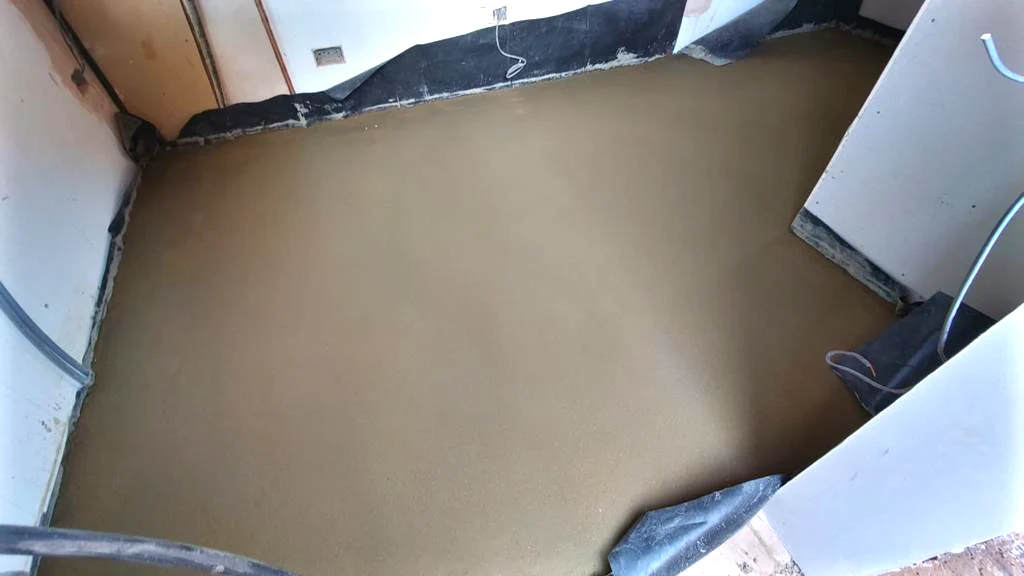
Rear extensions on post-war houses are the obvious case. Knock a kitchen and dining room into one space and the floor may run the full width of the house. Pumped in, the screed finds its own level across that width and finishes to SR1 or SR2, a gap of 3mm or 5mm at most beneath a 2m straightedge. Because it hardly shrinks, it needs far fewer joints than a hand-laid cement floor.
It is thinner too. Floating in a house it can go down at about 35mm, where sand and cement would want about 65mm, and that saving often lets a Peachcroft extension meet the old floor with no step. Laid over heating pipes it must cover them by 25mm or more, so expect 45 to 50mm overall. If you are also fitting a wet heating system, read screed over underfloor heating in Abingdon-on-Thames before settling the depth.
There are two binders to choose from, calcium sulphate and cement. Both go through the pump and settle level in the same way, and we pick between them by looking at the room, your programme and the finish going on top. If the drawings call up a CA grade, what anhydrite grades mean is explained on its own page.
Pump access to Abingdon-on-Thames houses and flats
Lorry, mixer and pump all stay outside, and the screed reaches the room along a hose. A hose can run along a hallway, through a finished room with protection down, or up a stairwell to an upper floor. That makes a pumped screed a practical choice in flats, where each bag of sand and cement would otherwise go up by hand.
For a block, the managing agent usually needs to know in advance, and communal floors and lifts should be protected. For a house, the question is where the lorry can stand. 24% of homes here are detached, and a drive gives the lorry an easy spot; elsewhere, tell us about permit parking, narrow lanes or a long path to the back garden when you ask for a price. The rig itself is described on our screed pumping page.
Preparation must be complete on the day: edge strip round every wall, a membrane over the insulation with taped joints, and dams at doorways so the screed stays in its room. We check this before pumping starts.
After the pour, keep windows and doors shut for the first 24 to 48 hours or so, which stops the top drying out too fast, and then open up. You can walk across it early on, yet LVT, tiles or wood have to wait until it is dry enough for that particular finish. How depth and airflow stretch or shorten that wait is covered in how long screed takes to dry.
Liquid Screed prices in Abingdon-on-Thames
Liquid screed: £24 to £31 per m² supplied and laid (MyJobQuote, August 2026), so £960 to £1,240 for 40 m². MyJobQuote does not say whether these figures include VAT. See our floor screeding cost guide or screed calculator.
Who lays your liquid screed in Abingdon-on-Thames
K & B Screeding’s own team, led by director Donatas Bardisevicius. Founded 2019, company 12298780.
See what customers say in our Google reviews and on our testimonials page.
Liquid Screed from Slough to Abingdon-on-Thames
Abingdon-on-Thames is about 29 miles west-north-west of our Slough base as the crow flies, with postcodes including OX14. The nearest towns to it are Didcot (4.7 miles), Oxford (5.7 miles), Wantage (8.4 miles) and Kidlington (10.5 miles).
More on liquid screed, part of our screeding services.