
Pipe cover and depth for Romsey heated floors
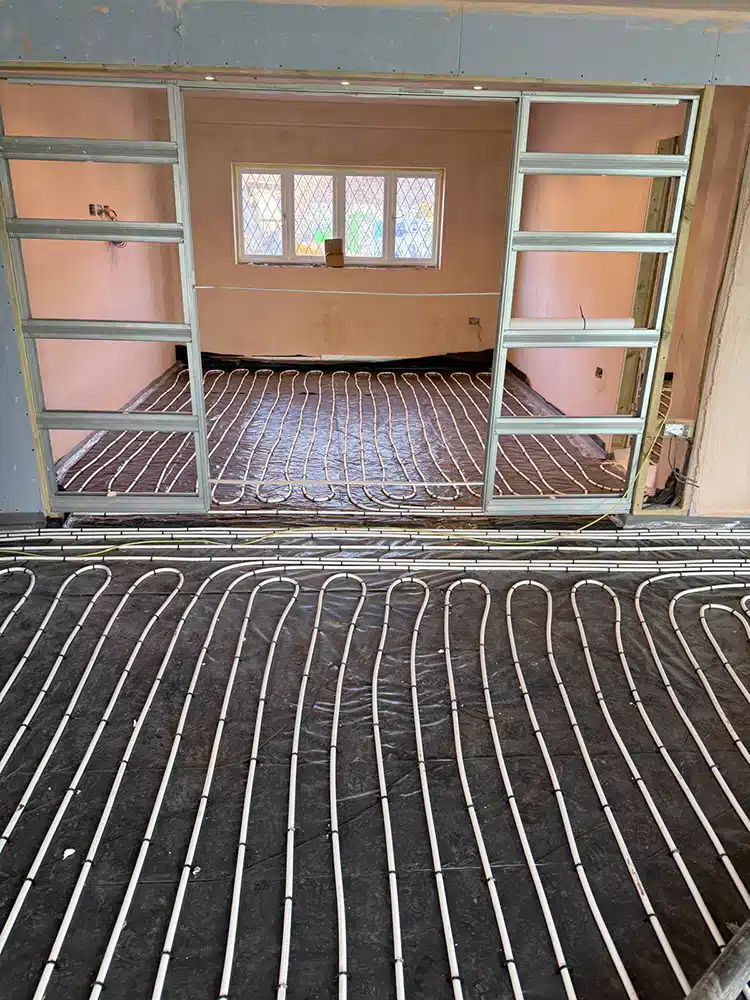
Heat spreads up through the screed, so how deep it sits over the pipes governs both how well the system performs and how strong the floor is. With liquid, 25mm is the least cover we leave over the pipes, which tends to make the floor 45 to 50mm in all. Hand-laid sand and cement wants roughly 45mm of cover, which builds a deeper floor overall. Those extra millimetres count in a post-war Romsey semi, because the new rear extension and the existing rooms must finish level with each other.
Because liquid screed runs right round the pipes and leaves no air pockets, warmth gets to the surface quickly and evenly. With sand and cement, the screed has to be packed carefully around each pipe by hand. Our comparison of liquid screed and sand and cement covers the choice in more depth.
Adding heating to an older house takes more working out. Around the abbey and Market Place, older buildings may have floors with no damp proof membrane, and floor height is often tight at thresholds and stairs. Taking the floor out allows room for a membrane, insulation, pipes and screed, but each layer has to be measured against the doors. A thinner liquid build-up is usually the only way to fit it all in.
Before the pour we go over the insulation, the membrane and the edge strip, and the pipes must already have passed the installer's pressure test.
Turning the heating on in a Romsey home
Around 15% of homes in Romsey went up from 2015 onwards, and a house that recent is more likely to have had heating in the floor from day one. Whether the house is new or extended, the rules for bringing the heating up are the same.
An anhydrite floor is normally ready for its first warm-up a week in, at roughly day 7. For sand and cement, give it 21 days or more first. Whichever screed it is, begin with a low setting and nudge it upwards bit by bit, following the commissioning schedule from the maker of the heating system. Turning the thermostat straight up to maximum risks cracks.
The heating also helps the floor dry, which matters when a flooring fitter is waiting. We pass on heat-up guidance, so your plumber, your builder and you all follow one plan.
Where your spec calls for a calcium sulphate grade, the testing and sanding afterwards are on our Romsey anhydrite screed page. For a heated extension where speed and flatness matter most, see liquid screed in Romsey. The same heated floor service runs in Eastleigh.
Underfloor Heating Screed prices in Romsey
Liquid screed over underfloor heating: £20 to £35 per m² supplied and laid (trade2base, June 2026), so £700 to £1,230 for 35 m². trade2base gives these figures excluding VAT. See our floor screeding cost guide or screed calculator.
Who lays your underfloor heating screed in Romsey
K & B Screeding’s own team, led by director Donatas Bardisevicius. Founded 2019, company 12298780.
See what customers say in our Google reviews and on our testimonials page.
Underfloor Heating Screed from Slough to Romsey
Romsey is about 52.7 miles south-west of our Slough base as the crow flies, with postcodes including SO51 and SO16. The nearest towns to it are Totton (4.9 miles), Eastleigh (6.5 miles), Southampton (7.2 miles) and Winchester (9.6 miles).
More on underfloor heating screed, part of our screeding services.
