
Rebuilding old floors around Romsey Abbey
An old solid floor without a membrane lets ground moisture rise into the room, and it shows as lifting tiles, damp skirting and a cold floor. The fix is to take the floor out rather than cover it up. We break up the old surface, dig down far enough to fit the layers that replace it, and put in a damp proof membrane and insulation before screeding. That groundwork is what our membranes and insulation work covers.
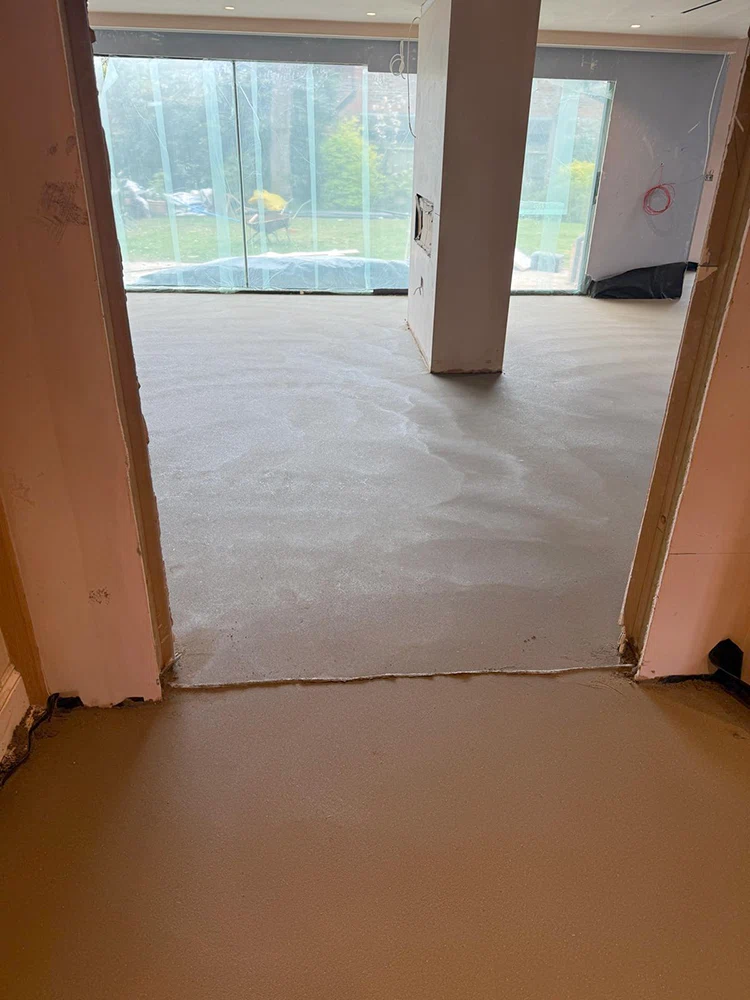
Laid floating like this, the screed goes in at about 65mm for a home and 75mm for commercial premises. It is laid in bays, compacted by hand and finished with a float, so it can follow awkward rooms, alcoves and doorways that a pumped screed would find harder to contain.
Not every floor is floating. Where the concrete below is sound and height is short, a bonded screed of 25 to 40mm goes straight onto it and saves depth. The choice between bonded and floating depends on the base and on how much height you can lose at the doors. Our screed thickness guide explains the numbers in more detail.
Time is the cost of choosing it. Liquid dries faster; with this, budget about 40 days for the first 40mm as a rough rule, and slower going past that. Leave room for that in the programme before you book the flooring fitter.
Wet rooms, garages and small rooms in Romsey
Terraced houses make up 30% of Romsey's homes, and terraces are full of the small rooms where hand-laid screed suits: a back kitchen, a utility, a downstairs cloakroom. It is laid with a shovel and a straightedge, so a job of a few square metres needs very little setting up.
In wet areas, sand and cement is simply the correct material. Showers and wet rooms need the floor to slope to the drain, and water does not weaken a cement screed the way it can a calcium sulphate one.
Garages are another case where it suits. Turning a garage into a room usually means building the floor up with insulation and fresh screed to the house level, while a garage kept for the car may need a floor that can take load early. Conversions have their own guide to garage floor screed.
The post-war terraces and semis around Cupernham and Halterworth have original screeds that can crack or lift with age. Where only part of a floor has failed, a local repair may be enough rather than a full relay; see screed repairs. For better crack resistance, fibres can go into the mix for roughly £1 to £3 extra per m².
Sand and Cement Screed prices in Romsey
Sand and cement screed: £18 to £25 per m² supplied and laid (MyJobQuote, August 2026), so £450 to £630 for 25 m². MyJobQuote does not say whether these figures include VAT. See our floor screeding cost guide or screed calculator.
Who lays your sand and cement screed in Romsey
K & B Screeding’s own team, led by director Donatas Bardisevicius. Founded 2019, company 12298780.
See what customers say in our Google reviews and on our testimonials page.
Sand and Cement Screed from Slough to Romsey
Romsey is about 52.7 miles south-west of our Slough base as the crow flies, with postcodes including SO51 and SO16. The nearest towns to it are Totton (4.9 miles), Eastleigh (6.5 miles), Southampton (7.2 miles) and Winchester (9.6 miles).
More on sand & cement screed, part of our screeding services.
