
Replacing old floors in terraces near Eastleigh town centre
Taking out a tired floor in an older terrace is a sequence. First the old timber boards and joists, or the thin early concrete, come out. The ground is prepared, then insulation and a membrane go down, and finally the screed is laid to a set level so doors, skirting and the next room all line up.
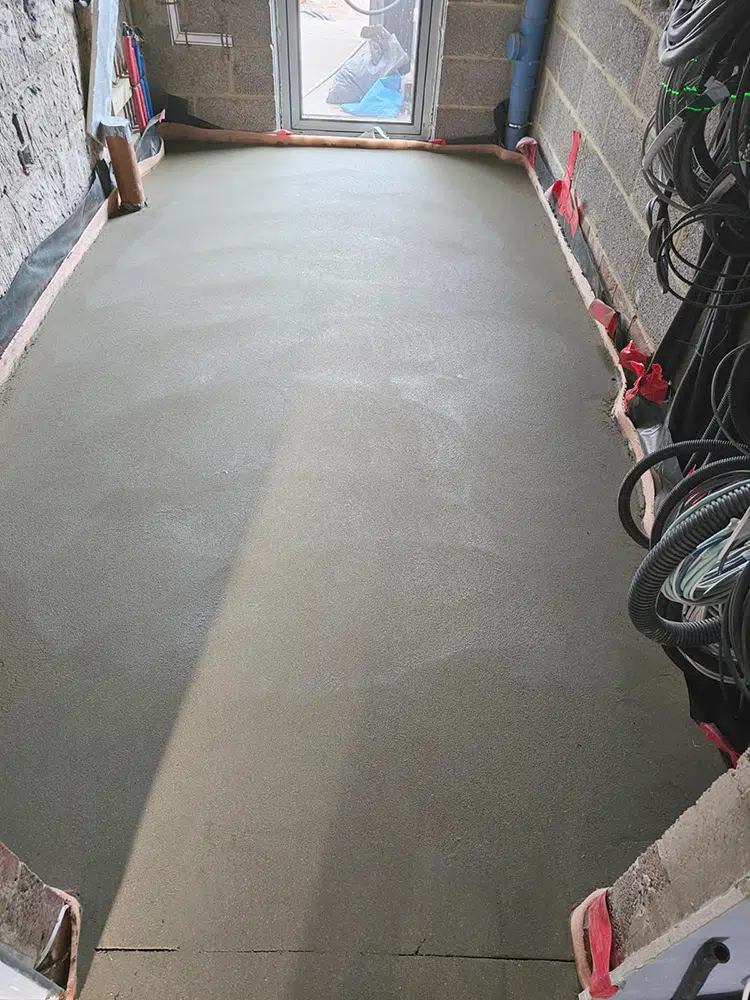
Sand and cement is the usual choice here. It is mixed on site, so each room can be laid at the depth it needs, and it does not rely on a pump, which suits houses that open straight onto the street. It is also cost effective on small and awkward areas such as a narrow hallway, a rear lobby or an under-stairs cupboard.
Depth follows the method. A floating screed over insulation in a house is 65mm, or 75mm in commercial work. Bond it straight onto an existing slab in good condition and 25 to 40mm is usually enough. Our screed thickness guide explains when each applies.
Homes built between the wars, 16% of the stock, often share the same issue with uninsulated floors. Getting the insulation and membrane right matters as much as the screed on top, and our insulation and membranes service can supply the full build-up if you need it. Where a floor needs extra resistance to cracking, fibres can be added to the mix, as described on our fibre reinforced screed page.
Eastleigh wet rooms, garages and heavy floors
Some rooms need a cement screed whatever else is in the house. A wet room or walk-in shower has to be laid to falls so water drains away, and a hand-laid screed can be shaped accurately to those falls. Calcium sulphate products cannot be used there, because prolonged moisture weakens them.
Garages and workshops are the other case. A garage being turned into a room usually has a floor lower than the house, so the new build-up of insulation and screed has to bring it up to the hallway level. A garage that stays a garage may need a floor that takes load early, and cement is the right base for that.
Drying is the main drawback. At 65mm it stays damp much longer than a thin pumped floor, needing roughly 40 days for the first 40mm alone, with the rest drying more slowly. If flooring has to go down sooner, rapid drying additives can shorten the wait.
If the room is to be heated, the pipes need about 45mm of cover and the heating stays off for at least 21 days. Our underfloor heating screed service covers that side. For a rough budget, sand and cement comes in at £18 to £25 a square metre on the published 2026 UK prices.
Sand and Cement Screed prices in Eastleigh
Sand and cement screed: £18 to £25 per m² supplied and laid (MyJobQuote, August 2026), so £450 to £630 for 25 m². MyJobQuote does not say whether these figures include VAT. See our floor screeding cost guide or screed calculator.
Who lays your sand and cement screed in Eastleigh
K & B Screeding’s own team, led by director Donatas Bardisevicius. Founded 2019, company 12298780.
See what customers say in our Google reviews and on our testimonials page.
Sand and Cement Screed from Slough to Eastleigh
As the crow flies, our yard in Slough is about 49.6 miles from Eastleigh, which lies to the south-west. Postcodes here include SO50 and SO53, and Hedge End (4.4 miles), Southampton (5 miles), Romsey (6.5 miles) and Winchester (6.6 miles) are close by.
More on sand & cement screed, part of our screeding services.
