
Why Bishopstoke and Fair Oak extensions suit liquid screed
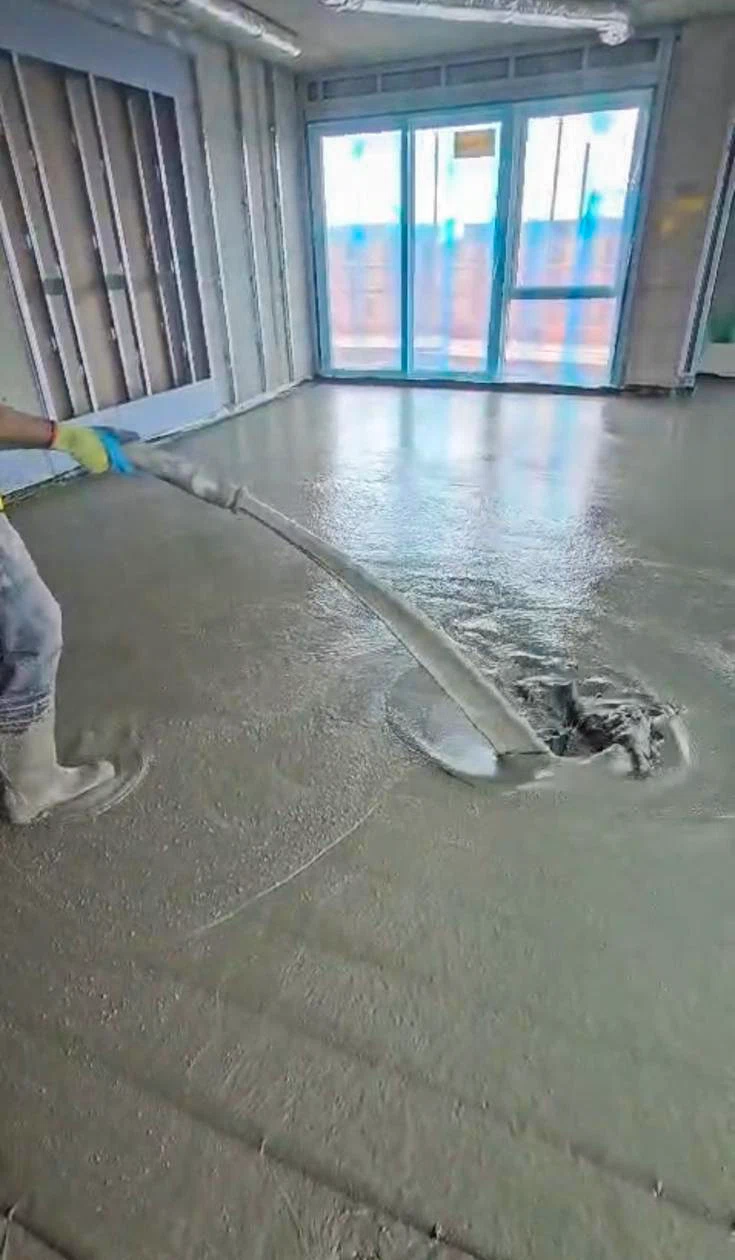
A single storey extension across the back of a semi usually creates one big room: kitchen, dining and living space in a single run. Laying that in sand and cement means a lot of hand compaction and joints. A liquid screed is pumped straight from the mixer, flows to a level surface and covers the whole area in one pour.
The finish is the other gain. Surface regularity to SR1 or SR2 is readily achievable, so the floor is ready for LVT, engineered wood or large tiles with little or no extra levelling. Low shrinkage helps too: a pumped floor gets by with far less jointing than a hand-laid cement one.
Depth stays modest: about 35mm floated over insulation in a house, and about 40mm in a commercial unit. Over underfloor heating the pipes need at least 25mm of cover, which means a total of 45 to 50mm. That thinner build-up helps where the new floor has to meet the existing house at exactly the right height.
The binder in a liquid screed is either calcium sulphate, usual for dry rooms and heated floors, or cement, kept for floors that might get wet. The material and its specification are covered on our anhydrite flow screed page for Eastleigh, and the trade-offs between the two main methods are in our liquid versus sand and cement guide.
New homes are part of the picture too: 16% of Eastleigh's homes were built from 2015 onwards.
Pump access in Eastleigh streets and flats
Every liquid pour depends on getting the hose from the pump to the room. The mixer and pump need to stand close to the property, and the hose then runs through a side gate, a hallway or a window. On the terraced streets of the town centre grid, where houses open straight onto the pavement, the hose usually passes through the front door and we protect the hall floor and frames.
Flats need more planning. Purpose-built blocks hold 17% of Eastleigh's homes, and pouring an upper floor means running the hose up a stairwell or through a window, with the building manager's agreement. The floor must be fully sealed at its edges so no screed escapes to the flat below.
People can usually cross it on foot after 24 to 48 hours, though the screed is still wet inside. It dries at around a millimetre a day for the first 40mm, and nothing goes on top until a moisture test passes. On the UK price guides published for 2026, liquid screed costs £24 to £31 a square metre.
Our screed pumping service explains the equipment. If your project is just east of the town, see liquid screed in Hedge End.
Liquid Screed prices in Eastleigh
Liquid screed: £24 to £31 per m² supplied and laid (MyJobQuote, August 2026), so £960 to £1,240 for 40 m². MyJobQuote does not say whether these figures include VAT. See our floor screeding cost guide or screed calculator.
Who lays your liquid screed in Eastleigh
K & B Screeding’s own team, led by director Donatas Bardisevicius. Founded 2019, company 12298780.
See what customers say in our Google reviews and on our testimonials page.
Liquid Screed from Slough to Eastleigh
As the crow flies, our yard in Slough is about 49.6 miles from Eastleigh, which lies to the south-west. Postcodes here include SO50 and SO53, and Hedge End (4.4 miles), Southampton (5 miles), Romsey (6.5 miles) and Winchester (6.6 miles) are close by.
More on liquid screed, part of our screeding services.
