
Liquid floors for Hedge End kitchen extensions
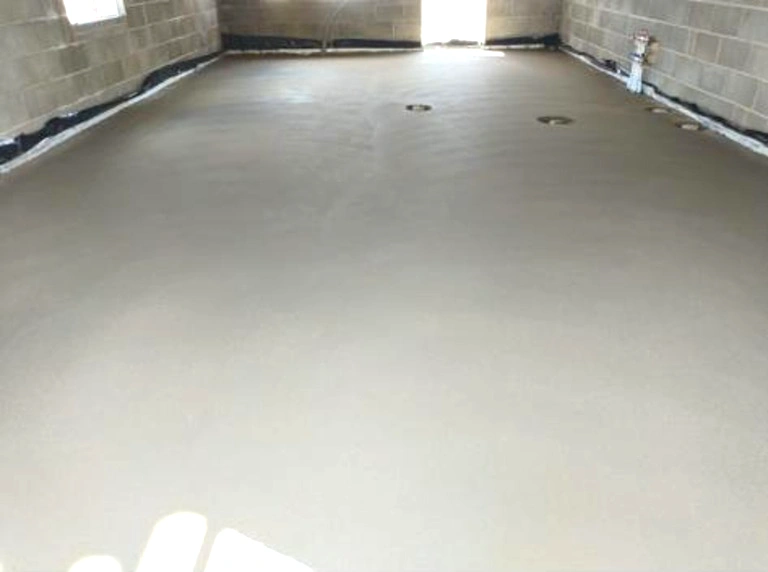
A kitchen extension on a 1980s or 1990s house usually opens into the existing kitchen or dining room, so the new floor must finish at exactly the same height. Liquid screed makes that easier in two ways. It is thinner, starting at about 35mm as a floating domestic screed rather than 65mm for sand and cement, which leaves more depth for insulation. And it finds its own level, reaching SR1 or SR2 under a 2m straightedge as a matter of course, which is what tiles, LVT and engineered wood need.
Semis make up 24% of Hedge End's homes. On a semi or a detached house the pump can often stand on the drive, with a short hose run round the side or through the house. We still walk the route first and protect floors, doors, paving and anything else the hose passes on its way in.
Coverage is quick. One visit with the pump covers the whole of a typical Hedge End kitchen extension; because the screed hardly shrinks it needs only a few joints where hand-laid screed would need many, and the next trade is usually back on it after 24 to 48 hours. Drying out takes longer: think of a day for each millimetre up to 40mm, and slower past that, before wood or LVT can go down. If you are weighing up pumped against hand-laid, our side by side guide to the two screeds covers cost and drying too.
Liquid screed in newer Hedge End homes and flats
In Hedge End, 16% of homes were built since 2000, and newer houses such as those around Dowd's Farm are more likely to need levelling or small repairs than a new screed. Where a builder is adding a new room or a developer is laying out plots, liquid screed is the usual pumped choice.
Flats are where a pump earns its keep. For a first or second floor flat, the hose is run up the stairs or in at a window, nobody carries buckets of wet screed, and a full apartment floor can be poured in a day. The hose route, lift or stair protection and the lorry's standing place are agreed with the building's managing agent before the date is fixed.
Pumped screeds are not all the same material. Calcium sulphate types are low shrinkage and suit large bays over heating, but are not for areas that may get wet, and cement based flowing screeds fill that gap. The anhydrite flow screed page for Hedge End covers grades, sanding and moisture limits, and the underfloor heating screed page covers heated floors. The neighbouring town has its own page for liquid screed in Eastleigh.
Liquid Screed prices in Hedge End
Liquid screed: £24 to £31 per m² supplied and laid (MyJobQuote, August 2026), so £960 to £1,240 for 40 m². MyJobQuote does not say whether these figures include VAT. See our floor screeding cost guide or screed calculator.
Who lays your liquid screed in Hedge End
K & B Screeding’s own team, led by director Donatas Bardisevicius. Founded 2019, company 12298780.
See what customers say in our Google reviews and on our testimonials page.
Liquid Screed from Slough to Hedge End
On the map, Hedge End sits south-south-west of Slough, about 51.4 miles from our base in a straight line (postcodes including SO30 and SO31), next to Eastleigh (4.4 miles), Southampton (4.4 miles), Fareham (7 miles) and Totton (8.1 miles).
More on liquid screed, part of our screeding services.
