
From timber joists to screed in Freemantle and Shirley
A suspended timber floor sits on joists above a void. Over time the timber can rot, the floor becomes springy, and when a kitchen is extended at the back the old floor rarely lines up with the new one. Replacing it with a solid floor puts the whole ground floor on one base.
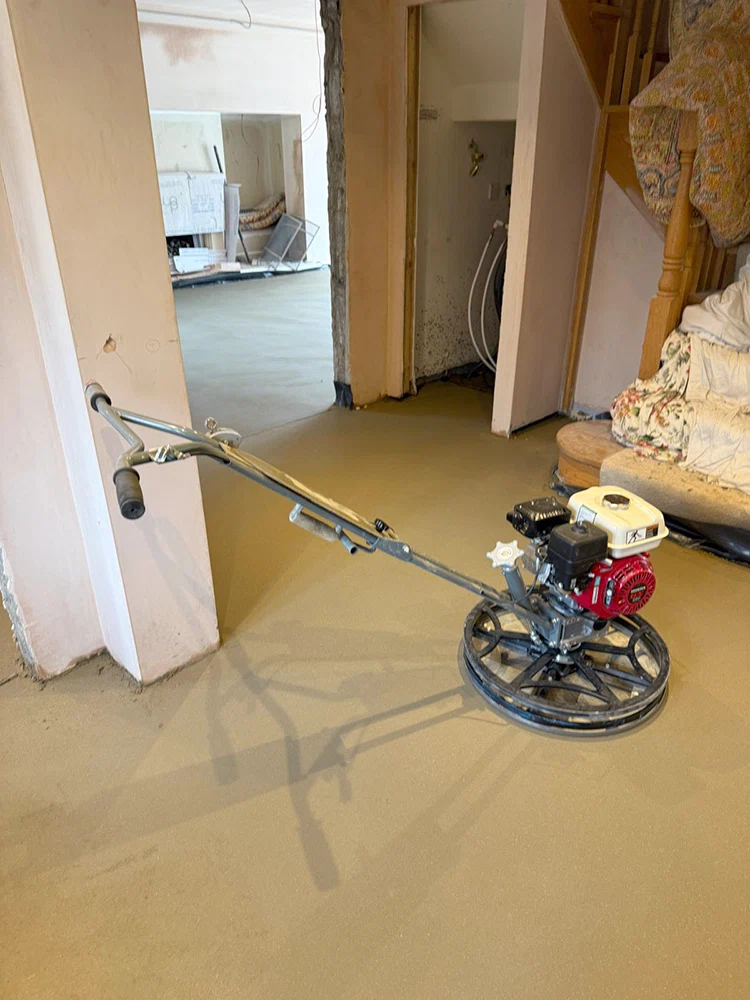
The sequence matters. Once the joists are out and the new base is in, a damp proof membrane and insulation go down, and the screed is laid on top as a floating floor at about 65mm in a house. Commercial floors are laid at about 75mm. We compact it by hand in bays and finish it with a float, which lets us work around chimney breasts, alcoves and narrow hallways.
With sound concrete below and little height to play with, a 25 to 40mm bonded screed can be stuck straight onto the slab instead. How each of those depths is worked out is in our guide to screed depths.
Homes from between the wars are a large share too, with 18% built between 1919 and 1944. Solid floors of that age can crack or lose their damp protection with age, and taking them up and relaying in sand and cement follows the same order of work.
The trade-off is time. Liquid screed dries faster; this needs about a day per mm through the first 40mm, then longer, so leave room for that before the flooring date.
Quick turnarounds in Portswood and Highfield lets
In the student neighbourhoods of Portswood and Highfield, floor work in lets is squeezed into the weeks between tenancies. A standard sand and cement screed may not be dry in time, and that is where a fast drying sand and cement screed helps. It is laid in the same way but reaches the point where floor coverings can go down much sooner. On published 2026 figures, fast drying screed costs £20 to £28 a square metre.
Where a let includes a shower room, sand and cement is the right material for that floor. A shower floor laid to falls towards the drain needs a cement screed, because calcium sulphate can be weakened by water.
Small rooms are the other strength. A hand-laid screed does not need a pump or a long hose run, so a single kitchen or bathroom is straightforward to price and lay. For extra crack resistance in floors that take heavy use, a fibre reinforced screed adds about £1 to £3 per m². The same hand-laid service is available in Eastleigh.
Sand and Cement Screed prices in Southampton
Sand and cement screed: £18 to £25 per m² supplied and laid (MyJobQuote, August 2026), so £450 to £630 for 25 m². MyJobQuote does not say whether these figures include VAT. See our floor screeding cost guide or screed calculator.
Who lays your sand and cement screed in Southampton
K & B Screeding’s own team, led by director Donatas Bardisevicius. Founded 2019, company 12298780.
See what customers say in our Google reviews and on our testimonials page.
Sand and Cement Screed from Slough to Southampton
Southampton is about 54.4 miles south-west of our Slough base as the crow flies, with postcodes including SO14, SO16, SO15 and SO17. The nearest towns to it are Totton (3.8 miles), Hedge End (4.4 miles), Eastleigh (5 miles) and Romsey (7.2 miles).
More on sand & cement screed, part of our screeding services.
