
Relaying solid floors in older Gosport terraces
Of Gosport's homes, 15% went up before 1919 and 18% between the wars. Floors of that age are often solid with no damp proof membrane, and they give themselves away with damp marks along the skirting, flooring that lifts and a room that never feels warm underfoot. Fixing that means breaking the old floor out, excavating to make room for the new layers, and then laying a membrane, insulation and fresh screed. The digging and groundwork come under our floor preparation work, and the layers below the screed are on our insulation and membrane page.
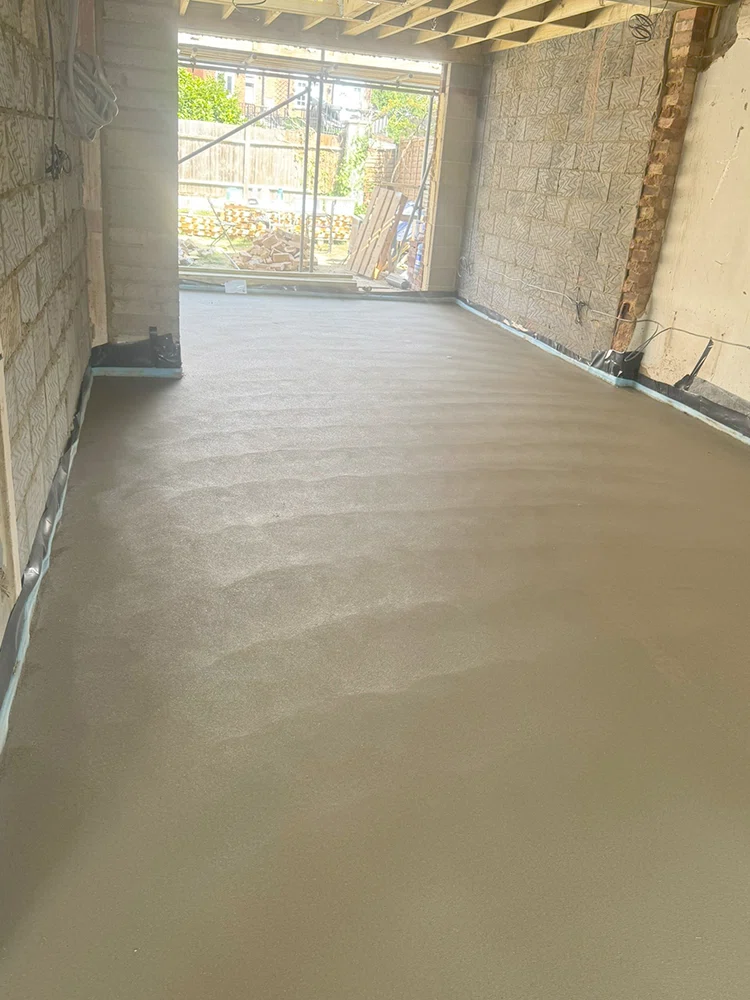
There are practical reasons sand and cement fits this work. Mixing it in small batches on site means narrow halls, back additions and oddly shaped rooms are no trouble. Each room can take a different depth, and the screed can be bonded or floating to suit the build-up. Laid floating over insulation boards in a Gosport terrace, it needs to be 65mm deep; commercial premises need 75mm. If the old concrete turns out to be solid and we can bond to it, a bonded layer of 25 to 40mm works.
Once compacted, it is power floated until the surface is dense and flat enough for tiles or timber. If you need early strength or quicker drying, we can add fibres, or an additive that speeds up drying; on published figures fibres add £1 to £3 per m². When that is worth paying for is set out under screed with added fibres. Plain mix, with no fibres or additives, is listed at £18 to £25 a m² in the 2026 published prices.
Wet rooms, garages and falls in Gosport homes
Some rooms in a Gosport house need cement screed whatever goes in the others. A wet room or walk-in shower has to fall towards the drain and may stay damp, and that rules calcium sulphate out. Laid by hand, sand and cement can be shaped to accurate falls and copes with water once it has cured. Utility rooms and ground floor bathrooms in terraced houses fall into the same group.
Then there are garages. Turning one into a room means lifting the floor, insulating it and bringing it up to the house level, and our guide to garage floor screed shows the layers. Sand and cement also takes load sooner, useful if a workshop or store has to be back in service fast.
The catch is the wait. At roughly 1 day per mm up to 40mm and slower beyond, a 65mm floating screed needs many weeks before a moisture sensitive finish can be laid. Build that into the programme, or ask about a quick drying mix. If time matters more than a hand-laid finish, set it against Gosport liquid screed, pumped in.
Sand and Cement Screed prices in Gosport
Sand and cement screed: £18 to £25 per m² supplied and laid (MyJobQuote, August 2026), so £450 to £630 for 25 m². MyJobQuote does not say whether these figures include VAT. See our floor screeding cost guide or screed calculator.
Who lays your sand and cement screed in Gosport
K & B Screeding’s own team, led by director Donatas Bardisevicius. Founded 2019, company 12298780.
See what customers say in our Google reviews and on our testimonials page.
Sand and Cement Screed from Slough to Gosport
As the crow flies, our yard in Slough is about 55 miles from Gosport, which lies to the south-south-west. Postcodes here include PO12 and PO13, and Portsmouth (1.4 miles), Fareham (4.6 miles), Havant (7.4 miles) and Emsworth (8.9 miles) are close by.
More on sand & cement screed, part of our screeding services.