
Relaying old floors in the Emsworth Conservation Area
The trouble with many older floors is what is missing underneath. Houses built before damp proof membranes were used can have worn, uneven or damp solid floors. Laying new flooring straight over them rarely lasts. The better approach is to lift the old floor, prepare the ground, and build a new floor up in layers: a membrane, insulation where there is depth for it, and a screed on top.
Hand-laid sand and cement suits these houses. It is mixed on site, so each room can be laid to the depth and level it needs, and no pump is required in narrow streets. It copes well with small rooms, uneven walls, steps between rooms and awkward doorways.
Depth depends on the build-up. Floated on insulation in an Emsworth house, the screed is usually 65mm deep. Where a new screed is bonded to a sound existing base, 25 to 40mm is possible, which helps when raising the floor would upset doors or old skirting. Our screed thickness guide explains both.
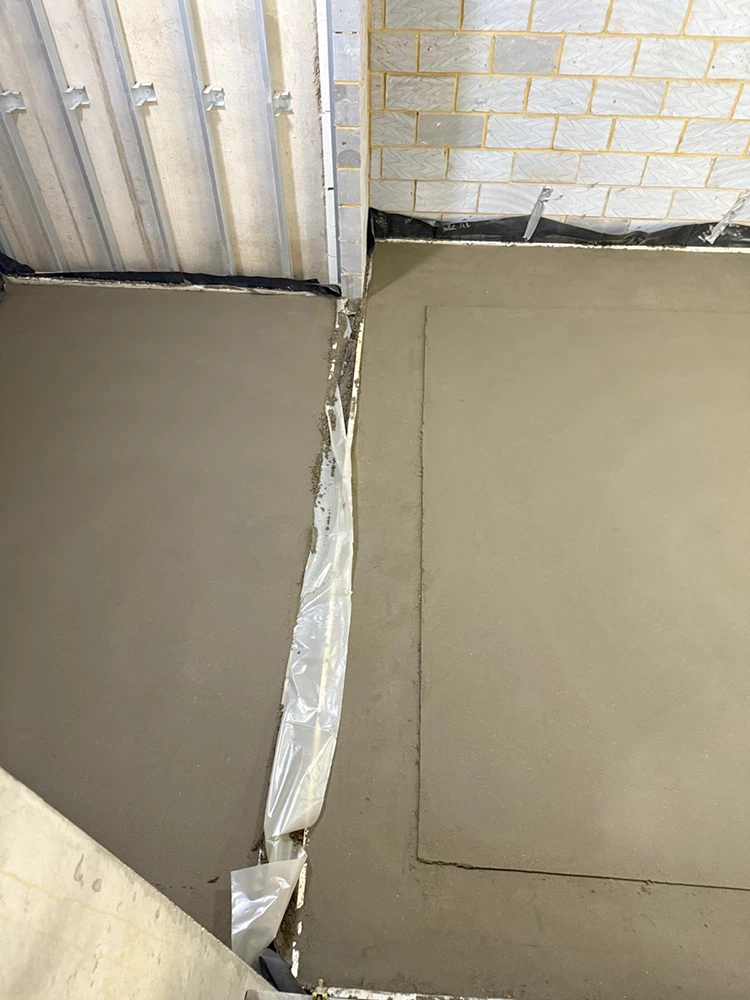
In these houses the membrane is the critical part, and it has to link properly to the walls. Our insulation and membranes service supplies and lays that layer if needed. Where the old floor needs breaking out and the base cleaning up first, see floor preparation.
Because the work is inside, it does not normally need the planning controls that apply to external changes in the conservation area.
Wet rooms, falls and drying in Emsworth houses
Bathrooms and wet rooms need a cement screed. A walk-in shower floor has to fall towards the drain, and a hand-laid screed can be shaped to that fall accurately. Calcium sulphate screeds are not suitable in rooms that may stay wet, so even a house with liquid screed elsewhere usually has sand and cement in the shower room.
Terraced houses make up 22% of Emsworth's homes, and in a narrow terrace the kitchen, utility and bathroom are often at the back, sometimes at a different level from the front room. A sand and cement screed can be laid room by room to bring those floors together, or kept at separate levels with a neat threshold.
Drying needs patience. At 65mm, allow about a day per millimetre for the first 40mm, and longer after that, before a moisture test. Fibres or rapid drying additives can be added if the floor needs them.
Published 2026 UK figures put sand and cement screed at £18 to £25 per m². If the floor is sound but uneven, a thin compound may be enough, as explained on our Emsworth floor levelling page.
Sand and Cement Screed prices in Emsworth
Sand and cement screed: £18 to £25 per m² supplied and laid (MyJobQuote, August 2026), so £450 to £630 for 25 m². MyJobQuote does not say whether these figures include VAT. See our floor screeding cost guide or screed calculator.
Who lays your sand and cement screed in Emsworth
K & B Screeding’s own team, led by director Donatas Bardisevicius. Founded 2019, company 12298780.
See what customers say in our Google reviews and on our testimonials page.
Sand and Cement Screed from Slough to Emsworth
Emsworth is about 48.9 miles south-south-west of our Slough base as the crow flies, with postcodes including PO10. The nearest towns to it are Havant (2.2 miles), Horndean (5.2 miles), Chichester (7 miles) and Portsmouth (7.6 miles).
More on sand & cement screed, part of our screeding services.
