
Replacing timber ground floors in Fratton and North End
The Victorian terraces across Fratton, North End and Southsea were mostly built with suspended timber ground floors. After a century or more, joists rot, floors bounce and draughts come up through the boards. Many owners replace them outright with an insulated slab and a screed.
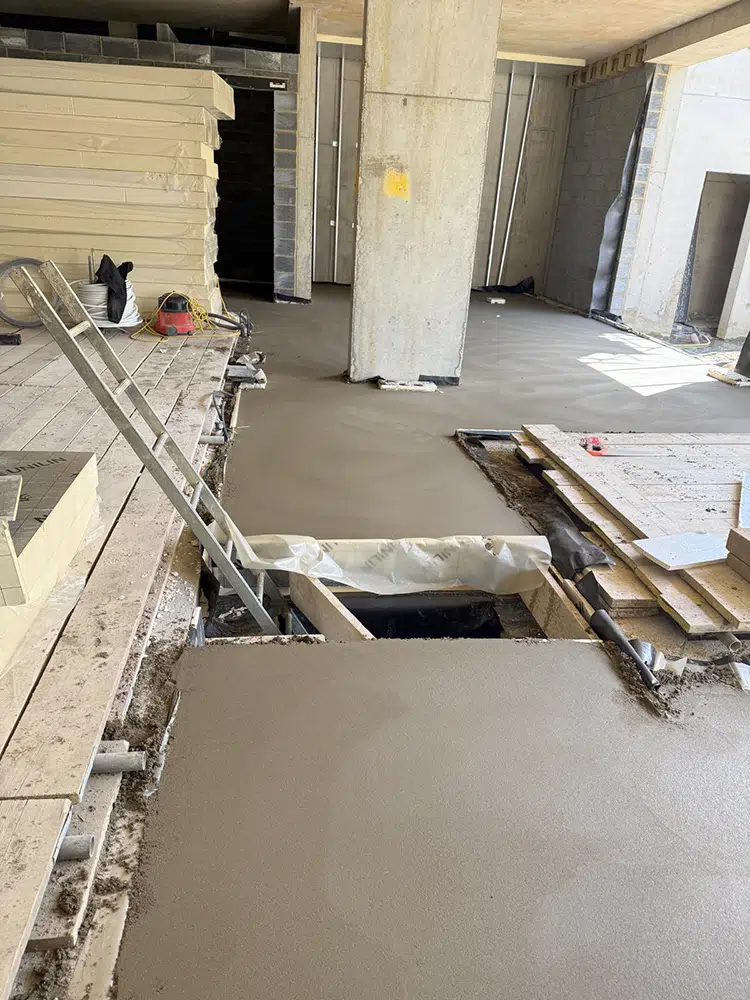
The process is straightforward but heavy. The boards and joists come out, the ground is prepared, and a concrete slab is laid with insulation and a damp proof membrane. The screed goes on top as the finished, level surface, at about 65mm for a floating screed in a house. Those lower layers can come from us too, under insulation and membranes, so one crew answers for the floor from the ground up.
Sand and cement suits this work because every room can be mixed to its own depth, and the rooms in a terrace are often small and uneven in size. There is no need to book a pump for a front room and a hallway.
Southsea's conservation areas, around the streets Thomas Ellis Owen built, may bring extra rules on what changes are acceptable. Check before you start.
Homes built between 1919 and 1944 make up 18% of Portsmouth's housing. In houses of that age, a cracked solid floor over a slab that is still sound can often take a bonded screed just 25 to 40mm thick, stuck straight to the prepared slab, which keeps the doors from needing trimming.
Portsmouth wet rooms, garages and heavy use floors
Some floors need a cement base. A wet room is the plainest case. We shape the sand and cement so water runs to the gully, and wet conditions that would soften calcium sulphate leave it unharmed. Utility rooms and ground floor shower rooms in older terraces fall into the same group.
Garages are another. Whether it stays a garage or becomes a room, a sand and cement screed takes early load and can be built up to match the house level. If you are turning a Portsmouth garage into a room, how to floor a converted garage walks through the options.
When a tired solid floor is dug out and replaced, a traditional screed is usually the simplest finish, and it can take early load from trades working in the house soon after. Hand mixing also suits a single small room, where booking a pump would cost more than it saves.
The catch is patience. The first 40mm lose moisture at about a day per millimetre and the remainder slower still, so a 65mm Southsea floor is weeks from ready. Mixing in fibres for a fibre reinforced screed costs £1 to £3 per m² more and helps hold cracks back, and quick drying mixes shorten the wait before flooring.
Sand and Cement Screed prices in Portsmouth
Sand and cement screed: £18 to £25 per m² supplied and laid (MyJobQuote, August 2026), so £450 to £630 for 25 m². MyJobQuote does not say whether these figures include VAT. See our floor screeding cost guide or screed calculator.
Who lays your sand and cement screed in Portsmouth
K & B Screeding’s own team, led by director Donatas Bardisevicius. Founded 2019, company 12298780.
See what customers say in our Google reviews and on our testimonials page.
Sand and Cement Screed from Slough to Portsmouth
Portsmouth is about 54.4 miles south-south-west of our Slough base as the crow flies, with postcodes including PO1, PO3, PO2 and PO6. The nearest towns to it are Gosport (1.4 miles), Fareham (5.3 miles), Havant (6.2 miles) and Emsworth (7.6 miles).
More on sand & cement screed, part of our screeding services.
