
Floors that have dropped in Southsea and Fratton
Portsmouth's Victorian terraces are old enough that floors have moved. Slabs have settled, patches have been added and old coverings have left adhesive and ridges behind. Modern thin finishes show every dip.
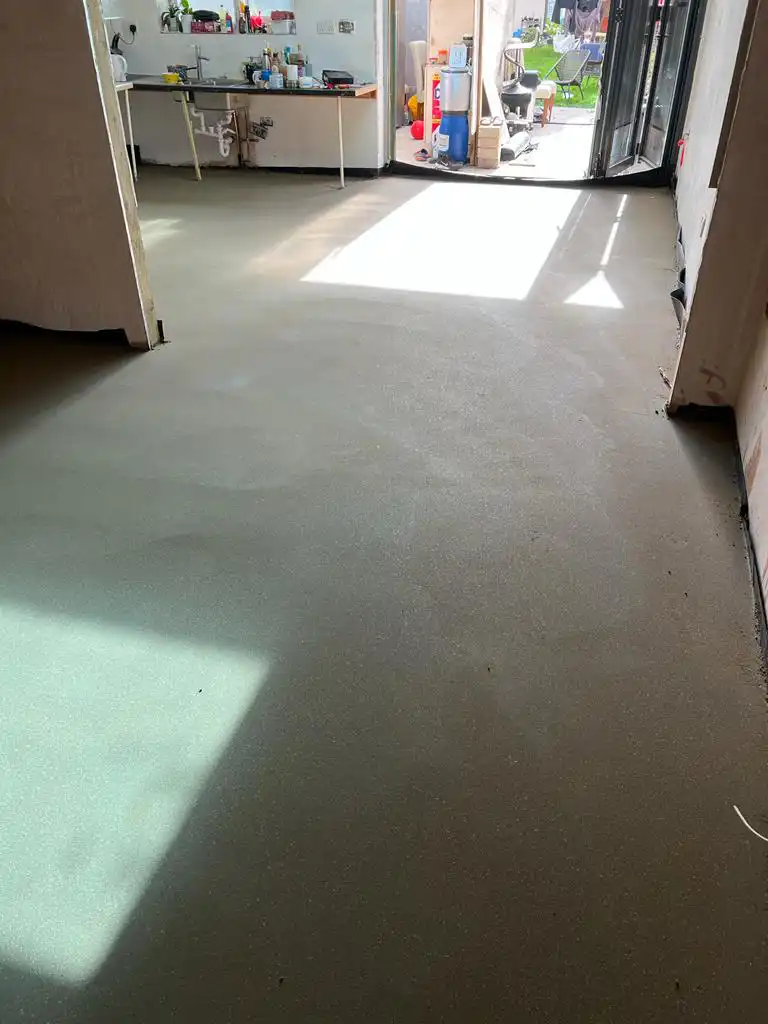
Levelling compound is the fix when the base is sound. As a rule it goes on somewhere between about 2mm and around 10mm thick, though certain products allow more. Before it goes down we clean the floor, mend what needs mending and prime it to suit the base, be that sand and cement, concrete or calcium sulphate. Finally the mix goes down, gets pushed out across the room and settles itself flat.
How flat is flat enough depends on what goes on top. Many thin sheet products want SR1, meaning a 2m straightedge shows no more than 3mm of gap; SR2 relaxes that to 5mm and SR3 to 10mm, all measured to BS 8204.
Converted flats, 7% of Portsmouth's homes, often combine old floors with new partitions and bathrooms, so levels can vary between rooms. We measure before we price, using a straightedge across each room, and we tell you which areas can be levelled and which need more work.
Where a floor has dropped too far, compound is the wrong tool. Piling compound into a hollow that really needs rescreeding tends to end with cracks and patches lifting. In a Fratton or North End house in that state, we will recommend a fresh hand-laid sand and cement floor instead. For the thinnest corrections, latex screed compounds work at a few millimetres.
Shop and unit refits from Gunwharf Quays to Farlington
Commercial floors in Portsmouth range from waterfront retail to post-war industrial units. Gunwharf Quays, redeveloped from the former HMS Vernon site, is the city's main waterfront retail scheme, and shop refits there and elsewhere in the city need flat floors for new vinyl, LVT and tiles.
The industrial estates date from the council's post-war building. The council built one at Fratton in 1948, with more at Paulsgrove and Farlington in the 1950s and 1960s. Units of that age often have worn or uneven floors, and a new occupier usually wants a clean, level surface for offices, showrooms and staff areas.
Businesses need the work done with little downtime. Fast drying compounds keep the programme moving, and larger areas can be done in phases so part of the premises stays open. We agree the sequence, the drying time and the handover date with you before starting.
The groundwork under the compound counts for a lot on these older estates. Contaminated or weak concrete surfaces are ground back first with concrete floor grinding, and cracked or damaged slabs are repaired through our concrete floor repair service before levelling begins.
How we price floor levelling in Portsmouth
A fixed written price within 24 hours, once we know the area and the base. See our floor screeding cost guide.
Who levels your floor in Portsmouth
K & B Screeding’s own team, led by director Donatas Bardisevicius. Founded 2019, company 12298780.
See what customers say in our Google reviews and on our testimonials page.
Floor Levelling from Slough to Portsmouth
Portsmouth is about 54.4 miles south-south-west of our Slough base as the crow flies, with postcodes including PO1, PO3, PO2 and PO6. The nearest towns to it are Gosport (1.4 miles), Fareham (5.3 miles), Havant (6.2 miles) and Emsworth (7.6 miles).
More on floor levelling, part of our screeding services. Not sure whether you need a thin compound or a full flowing screed? See self levelling screed explained.
