
Thin levelling layers for period floors in Chichester
Every dip shows through a thin finish. LVT and sheet vinyl copy whatever is under them, and a large format tile will rock on a hump. Plenty of sheet products require SR1: a 2m straightedge with no gap under it bigger than 3mm. SR2 relaxes that to 5mm, SR3 to 10mm.
Expect a layer of roughly 2mm at the thin end and around 10mm at the thick end, and a few products are rated deeper. That range suits a floor that is sound but uneven: an old slab with a gentle fall, a screed with trowel marks, or the step where an extension meets the original house. In period and listed homes inside the walls, where the floor often cannot rise far, a thin layer may be all that fits.
Compound has its limits. If an old solid floor has cracked, lifted or lacks a damp proof membrane, compound poured over it will follow its faults. Used as a deep fill on a floor that needed screeding, compound can crack and part company with the base. In that case we say so, and the quote is for relaying in sand and cement instead.
Converted flats make up 4% of the city's homes. Floors in converted buildings often mix old slabs, patched concrete and new sections, and each part needs checking before anything is poured. Loose or hollow areas are fixed first through our screed repairs service, so the compound has a sound base to bond to.
Shop and office refits around Chichester
When a commercial unit changes hands, the new floor finish usually needs a flat base, and the old floor is rarely ready for it. Adhesive residue, old tile beds and patched screed all have to go first. Mechanical floor preparation removes them, and the right primer goes on before any compound is poured.
Priming depends on the base. Each base takes its own primer, whether it is concrete, a sand and cement screed, old tiles or calcium sulphate, and the calcium sulphate needs its laitance taken off first. Compound that lifts months later has often been laid over the wrong primer.
Redevelopment brings this work. The Southern Gateway plan covers the area from the law courts to the canal basin, and mixed-use schemes like this are where commercial and residential floors meet. Several marinas and related marine businesses, including Chichester Marina, sit in the wider area, and any business premises being refitted need the same flat base before new flooring. Fast drying compounds help keep a refit on programme, and the work is planned around opening dates.
For very thin smoothing layers over a sound floor, see latex screed.
How we price floor levelling in Chichester
A fixed written price within 24 hours, once we know the area and the base. See our floor screeding cost guide.
Who levels your floor in Chichester
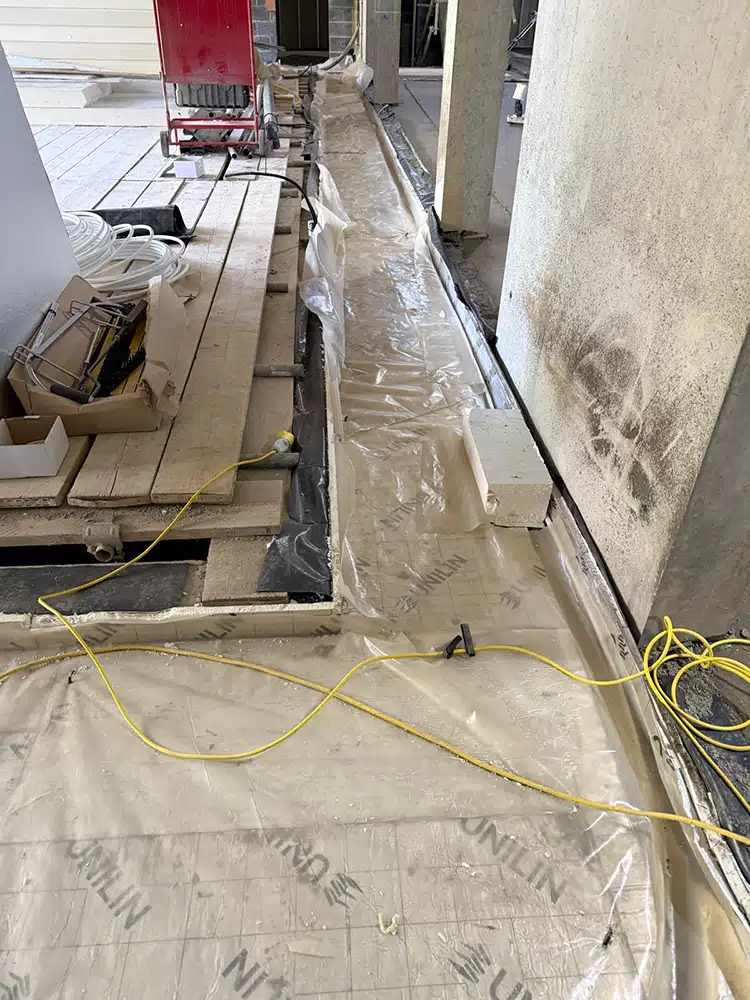
K & B Screeding’s own team, led by director Donatas Bardisevicius. Founded 2019, company 12298780.
See what customers say in our Google reviews and on our testimonials page.
Floor Levelling from Slough to Chichester
On the map, Chichester sits south of Slough, about 48.4 miles from our base in a straight line (postcodes including PO19), next to Bognor Regis (6 miles), Emsworth (7 miles), Selsey (7.2 miles) and Havant (9.2 miles).
More on floor levelling, part of our screeding services. Not sure whether you need a thin compound or a full flowing screed? See self levelling screed explained.
