
Rebuilding older solid floors inside Chichester's walls
When an old solid floor has cracked, sunk or let damp through, patching rarely lasts. In most cases it comes up, the ground is dug to depth, and the floor is rebuilt with a membrane, a new screed and insulation if the height allows it. Inside the conservation area, the finished level is the hard limit. Doors, thresholds and skirtings may all be original, and floor build-ups often have to stay thin, so the depth is worked out before any digging starts.
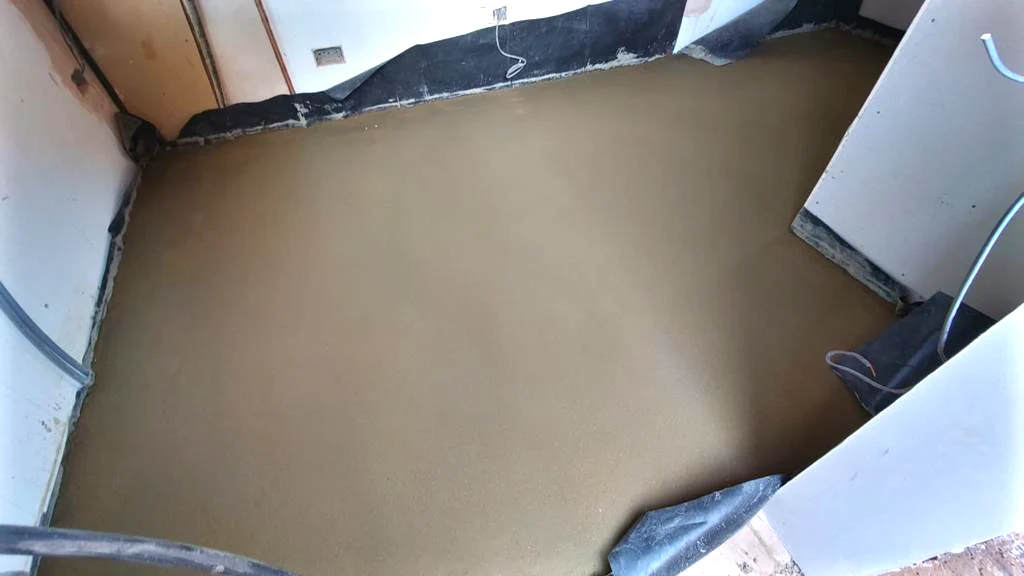
Sand and cement handles this kind of floor well. It is mixed in small batches, barrowed in and laid one room at a time, which suits narrow hallways and small rooms where a pump hose would gain nothing. Over insulation, a floating screed in a house wants about 65mm; commercial work is 75mm. When height is very tight and the slab beneath is sound concrete, a thin bonded screed, 25 to 40mm deep and stuck straight to it, may fit.
Homes built between 1919 and 1944 make up 11% of the city, and their floors raise similar questions when a kitchen is opened up or a room is taken back to the slab. If the existing slab is sound and only uneven, levelling the floor instead can avoid a dig altogether.
Whatever the depth, the base has to be clean and sound before screed goes down. That groundwork is what our floor preparation service is for.
Wet rooms, garages and drying times in Chichester
Some rooms need a cement substrate whatever the rest of the house has. Showers and wet rooms want the floor sloping to the drain, and a hand-laid cement screed can be shaped to that slope before the tiler tanks it. Calcium sulphate screed is not suitable where a floor may get wet, so a bathroom in an otherwise anhydrite house is often laid in sand and cement.
Garages are the other classic job. A conversion needs the floor raised, insulated and brought level with the house, and a cement screed takes early load and copes with the extra depth. Our garage conversion floor guide shows the layers.
The catch is the wait, roughly a day per millimetre over the first 40mm and slower beyond, so a 65mm Chichester floor sits for several weeks before moisture sensitive flooring can go on. Rapid drying additives or fibres can go into the mix where the programme or the floor calls for them. On price, 2026 figures have sand and cement from £18 up to £25 per square metre, and fibres put on an extra £1 to £3 per m². A hygrometer test, rather than counting weeks, tells us the floor can take its covering.
Sand and Cement Screed prices in Chichester
Sand and cement screed: £18 to £25 per m² supplied and laid (MyJobQuote, August 2026), so £450 to £630 for 25 m². MyJobQuote does not say whether these figures include VAT. See our floor screeding cost guide or screed calculator.
Who lays your sand and cement screed in Chichester
K & B Screeding’s own team, led by director Donatas Bardisevicius. Founded 2019, company 12298780.
See what customers say in our Google reviews and on our testimonials page.
Sand and Cement Screed from Slough to Chichester
On the map, Chichester sits south of Slough, about 48.4 miles from our base in a straight line (postcodes including PO19), next to Bognor Regis (6 miles), Emsworth (7 miles), Selsey (7.2 miles) and Havant (9.2 miles).
More on sand & cement screed, part of our screeding services.
