
Rebuilding dug-out ground floors in Portchester and Catisfield
Many houses in suburbs such as Portchester and Catisfield date from the 1950s to the 1970s, and their ground floors are often being dug out to add insulation that was never there. The old floor is broken out, dug down, and rebuilt with a membrane, rigid insulation and a new screed on top. The catch is height. The finished floor has to meet the existing door thresholds, so the depth of dig sets how much insulation fits.
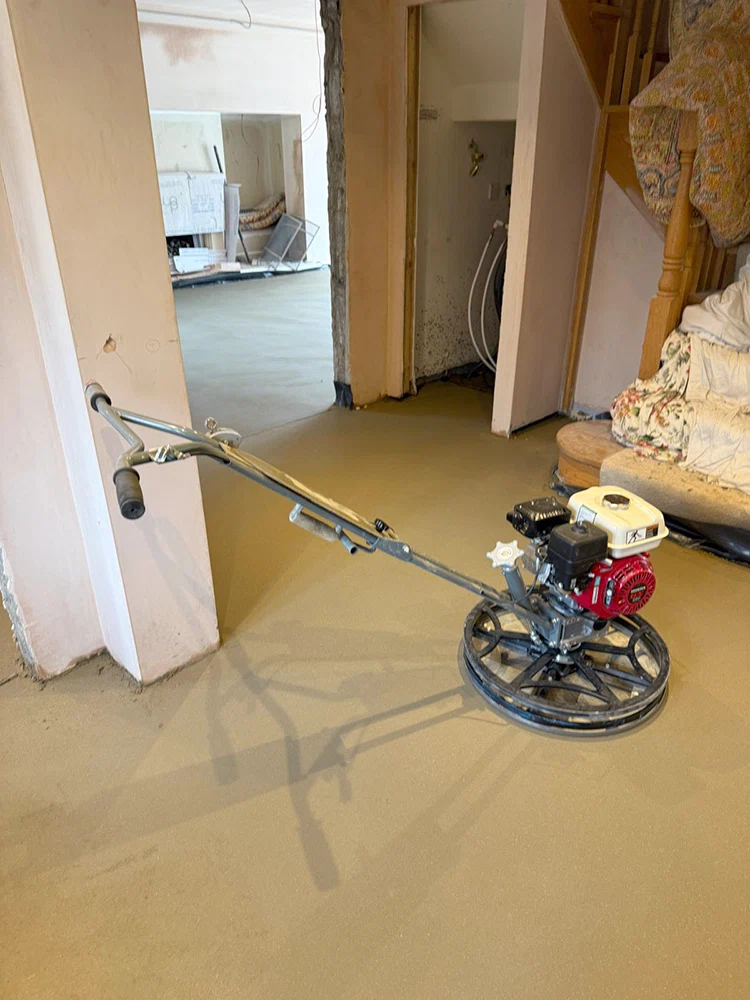
On top of insulation in a Portchester or Catisfield house, sand and cement goes in 65mm thick as a floating screed. That is thicker than a liquid screed, but it has advantages on this kind of job. Because we mix it in small batches on the spot, it is no trouble if the hallway, cloakroom and kitchen are dug out on separate days. We can lay it to falls as well. And it gives a cement surface that suits tiles, adhesives and wet areas without the extra preparation calcium sulphate needs.
Fareham also has older stock. 7% of its homes were built before 1919 and 14% between the wars. Floors in houses of those ages have often been patched more than once, and a failed section is usually easier to rebuild in sand and cement than to match any other way. If the failure is limited to part of the floor, patch repairs to the screed could be all it needs.
For a direct comparison of drying, depth and cost, see liquid versus traditional screed.
Wet rooms, garages and bonded toppings in Fareham
Where water is expected, choose sand and cement. A wet room floor must slope to the drain, and a hand-shaped cement screed gives it that slope. Calcium sulphate should stay out of anywhere likely to get wet, so bathrooms and utility rooms in Fareham houses normally go in sand and cement.
Garages turned into rooms, a common change to Fareham's post-war semis, often end up in sand and cement too, especially where the new floor has to step up over an existing slab by an awkward amount. Where the garage slab is in good shape and the new floor only has to rise a little, a 25 to 40mm bonded screed fixed straight to the concrete may be enough; bonded screeds and when they suit has the detail.
The cost is in drying time. As a rule of thumb, the first 40mm dries at about a millimetre a day and the depth below that goes slower still, which is why a 65mm floor in a converted garage stands for weeks before most coverings, and longer if the room is cold and unheated. For crack resistance, fibres add £1 to £3 per m²; a quick drying mix is £20 to £28 per m², where standard is £18 to £25. Tell us your flooring date and we will say which mix fits it.
Sand and Cement Screed prices in Fareham
Sand and cement screed: £18 to £25 per m² supplied and laid (MyJobQuote, August 2026), so £450 to £630 for 25 m². MyJobQuote does not say whether these figures include VAT. See our floor screeding cost guide or screed calculator.
Who lays your sand and cement screed in Fareham
K & B Screeding’s own team, led by director Donatas Bardisevicius. Founded 2019, company 12298780.
See what customers say in our Google reviews and on our testimonials page.
Sand and Cement Screed from Slough to Fareham
On the map, Fareham sits south-south-west of Slough, about 52.3 miles from our base in a straight line (postcodes including PO16, PO15 and PO14), next to Gosport (4.6 miles), Portsmouth (5.3 miles), Hedge End (7 miles) and Horndean (8.3 miles).
More on sand & cement screed, part of our screeding services.
