
Choosing an anhydrite grade for an Emsworth floor
On a large new build, the engineer writes the grade into the specification. On a single house, the choice is often ours to recommend, so it helps to know what the designations mean.
Each grade is written as CA, then a C number and an F number. CA means calcium sulphate. The C number is the compressive strength and the F number the flexural strength, in N/mm2, as the BS EN grading for screeds defines them. A quiet domestic room with light traffic can take CA-C20-F4. CA-C25-F5 covers most homes, apartments and offices, and CA-C30-F6 is kept for heavier wear.
For a bungalow living floor or a kitchen extension, the domestic grades are usually right. Alpha hemihydrate products are another option. They are chosen where faster drying or a thinner section matters, such as an extension to an older house with limited height, and each follows its own product sheet.
Calcium sulphate shrinks very little as it sets, so a whole bungalow floor can be poured in large bays with few joints. Joints are still planned where they are needed, at doorways or between heating zones. Purpose-built flats make up 10% of Emsworth's homes, and a flat refit is another place the material fits, with a single pour covering the whole apartment floor.
Because calcium sulphate is so often poured over underfloor heating, read our Emsworth underfloor heating screed page alongside this one. The guide to anhydrite screed covers the material in more depth.
Aftercare for anhydrite floors in Emsworth homes
An anhydrite floor needs two jobs done after the pour. First, laitance: a weak surface layer forms as the screed dries, and adhesives will not hold properly on it. Sanding takes it off once the floor has dried enough, and a calcium sulphate compatible primer follows. On a bungalow laid in anhydrite throughout, that means sanding every room before the flooring goes down.
Second, moisture. Flooring manufacturers frequently set calcium sulphate a tighter moisture limit than cement. We test with a hygrometer and share the reading. If there is underfloor heating, the screed can usually be force dried with it from about 7 days, which shortens the wait.
The material has one firm limit. Calcium sulphate is weakened by prolonged moisture, so wet rooms, walk-in showers and utility floors at risk of leaks need a cement based flowing screed instead.
Before thin sheet flooring or LVT, a sanded anhydrite floor may still need a skim to reach SR1, which our floor levelling service in Emsworth provides. For flow screed along the coast to the west, see anhydrite screed in Portsmouth.
Anhydrite & Flow Screed prices in Emsworth
Liquid flowing screed (which includes anhydrite): £24 to £31 per m² supplied and laid (MyJobQuote, August 2026), so £960 to £1,240 for 40 m². MyJobQuote does not say whether these figures include VAT. See our floor screeding cost guide or screed calculator.
Who lays your anhydrite and flow screed in Emsworth
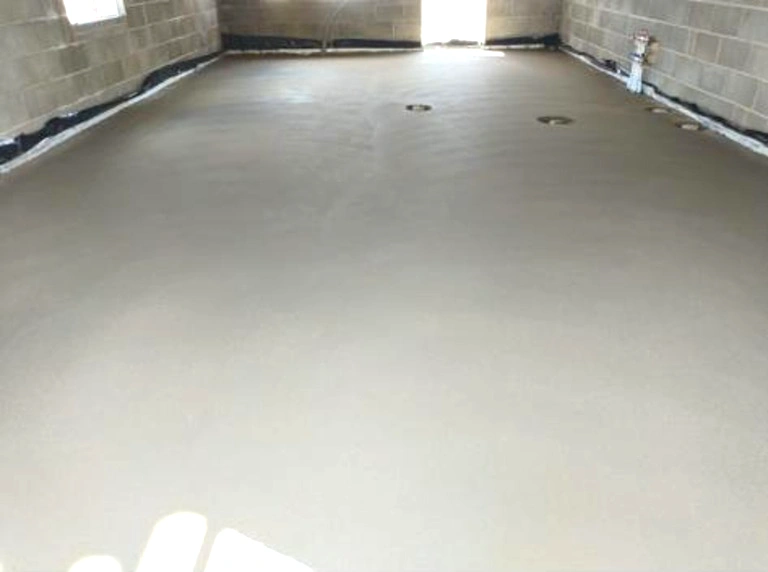
K & B Screeding’s own team, led by director Donatas Bardisevicius. Founded 2019, company 12298780.
See what customers say in our Google reviews and on our testimonials page.
Anhydrite & Flow Screed from Slough to Emsworth
Emsworth is about 48.9 miles south-south-west of our Slough base as the crow flies, with postcodes including PO10. The nearest towns to it are Havant (2.2 miles), Horndean (5.2 miles), Chichester (7 miles) and Portsmouth (7.6 miles).
More on anhydrite screed, part of our screeding services.
