
Choosing a calcium sulphate grade for Horndean floors
Anhydrite grades are written as codes under the European standard that covers screed materials. Read the C figure as how much crushing it resists and the F figure as how much bending, both measured in N/mm2. Almost all house work uses one of three. CA-C20-F4 covers lightly trodden rooms in a house. CA-C25-F5 is what most houses, flats and office floors get. For floors facing heavier use, CA-C30-F6 steps up.
When a detached Horndean house is extended, the architect or engineer may have put a grade on the drawings already, and we pour that grade without swapping it. With no grade on the plans, we propose one after looking at what each room is for, what flooring is going down and the weight it must carry.
Alpha hemihydrate screeds are a different group, picked when quicker drying or a thinner section is the priority. Depth and drying for those come from their own product sheet, so the usual anhydrite rules may not hold.
Low shrinkage is the big benefit of the material. Big bays go down with few joints, letting an open-plan ground floor read as one surface. Joints are still set where needed, at door thresholds or between heating zones, and their positions are agreed before pouring.
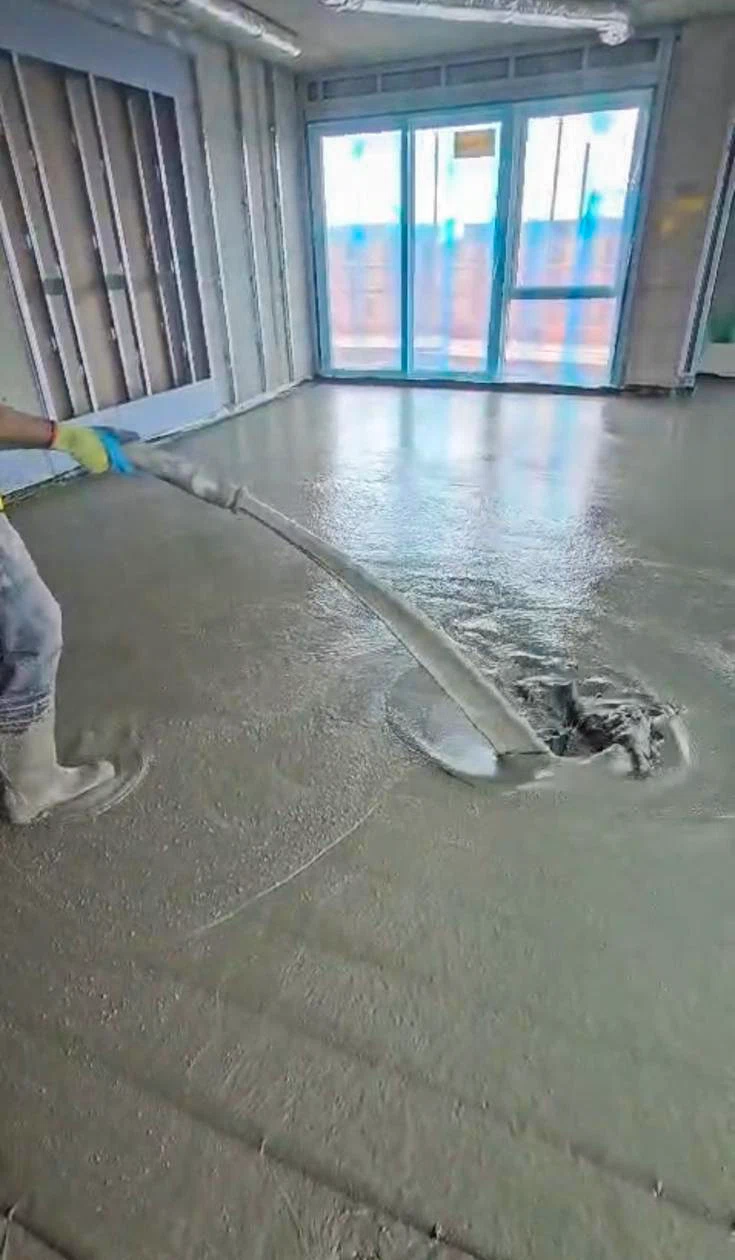
Background reading on the binder and how it behaves: anhydrite screed explained. For pumping and getting the hose in, see our Horndean liquid screed page.
Laitance, moisture and wet areas in Horndean homes
On pour day a calcium sulphate floor is nowhere near ready for flooring. A thin, weak surface layer called laitance forms while it dries, and once the floor is dry this must be sanded away and the surface primed with something compatible with calcium sulphate. Leave it on and the adhesive grips that crust, not the screed, and that is how tiles and LVT later come loose.
Moisture is checked next. Flooring makers are often stricter about anhydrite, setting it a lower allowable moisture figure than a cement floor, and a pale surface tells you nothing about the core. A hygrometer reading decides, not the calendar. If heating is fitted, force drying can normally begin at about 7 days.
Some rooms should not get calcium sulphate at all. Showers, wet rooms and any utility where a washing machine might leak need a cement flowing screed, or hand-laid sand and cement for Horndean wet areas. Where an older base needs work before anything is poured, our preparation work on existing floors goes first.
Anhydrite & Flow Screed prices in Horndean
Liquid flowing screed (which includes anhydrite): £24 to £31 per m² supplied and laid (MyJobQuote, August 2026), so £960 to £1,240 for 40 m². MyJobQuote does not say whether these figures include VAT. See our floor screeding cost guide or screed calculator.
Who lays your anhydrite and flow screed in Horndean
K & B Screeding’s own team, led by director Donatas Bardisevicius. Founded 2019, company 12298780.
See what customers say in our Google reviews and on our testimonials page.
Anhydrite & Flow Screed from Slough to Horndean
As the crow flies, our yard in Slough is about 45.9 miles from Horndean, which lies to the south-south-west. Postcodes here include PO8, and Havant (3.7 miles), Emsworth (5.2 miles), Petersfield (7.3 miles) and Fareham (8.3 miles) are close by.
More on anhydrite screed, part of our screeding services.
