
Heated floors when Southampton timber floors come out
In the older terraces of Shirley, Freemantle and Bevois Valley, replacing a suspended timber floor with a screeded slab is the natural time to add underfloor heating. The floor is already open, so insulation, pipes and screed can all go into the new build-up without raising the rooms. Planning the heating at this stage costs far less than lifting a finished floor later.
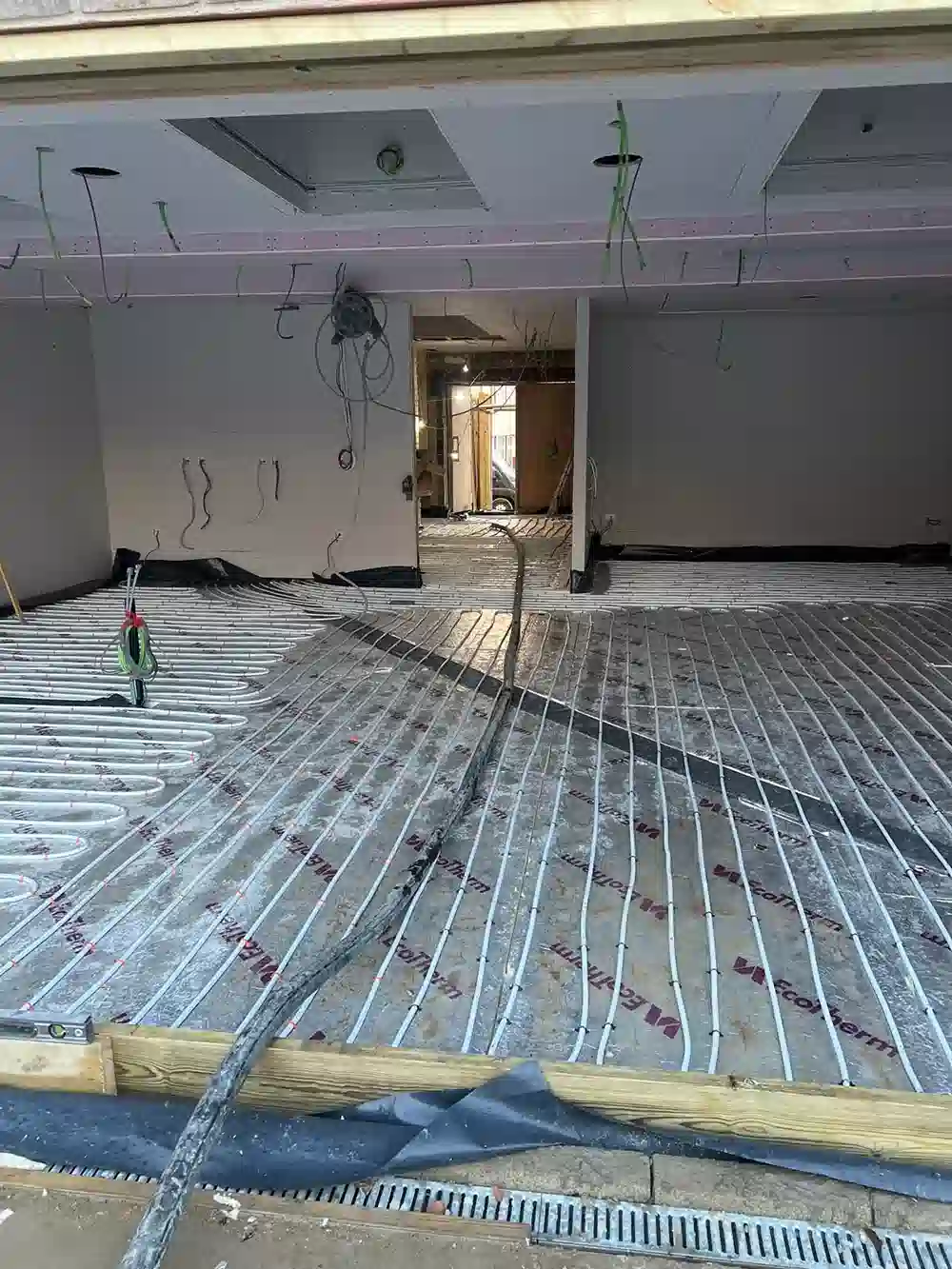
Everything hinges on how deep the screed sits above the pipes. Pumped screed covers them by 25mm at the very least, which typically leaves a floor 45 to 50mm thick. Sand and cement needs closer to 45mm of cover, which builds a thicker floor. In a narrow Shirley or Freemantle terrace, where one new floor has to line up with the hall, the doorstep and the extension, that difference in thickness can settle which screed goes in.
A liquid floor runs right round every pipe with no air trapped, so the heat comes through quickly and evenly. Sand and cement is worked around the pipes by hand and suits rooms where a cement base is needed, such as a shower room. The choice between the two is set out in our liquid versus sand and cement guide.
Pour day starts with a look at what is underneath (insulation, membrane, edge strip) and a check that your installer has pressure tested the pipes. If anything is missing, we can supply the insulation and membrane as part of the job.
Warm-up schedules for Southampton semis and flats
Roughly 30% of homes in Southampton went up between 1945 and 1972. Houses of that age are often extended and replanned, and a heated extension brings a new floor into an older building. Post-war house or brand new, the screed and its heating need bringing up to temperature with care.
Roughly 7 days after pouring, a calcium sulphate floor is usually ready for heat. Sand and cement is a longer wait, 21 days at a minimum. From then, start the system low and nudge it up daily over several days, as the commissioning schedule from the heating manufacturer sets out. Putting it on full from the start risks cracks in the screed.
The heating also speeds up drying, which helps when a flooring fitter is booked. We hand over written guidance on the warm-up, so the plumber, the builder and the owner work from the same plan.
For a heated floor laid by pump, see liquid screed in Southampton. Where the heated room is a shower room, the sand and cement screed page for Southampton explains why that floor needs cement. The same heated floor service runs in Hedge End.
Underfloor Heating Screed prices in Southampton
Liquid screed over underfloor heating: £20 to £35 per m² supplied and laid (trade2base, June 2026), so £700 to £1,230 for 35 m². trade2base gives these figures excluding VAT. See our floor screeding cost guide or screed calculator.
Who lays your underfloor heating screed in Southampton
K & B Screeding’s own team, led by director Donatas Bardisevicius. Founded 2019, company 12298780.
See what customers say in our Google reviews and on our testimonials page.
Underfloor Heating Screed from Slough to Southampton
Southampton is about 54.4 miles south-west of our Slough base as the crow flies, with postcodes including SO14, SO16, SO15 and SO17. The nearest towns to it are Totton (3.8 miles), Hedge End (4.4 miles), Eastleigh (5 miles) and Romsey (7.2 miles).
More on underfloor heating screed, part of our screeding services.