
Floor height for heating retrofits in Totton houses
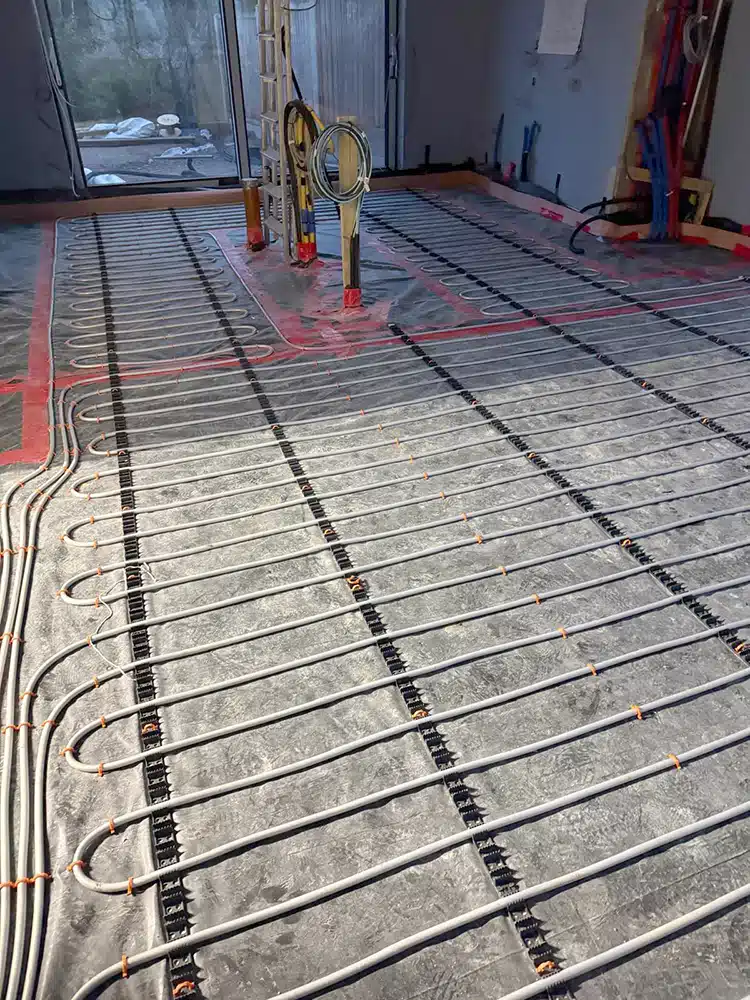
In an older Totton house, heating pipes start with a tape measure. Your new floor still has to line up with the doors, the stairs and the thresholds, and underneath it there must be room for insulation, the pipes, and enough screed over them to spread the heat and stay crack free. A house from the post-war decades may have a solid floor with little insulation in it, so the old floor often has to be dug out to find the space. That is as true in Calmore as it is in Rushington.
What you choose to pour changes the numbers. Pour liquid and it must bury the pipes under 25mm or more, so the floor finishes around 45 to 50mm. Sand and cement asks for about 45mm above the pipes, which pushes the total higher. When height is short, liquid normally comes out ahead, and because it flows it surrounds every pipe without trapping air.
For that reason most heated floors lead back to our page on liquid screed for Totton extensions. Sand and cement still earns a place in a small room, or where the floor finish calls for a cement base, and we lay it so that each pipe is fully enclosed.
What sits under the screed counts just as much. Insulation keeps the heat moving up, the membrane stops a flowing screed escaping, and an edge strip gives the floor room to expand as it warms. We check those layers, or supply them, through our insulation, membranes and preparation service. A poor build-up can crack the screed the first time the heating runs, no matter how well the pour went.
Switching on a new Totton heated floor
Totton heated floors get their first warmth in small, patient steps. The first heat goes into calcium sulphate at about 7 days as a rule, and into sand and cement no sooner than day 21. From there the flow temperature goes up a little at a time across several days, following the schedules from the heating manufacturer and the screed manufacturer, and is held there before any flooring is fitted.
Running the heating like this also drives moisture out, but a commissioned floor is not automatically ready for tiles or timber. It still needs a moisture test. Our guide to how long a screed takes to dry shows why thickness changes the wait so much.
Only 2% of Totton's homes were built from 2015 on, so heated floors in the town are more likely to be extensions, garden rooms and retrofits than new plots. Heat a new floor too hard and it can crack or lift at the edges, a costly repair once tiles are down. We follow the same process for underfloor heating screed in Eastleigh and across the area.
Underfloor Heating Screed prices in Totton
Liquid screed over underfloor heating: £20 to £35 per m² supplied and laid (trade2base, June 2026), so £700 to £1,230 for 35 m². trade2base gives these figures excluding VAT. See our floor screeding cost guide or screed calculator.
Who lays your underfloor heating screed in Totton
K & B Screeding’s own team, led by director Donatas Bardisevicius. Founded 2019, company 12298780.
See what customers say in our Google reviews and on our testimonials page.
Underfloor Heating Screed from Slough to Totton
Totton is about 56 miles south-west of our Slough base as the crow flies, with postcodes including SO40. The nearest towns to it are Southampton (3.8 miles), Romsey (4.9 miles), Eastleigh (6.9 miles) and Hedge End (8.1 miles).
More on underfloor heating screed, part of our screeding services.
