
Relaying solid floors in Faberstown and post-war Tidworth
Walter Faber began building houses in Faberstown in the early 1900s, and some older homes there may have older solid floors that need a membrane. Damp patches, cracked tiles and flooring that will not stay stuck are the usual signs. The cure is to dig the old floor out, put down a new base with a membrane and insulation, and screed over it.
The post-war semis and terraces raise a similar question for a different reason. When owners re-insulate a ground floor, the old screed often has to come up to make room for insulation boards, and a new screed goes back on top at the right level for the doors and hallway.
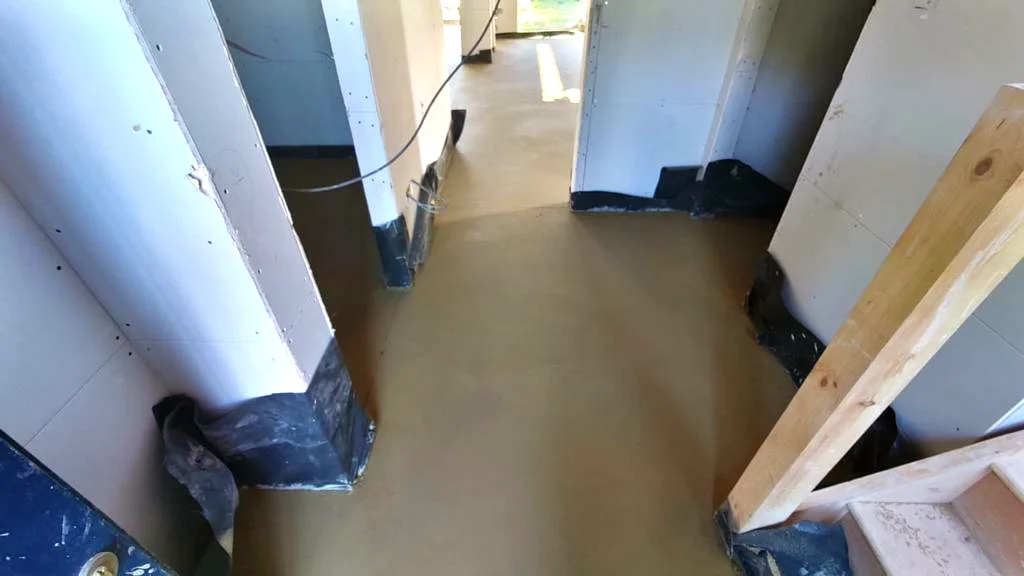
Sand and cement suits both jobs. It is mixed on site to the depth each room needs and laid by hand, so it copes with small rooms and with steps in level between old rooms. In a house where it floats on insulation, sand and cement goes down about 65mm thick. Where it is bonded to concrete in good condition, 25 to 40mm is possible.
Terraced houses make up 27% of Tidworth's homes, and on a terrace with limited parking, hand mixing near the door is often easier than setting up a pump. We compact it and then float the top, leaving a dense, flat floor that will take tiles, wood or carpet. Where the old floor is being removed, our insulation and membranes service covers the layers that go underneath.
Wet rooms, utility rooms and garages in Tidworth
Some floors need cement whatever the house. Walk-in showers and wet rooms must slope towards the drain, which can be formed by hand in sand and cement. It also tolerates moisture, which a calcium sulphate screed does not, so it is the safer base for bathrooms and utility rooms.
Garages are another common use. In a garage conversion the concrete floor normally sits low, so it is brought up to the level of the house with insulation, a membrane and a new screed. Our garage conversion floor guide lays out the usual layers.
Where a section has to be thin, sand and cement can be reinforced. Adding fibres costs £1 to £3 per m² extra on published figures, and a fibre reinforced screed is less prone to cracking.
The drawback is drying time. At 65mm, a hand-laid floor takes its time: count roughly one day per millimetre for 40mm, then longer for the rest. Where a liquid screed would suit the room instead, such as a large extension, our liquid screed page for Tidworth explains the faster option.
Sand and Cement Screed prices in Tidworth
Sand and cement screed: £18 to £25 per m² supplied and laid (MyJobQuote, August 2026), so £450 to £630 for 25 m². MyJobQuote does not say whether these figures include VAT. See our floor screeding cost guide or screed calculator.
Who lays your sand and cement screed in Tidworth
K & B Screeding’s own team, led by director Donatas Bardisevicius. Founded 2019, company 12298780.
See what customers say in our Google reviews and on our testimonials page.
Sand and Cement Screed from Slough to Tidworth
As the crow flies, our yard in Slough is about 48.4 miles from Tidworth, which lies to the west-south-west. Postcodes here include SP9 and SP11, and Amesbury (7 miles), Andover (8.4 miles), Salisbury (13.1 miles) and Devizes (16.2 miles) are close by.
More on sand & cement screed, part of our screeding services.
