
Latex over timber and tiles in older Windsor homes
Latex screed is the trade's shorthand for a two part compound. A cement based powder is mixed with a latex liquid in place of water, and the result spreads into a thin, slightly flexible coat that grips bases where ordinary compound can struggle. It goes down a few millimetres thick, so it smooths a floor rather than rebuilding one.
Older Windsor houses can throw up any of those bases. Besides the Victorian terraces near the centre, a further 8% of the town's homes date from 1919 to 1944, and a house that old has usually had its floors patched, boarded over or tiled at some point.
Where a terrace keeps its suspended timber floor, the boards themselves are never a base for latex. They move with the seasons and with every footstep, and a thin coat would crack along each joint. The fix is to screw flooring grade plywood over the boards, prime the ply and then lay latex over it. Sheet vinyl or LVT then sits on a seamless surface, with no board edges printing through.
Kitchens and bathrooms tiled decades ago are the other usual case. Quarry or ceramic tiles that are still firmly stuck can stay where they are. We clean off grease and polish, prime them as the system requires and lay latex straight over, which saves breaking them out and the mess that goes with it. Any tile that sounds hollow when tapped comes up first and the hole is filled.
Sound old adhesive left after lifting carpet or vinyl can sometimes be covered in the same way, provided it is hard, well bonded and compatible. Where it is soft or patchy it has to come off; our floor preparation service covers that stage.
When latex is the wrong answer in Windsor
Latex smooths. It does not stiffen, dry out or straighten a floor, and expecting it to is the usual reason a new vinyl floor fails within a year.
Springy boards head the list. If a timber floor flexes underfoot, plywood screwed over it will not cure the movement, and the joists or boards need attention before any overlay goes down. Damp comes next. Around Peascod Street, many Victorian terraces still stand on old solid floors laid without a membrane, and a coat a few millimetres thick does nothing to stop ground moisture coming through. We test before quoting, and a damp floor calls for a membrane and new screed, which our page on relaying a Windsor floor in sand and cement explains.
The third limit is level. A floor that drops by centimetres from one wall to the other needs a screed or a deeper repair, not a thin coat. Latex largely follows the shape of the base, so it suits floors that are rough over short distances rather than out of level overall. For flatness classes and general compound work, see floor levelling across Windsor.
Every base gets its own primer: plywood, tiles, concrete and cement screed differ. A calcium sulphate screed also has to have its laitance sanded off and be primed before latex goes on. There is also a separate page for latex screed in Egham, about 4.3 miles away.
How we price latex screed in Windsor
A fixed written price within 24 hours, once we know the area and the base. See our floor screeding cost guide.
Who lays your latex screed in Windsor
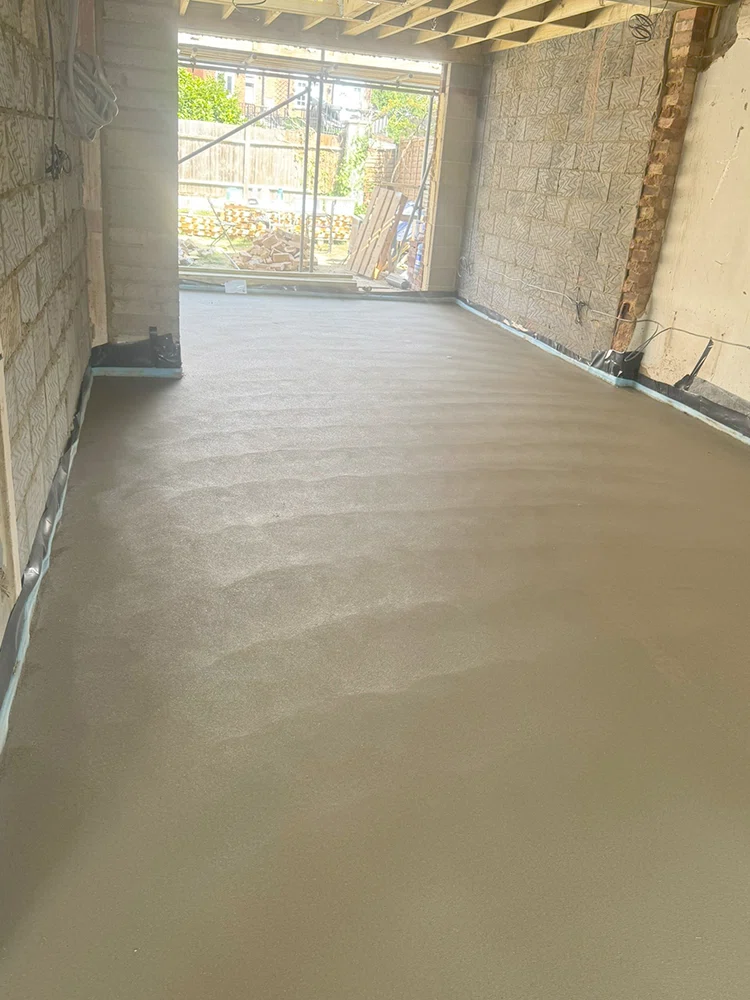
K & B Screeding’s own team, led by director Donatas Bardisevicius. Founded 2019, company 12298780.
See what customers say in our Google reviews and on our testimonials page.
Latex Screed from Slough to Windsor
Windsor is about 3.9 miles south-south-east of our Slough base as the crow flies, with postcodes including SL4 and TW19. The nearest towns to it are Slough (2.1 miles), Egham (4.3 miles), Staines-upon-Thames (5.3 miles) and Maidenhead (5.6 miles).
More on latex screed, part of our screeding services.
