
Latex screed in Chertsey kitchens and bathrooms
Kitchen and bathroom refits are where latex screed earns its place. Lift an old floor in a Chertsey house and the base underneath is rarely uniform. There may be old ceramic tiles in one corner, worn concrete by the back door and a patch of plywood where a pipe was once rerouted. Thin finishes like LVT and sheet vinyl show every one of those changes, so the base is evened out first.
Latex screed does that in a few millimetres. Powder and latex are mixed on site and spread across the floor, where they flow into a smooth, slightly flexible layer. It grips firmly bonded quarry or ceramic tiles, sound older concrete, plywood overboarding and some well stuck old adhesive, once each is cleaned and primed.
Terraced houses are 21% of Chertsey's homes, and a narrow terrace kitchen or a small bathroom is the kind of room where a thin build helps, because the new floor still has to meet the existing door and hallway. A latex layer adds very little height.
Timber floors need care. Latex is never poured straight onto floorboards: they move, and a thin coat would crack at the joints. The boards are fixed firmly and overboarded with flooring grade plywood, and the latex goes onto the ply.
Newer homes bring a different base. Many recent Chertsey houses and flats, Longcross among them, have liquid screed over underfloor heating pipes. Before latex goes onto one of those floors the screed has to be dry, and a calcium sulphate screed has its laitance sanded off first. For general flatness classes and levelling compound, see our Chertsey floor levelling page.
Old floors in the Chertsey conservation area
Some older buildings in Chertsey's conservation area have solid floors laid straight onto earth with no damp proof membrane. Latex is not a fix for that. It is a smoothing coat, not a barrier, and moisture rising through the old floor would loosen it and the finish on top. On a floor like that, a moisture check comes before anything else, and the conservation rules have a say in what replaces it.
Every other house in town, old or new, faces three checks too. Is it dry? Is it firm, with no springy boards or hollow concrete? Is it close to level, within a few millimetres? If the answer to any of those is no, the floor needs repair, overboarding or a new sand and cement screed before latex makes sense.
Primer is the last step before the pour. Each base has its own: concrete, tiles and plywood differ, and calcium sulphate always takes a primer once its laitance is gone. Where old paint or adhesive ridges need removing first, grinding the concrete prepares it. For a refit in a nearby town, we also lay latex screed in Egham.
How we price latex screed in Chertsey
A fixed written price within 24 hours, once we know the area and the base. See our floor screeding cost guide.
Who lays your latex screed in Chertsey
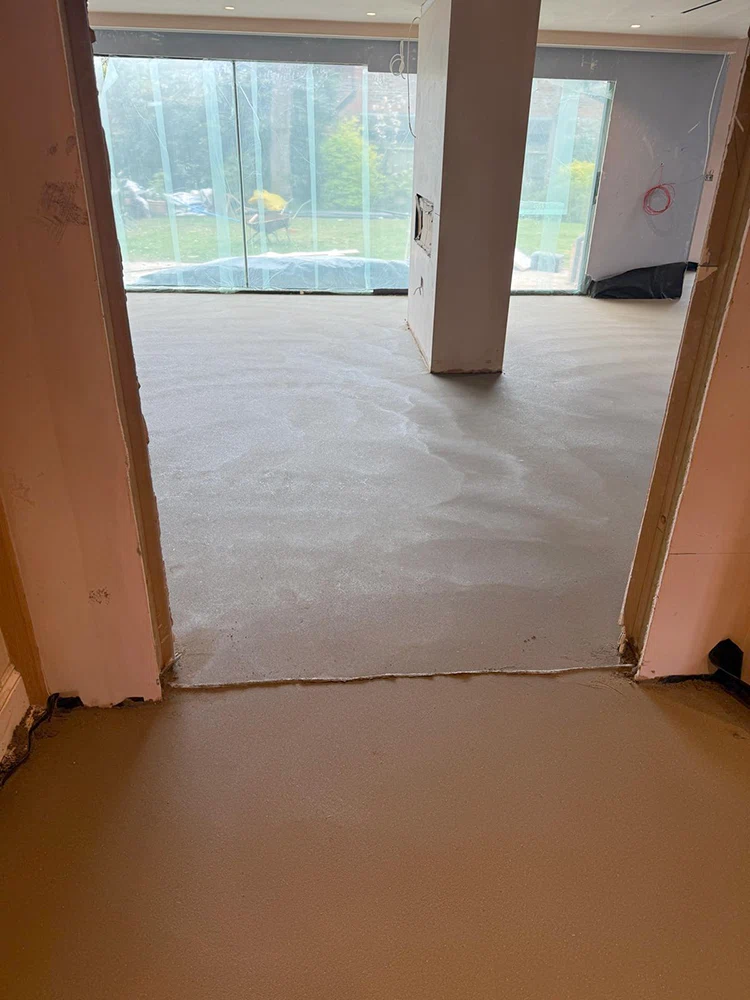
K & B Screeding’s own team, led by director Donatas Bardisevicius. Founded 2019, company 12298780.
See what customers say in our Google reviews and on our testimonials page.
Latex Screed from Slough to Chertsey
As the crow flies, our yard in Slough is about 11.4 miles from Chertsey, which lies to the south-south-east. Postcodes here include KT16, and Addlestone (1.6 miles), Weybridge (2.4 miles), Staines-upon-Thames (2.9 miles) and Ashford (3.3 miles) are close by.
More on latex screed, part of our screeding services.