
Latex over timber and tiles in Weybridge flats
The name is a little misleading. Latex screed is not a screed in the usual sense but a two part compound in which a latex liquid, not water, is mixed into a cement based powder. It is spread a few millimetres thick and cures to a tough, slightly flexible layer that grips well. That grip is the reason to choose it over a standard compound when the base is old tiles, plywood or a hard, shiny surface.
Most Weybridge flats are in blocks, but 4% of the town's homes are flats converted from houses or other buildings, and conversions of that sort commonly keep timber floors. Timber needs proper preparation. Bare floorboards move, so latex laid straight on them cracks along the joints. Boards are fixed down, loose ones replaced, and the floor is overboarded with flooring grade plywood screwed at close centres. Latex then goes over the primed plywood.
In blocks the base is more often a screed or a concrete slab, and some newer buildings use calcium sulphate. That last one needs its laitance removed and a compatible primer before latex goes on, every time.
Old ceramic or quarry tiles turn up in kitchens and utility rooms. If they are firmly stuck, they can be primed and covered instead of chiselled out, which spares a noisy, dusty job in a block where neighbours are close. Hollow tiles are lifted and the gaps filled first.
The finishes that gain most are the thin ones: sheet vinyl, LVT, lino, rubber, safety flooring and carpet.
Old Oatlands floors: when latex is not the answer
Oatlands grew in the 19th century, and its older houses often have ground floors without a damp proof membrane. That changes the conversation. Latex smooths a surface but does not keep moisture out. Lay it on a damp floor and the new vinyl or LVT can lift, blister or smell within months.
So the order in an older house is to test first. If the floor is dry and sound, latex can go on after the right primer. If it is damp, it needs a membrane or, more often in houses of that age, digging out and relaying with insulation, a membrane and a new hand-laid screed. Latex can then be the final smoothing layer if the finish needs it.
Two other conditions rule latex out. A floor that is badly out of level needs more than a thin coat, and deep layers of compound can crack and come loose. A timber floor that bounces underfoot needs its joists or fixings put right before any overboarding. If your Weybridge floor is uneven over a wider area, or an extension join needs blending, our Weybridge self levelling and flatness page is the place to start. Old adhesive or paint that stops a primer bonding can be removed by diamond grinding in Weybridge.
How we price latex screed in Weybridge
A fixed written price within 24 hours, once we know the area and the base. See our floor screeding cost guide.
Who lays your latex screed in Weybridge
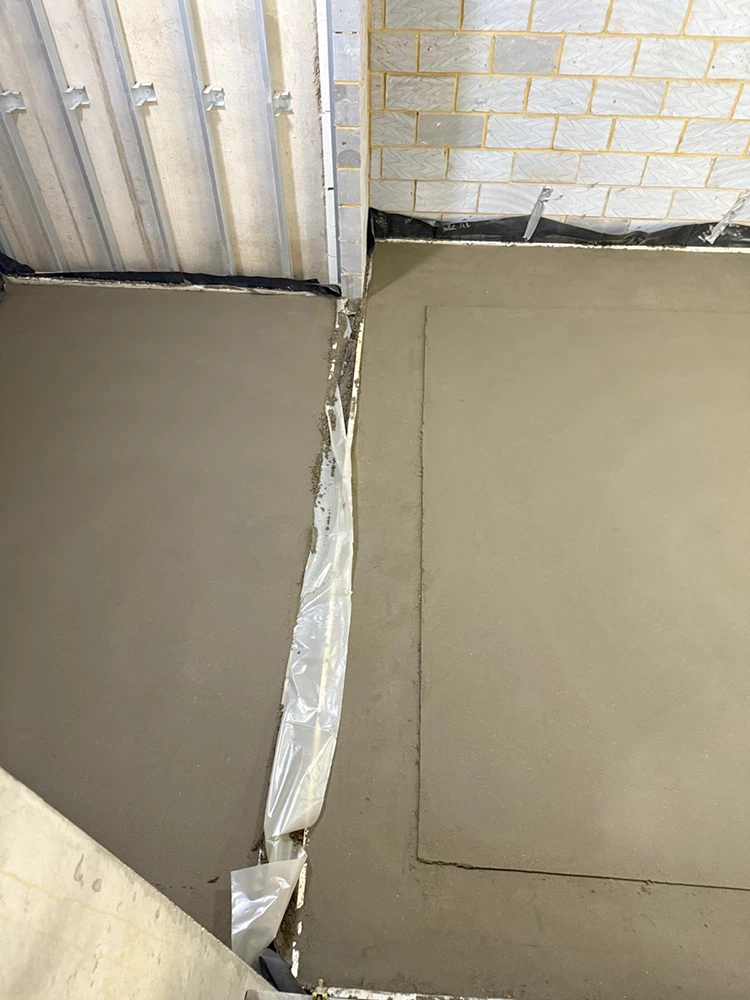
K & B Screeding’s own team, led by director Donatas Bardisevicius. Founded 2019, company 12298780.
See what customers say in our Google reviews and on our testimonials page.
Latex Screed from Slough to Weybridge
Weybridge is about 13.6 miles south-east of our Slough base as the crow flies, with postcodes including KT13 and KT15. The nearest towns to it are Addlestone (1.5 miles), Walton-on-Thames (2 miles), Chertsey (2.4 miles) and Sunbury-on-Thames (3.7 miles).
More on latex screed, part of our screeding services.
