
Relaying floors in the Chertsey conservation area
Chertsey's conservation area holds more than 56 listed buildings, mostly from the 16th and 17th centuries, grouped around the old abbey town. Some 14% of homes in Chertsey were built before 1919. In buildings of that age a ground floor may be laid directly onto earth, with no membrane, and years of damp can leave it cracked, crumbling or uneven.
Where a floor like that is rebuilt, the new one has to suit both the building and the conservation rules. Older walls often rely on moisture being able to move, and trapping it under an impermeable floor can push it into the walls instead. That is a question for the conservation officer and a surveyor before the floor is dug out, and the build-up is then set to match what is agreed.
When a modern build-up is approved, it usually goes in as a membrane, insulation and a screed. Floated over insulation, a house floor needs 65mm of sand and cement, or 75mm in a commercial building. If good concrete lies underneath and the doors leave little height, 25 to 40mm bonded straight onto it can do instead.
Hand-laid screed suits these jobs because it is mixed on site in batches and carried through by barrow, which matters behind a frontage set hard against the pavement. It is compacted and floated to a dense finish, and it gives the cement surface that stone and ceramic tiles often call for. Drying is slow, around one day for each of the first 40 millimetres. Read how thick a screed should be to see how depth changes strength and drying.
Wet rooms, garages and semis around Chertsey
In Chertsey, 29% of homes are semis. Extensions and kitchen diners on them often suit a pumped screed, but the smaller rooms, such as a shower room or utility, usually suit a hand-laid screed better. A pump truck brings a fixed cost that a single small room cannot justify.
A wet room shows the point plainly. Water has to run to the drain, so we trowel the screed to a slope, which a self-levelling pour will never hold. Cement based screed also tolerates water, where calcium sulphate does not.
Garages are another. A garage turned into a room usually needs its floor raised, insulated and screeded to meet the house, and sand and cement copes with the varying depth. Our guide to garage conversion floors shows each layer.
To help a floor resist cracking, adding fibres to the mix costs roughly £1 to £3 more per m². If your flooring fitter already has a date in the diary, a faster drying screed brings it closer. If the room is large and open, compare the cost of liquid screed in Chertsey.
Sand and Cement Screed prices in Chertsey
Sand and cement screed: £18 to £25 per m² supplied and laid (MyJobQuote, August 2026), so £450 to £630 for 25 m². MyJobQuote does not say whether these figures include VAT. See our floor screeding cost guide or screed calculator.
Who lays your sand and cement screed in Chertsey
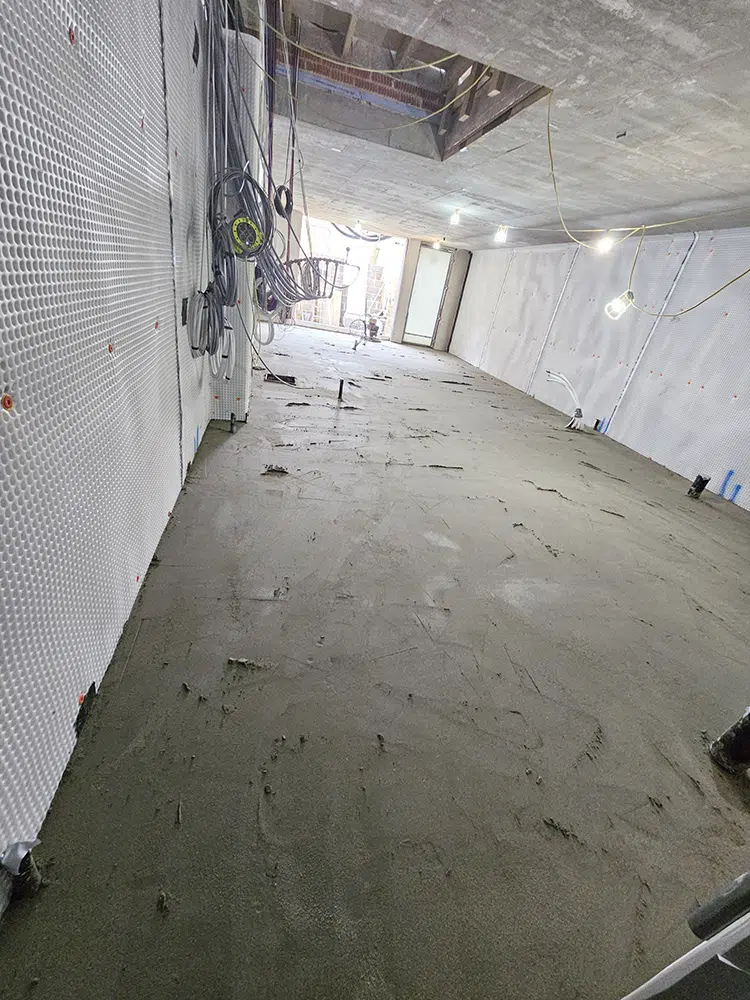
K & B Screeding’s own team, led by director Donatas Bardisevicius. Founded 2019, company 12298780.
See what customers say in our Google reviews and on our testimonials page.
Sand and Cement Screed from Slough to Chertsey
As the crow flies, our yard in Slough is about 11.4 miles from Chertsey, which lies to the south-south-east. Postcodes here include KT16, and Addlestone (1.6 miles), Weybridge (2.4 miles), Staines-upon-Thames (2.9 miles) and Ashford (3.3 miles) are close by.
More on sand & cement screed, part of our screeding services.
