
Relaying failed solid floors in older Woking homes
A solid ground floor in a post-war house can fail in a few ways. Tiles crack along a line, a patch sounds hollow, the floor dips towards the middle of a room, or damp shows at the skirting. Patching the top rarely lasts. What lasts is to break out the old floor, dig down to the right depth and build it back up with a membrane, insulation and fresh screed.
Repair work on post-war houses is typical of what sand and cement does well. Rooms are often modest, the new floor must meet existing thresholds and door linings, and the mix can be made up in small batches as the job moves from room to room.
Woking's oldest homes, the 11% built before 1919, raise the same questions, sometimes with a suspended timber floor instead of a solid one. Turning a timber floor into a solid screeded floor affects ventilation and levels, so it is worth talking through before anything is dug up.
Get the depth right first. Over insulation in a home we lay it about 65mm thick, and about 75mm on a commercial floor. Laid thinner over insulation, it is prone to cracking. Laid directly onto sound concrete instead, a bonded screed can be just 25 to 40mm, and where a floor will carry more weight, adding fibres to the mix helps it resist cracking.
Woking wet rooms, garages and floors laid to falls
Water does not harm a cement screed the way it harms calcium sulphate, which is why a walk-in shower with level access, or a full wet room, gets a sand and cement base. We form the falls towards the drain in the screed itself, which gives the tiler a true surface to follow rather than building the slope up in adhesive.
Then there are garages being turned into rooms. Bringing a garage floor up to the level of the house usually means adding insulation and a membrane, then screeding to a level so the new room sits flush with the hallway. Our guide to garage conversion floors walks through each stage.
Pick it as well when the finish needs a cement base beneath it, or when the floor has to bear weight earlier than calcium sulphate would allow.
Drying is the trade-off. At 65mm deep it stays damp much longer than a thinner liquid floor: count on one day for every millimetre of the first 40mm, and more slowly beyond. A quick drying mix helps when a programme is tight. Neighbouring Addlestone has the same service if your project sits over the border.
Sand and Cement Screed prices in Woking
Sand and cement screed: £18 to £25 per m² supplied and laid (MyJobQuote, August 2026), so £450 to £630 for 25 m². MyJobQuote does not say whether these figures include VAT. See our floor screeding cost guide or screed calculator.
Who lays your sand and cement screed in Woking
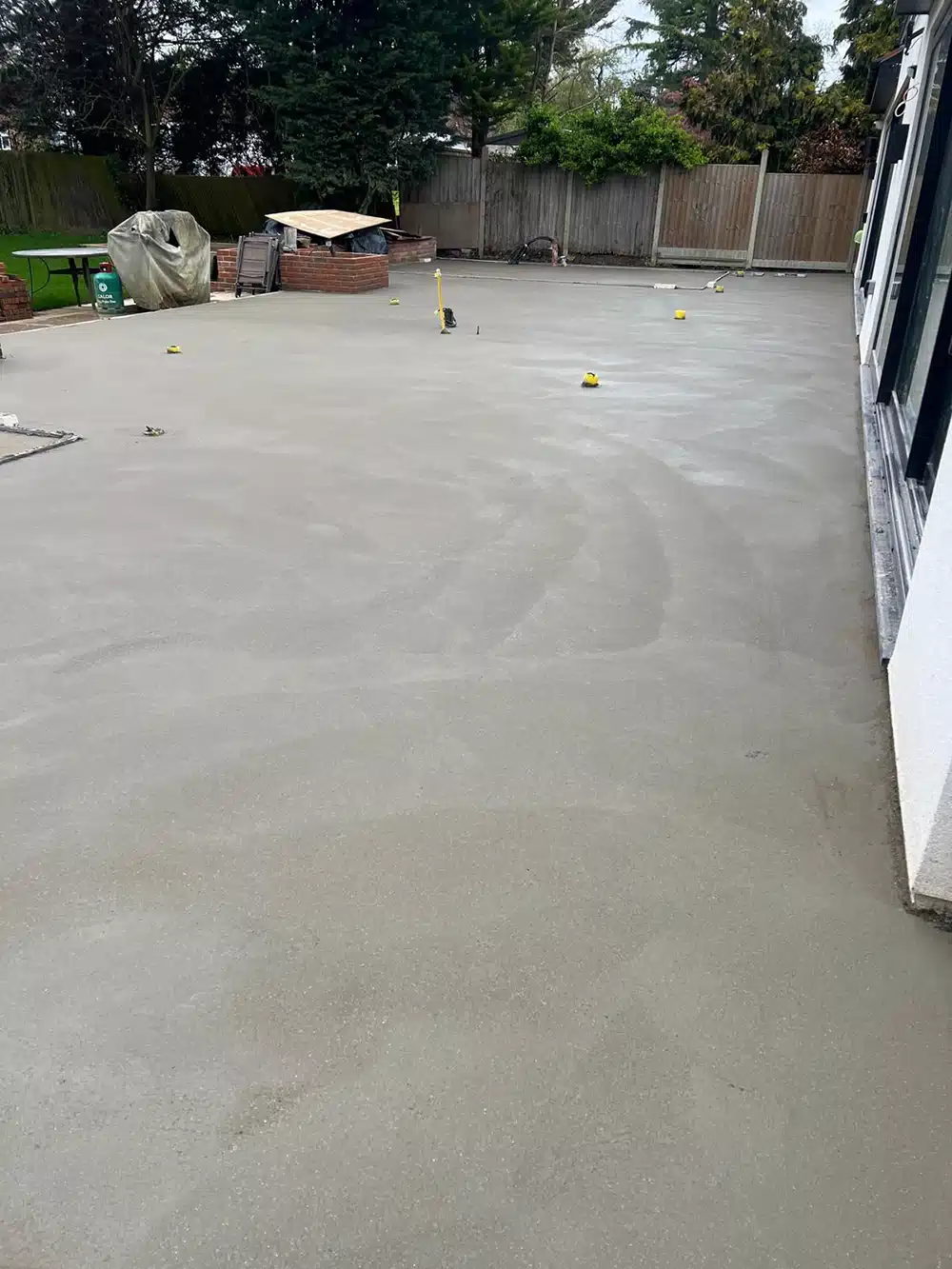
K & B Screeding’s own team, led by director Donatas Bardisevicius. Founded 2019, company 12298780.
See what customers say in our Google reviews and on our testimonials page.
Sand and Cement Screed from Slough to Woking
As the crow flies, our yard in Slough is about 15.2 miles from Woking, which lies to the south-south-east. Postcodes here include GU21, GU23 and GU22, and Addlestone (4.6 miles), Guildford (5.5 miles), Chertsey (5.6 miles) and Weybridge (5.7 miles) are close by.
More on sand & cement screed, part of our screeding services.