
Rebuilding old solid floors at Crownpits and nearby
Many Victorian ground floors were simply put down on the earth, with nothing to stop damp rising and nothing to keep heat in. At Crownpits and in other older Godalming streets, that floor, or a tired timber one, is the classic renovation problem. Patching it rarely lasts, so a renovation usually removes it and starts again.
Rebuilding happens from the ground up. We break out the old floor and make good the ground beneath, then lay a damp proof membrane, rigid insulation and a separating layer, and the screed goes on last. Floating like that in a house, sand and cement goes down at 65mm, or 75mm on commercial work. If instead it bonds straight onto a sound slab, a depth of 25 to 40mm will do.
Why hand-laid? Because a site-mixed batch can be as small as the room, it suits a narrow Godalming hallway, a pantry or a tiny cloakroom. A screeder can slope it gently towards a drain. Unlike calcium sulphate, it copes with water. A rapid drying additive can go into the mix, or fibres for extra strength, as our fibre reinforced screed page explains.
What you give up is speed. A hand-laid floor takes longer to dry than a pumped one: about a day for every millimetre up to 40mm, and longer beyond that. Our guide to screed depths shows how much extra waiting each extra millimetre adds.
Godalming wet rooms, garages and inter-war floors
About 12% of Godalming homes were built between 1919 and 1944, including the 168 council homes of the Ockford Ridge estate finished in 1931. Houses of that age often reach a renovation with tired floors and small rooms, and bathrooms are a common place to start. For a wet room, the screed has to slope gently down to the drain so the water finds its way out, and shaping that slope is hand work with a traditional mix.
Turning a garage into a room also suits it. A garage slab is often lower than the house and may slope, so the new floor has to lift and level it while taking a membrane and insulation. Sand and cement can be laid thick where needed and takes early load well. The usual layers are set out in our guide to garage conversion floors.
Put heating pipes in a sand and cement floor and they want roughly 45mm on top, with the system left off for 21 days or more. That longer wait is worth planning into the programme from the start. Our quick drying screed option can shorten it where a deadline is tight.
Sand and Cement Screed prices in Godalming
Sand and cement screed: £18 to £25 per m² supplied and laid (MyJobQuote, August 2026), so £450 to £630 for 25 m². MyJobQuote does not say whether these figures include VAT. See our floor screeding cost guide or screed calculator.
Who lays your sand and cement screed in Godalming
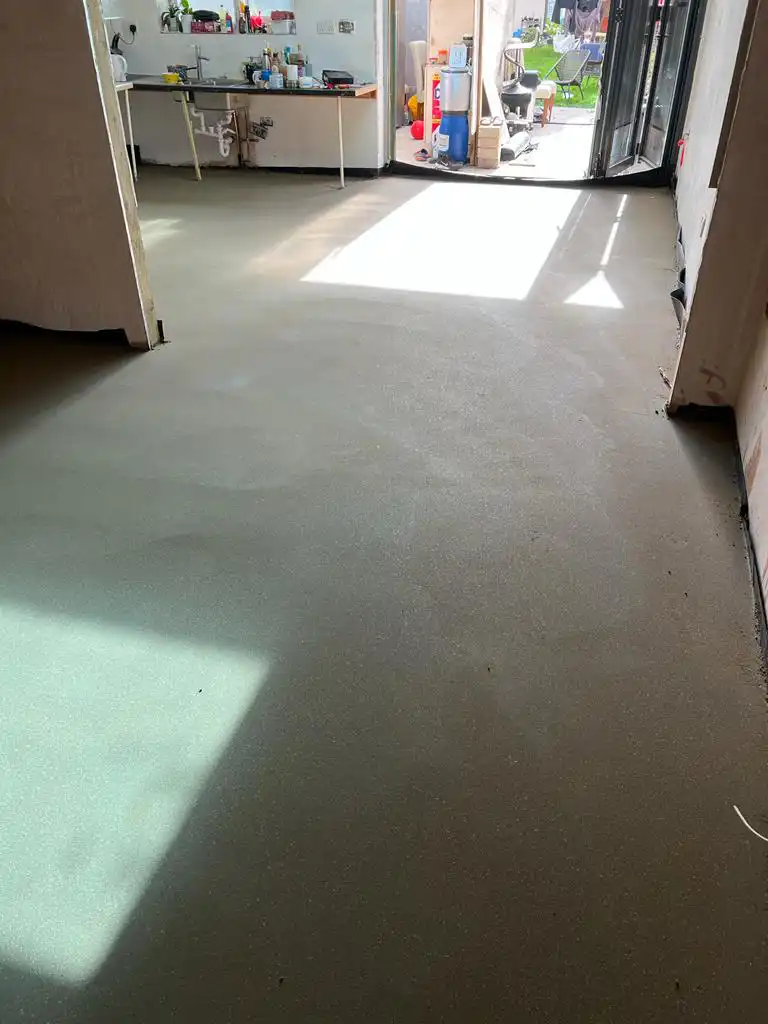
K & B Screeding’s own team, led by director Donatas Bardisevicius. Founded 2019, company 12298780.
See what customers say in our Google reviews and on our testimonials page.
Sand and Cement Screed from Slough to Godalming
Godalming is about 24 miles south of our Slough base as the crow flies, with postcodes including GU7 and GU8. The nearest towns to it are Guildford (4.1 miles), Aldershot (7.8 miles), Haslemere (7.9 miles) and Farnham (8.3 miles).
More on sand & cement screed, part of our screeding services.