
Calcium sulphate grades on Godalming specifications
Every anhydrite screed carries a code under the European standard that covers screed materials. In that code, C gives compressive strength and F flexural strength, each in N/mm2. Three codes turn up on most drawings. CA-C20-F4 is meant for lightly used domestic floors. CA-C25-F5 covers the bulk of homes, apartments and offices. Busier floors get CA-C30-F6.
For a Godalming block of flats or a new house, the engineer picks the grade and we pour exactly that. Some drawings name an alpha hemihydrate product instead, chosen because it dries faster or can go down thinner. Each of those comes with a product sheet, and its figures for depth and drying overrule any general guidance.
Why specify calcium sulphate at all? It barely shrinks while setting, so big bays go down with only a handful of joints, which suits open apartment floors and wide ground floors on new plots. Where a joint is needed, such as at a doorway or a boundary between heating zones, the bay layout is planned before the pour.
Heated floors are another reason. With the pipes running, the screed can normally be force dried once it is about 7 days old. There are places to avoid it, though. Any floor likely to get wet takes a flowing screed with a cement base instead. More on how the material behaves is in our guide to anhydrite screed.
Laitance and testing before Godalming floors are finished
With calcium sulphate, hard to the touch does not mean ready for flooring. While it dries, laitance, a thin and weak skin, rises to the surface. Neither adhesive nor levelling compound bonds well to that skin, so once the floor is dry enough the laitance is sanded off and the surface primed with a product compatible with calcium sulphate.
Moisture is the second check. Flooring makers often allow less moisture in calcium sulphate than in a cement screed, so a reading that would suit tiles on sand and cement can still be too high. We test rather than count days, and hand over written drying and laitance advice. Where heating is installed, running it gently from about 7 days helps the floor reach that point sooner, but the test still decides when flooring can start.
On a converted building or a flat where the base is uneven before the pour, floor preparation may come first. After the screed is sanded, primed and dry, a thin levelling coat before LVT can bring it to SR1 where a sheet finish demands it.
Anhydrite & Flow Screed prices in Godalming
Liquid flowing screed (which includes anhydrite): £24 to £31 per m² supplied and laid (MyJobQuote, August 2026), so £960 to £1,240 for 40 m². MyJobQuote does not say whether these figures include VAT. See our floor screeding cost guide or screed calculator.
Who lays your anhydrite and flow screed in Godalming
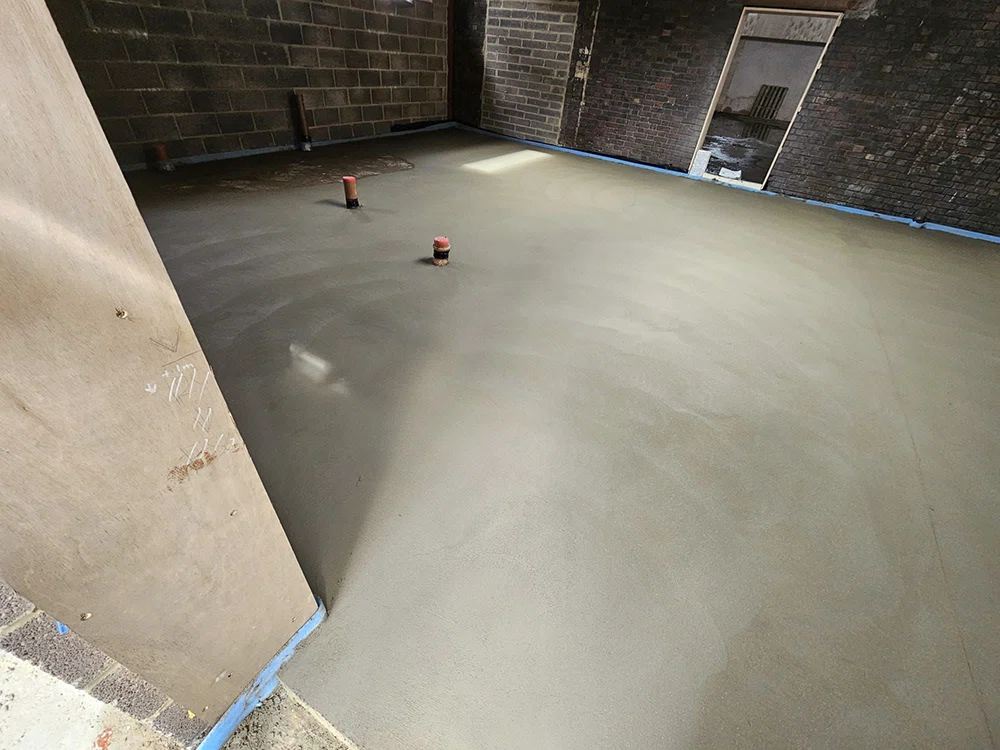
K & B Screeding’s own team, led by director Donatas Bardisevicius. Founded 2019, company 12298780.
See what customers say in our Google reviews and on our testimonials page.
Anhydrite & Flow Screed from Slough to Godalming
Godalming is about 24 miles south of our Slough base as the crow flies, with postcodes including GU7 and GU8. The nearest towns to it are Guildford (4.1 miles), Aldershot (7.8 miles), Haslemere (7.9 miles) and Farnham (8.3 miles).
More on anhydrite screed, part of our screeding services.
