
Calcium sulphate specifications for Frimley plots and apartments
On the drawings you will see a code along the lines of CA-C25-F5. Its C value gives compressive strength and its F value bending (flexural) strength, measured in N/mm2. A lightly used domestic floor can take CA-C20-F4, ordinary houses, flats and offices normally get CA-C25-F5, and CA-C30-F6 is kept for harder wear.
In Frimley, 12% of homes are in purpose-built blocks of flats. Apartment floors are a typical place for a named grade over insulation or an acoustic layer, and the low shrinkage of calcium sulphate lets each floor go down in large bays with few joints. Where the bays and joints fall, including at thresholds and where one base meets another, is worked out before pouring.
If a floor must dry sooner or go down thinner, alpha hemihydrate products come into play. Every one has its own data sheet setting how deep it goes, how it dries and when heat can be applied, and that sheet, not a rule of thumb, is what we follow.
Water is where calcium sulphate falls down, so keep it out of shower areas, wet rooms, outbuildings and any other floor likely to get wet. In those areas we lay a cement based flowing screed instead, which pumps and levels in the same way.
Our own team lays the whole build-up, and if you are weighing up materials, what anhydrite screed is covers the chemistry. For the pumping and access side, see liquid screed in Frimley.
Laitance and moisture checks before Frimley flooring goes down
As it cures, calcium sulphate grows a fragile top skin called laitance. When the floor is dry enough we sand that skin away and vacuum the dust, and only then can anything be stuck down. Tile adhesive or levelling compound laid over laitance can lift.
Moisture testing follows. Many flooring manufacturers set a lower moisture limit for calcium sulphate than for cement screed, and a hygrometer reading is compared with that limit, not with the figure for a cement floor.
Where heating pipes run through the floor, they can normally drive the moisture out from around day 7 under the commissioning schedule, which helps when the handover date is close.
After that it needs a primer made to work on calcium sulphate. Some systems designed for cement do not suit it, so the flooring fitter should confirm theirs. Where the finish needs extra smoothness, thin levelling compound goes over the primed screed. If a floor has been damaged since it was laid, screed repairs come first.
We hand over drying and laitance advice in writing, so the next trade on a Frimley plot knows exactly what state the floor is in.
Anhydrite & Flow Screed prices in Frimley
Liquid flowing screed (which includes anhydrite): £24 to £31 per m² supplied and laid (MyJobQuote, August 2026), so £960 to £1,240 for 40 m². MyJobQuote does not say whether these figures include VAT. See our floor screeding cost guide or screed calculator.
Who lays your anhydrite and flow screed in Frimley
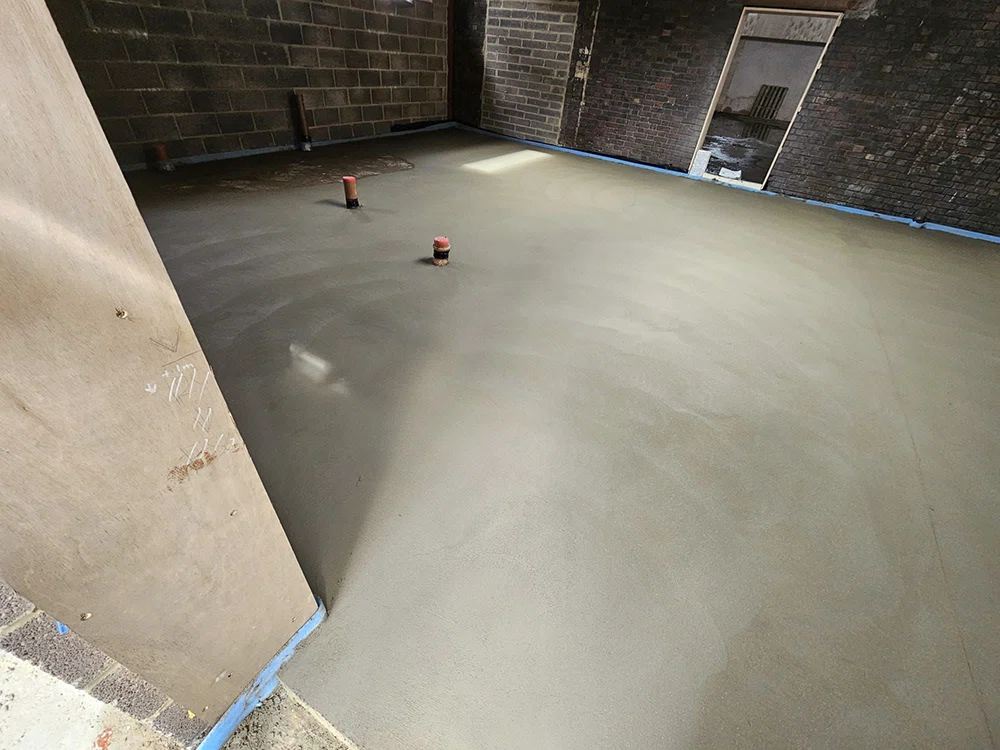
K & B Screeding’s own team, led by director Donatas Bardisevicius. Founded 2019, company 12298780.
See what customers say in our Google reviews and on our testimonials page.
Anhydrite & Flow Screed from Slough to Frimley
As the crow flies, our yard in Slough is about 15.6 miles from Frimley, which lies to the south-south-west. Postcodes here include GU16, and Camberley (1.7 miles), Farnborough (1.8 miles), Sandhurst (3.5 miles) and Yateley (3.8 miles) are close by.
More on anhydrite screed, part of our screeding services.